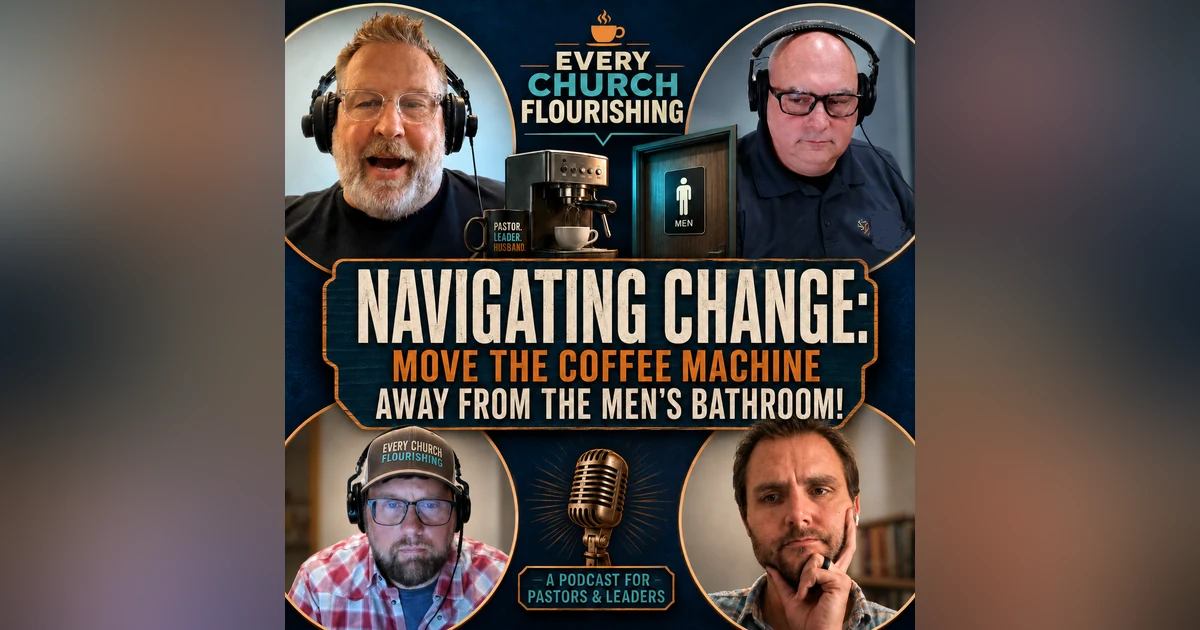
Navigating Change: Move the Coffee Machine Away From the Men's Bathroom! How can pastors build trust in new or hurting congregations? How Vulnerable Should Pastors Be When it Comes to Confessing Sins? + Great Soda Review and Possible Home I


 Apple Podcasts
 Spotify
 Amazon Music
 YouTube
 Youtube Music
 iHeartRadio
 Podchaser
 JioSaavn
 Castbox
 Gaana
Gaana Every Church Flourishing Episodes 29-30 Jeff Woolstenhulme and Michael Denton
Practical Wisdom on Church Change for small and medium sized churches, and church replants. How can pastors build trust in new or hurting congregations? How Vulnerable Should Pastors Be When it Comes to Confessing Sins? Benign Neglect: Not everything needs to be changed.
Also, during today’s soda review, a possible home/office invasion happens - in progress - which may spell the end of Pastor Christopher Cole, co-host of the Every Church Flourishing podcast. Will PC survive? Listen to the end for the astonishing answer!
Also: The conquest of Hawaii and which ECF host would be in favor of it.
Pastor Christopher mentioned David Jackson’s book, Falling in Love with Jesus Again, which is all about the importance of spiritual renewal in church revitalization, emphasizing soul care for leaders and congregations and helping churches by first focusing them on looking to Jesus and understanding what He desires to do with your church. Great news on that - we will have David Jackson on in the next few episodes to discuss that same book, so that’s exciting!
When should a church replant or revitalize team begin to emphasize outreach and evangelism?
I don’t trust people - and pastors - who aren’t pretty transparent about confessing their sins.
How can new pastors triage and determine what needs to be changed immediately and what can wait?
For remaining members in a church replant situation, bring them along, don’t push them aside.
The B.L.E.S.S. Book by Dave and John Ferguson - How do you love people to begin to build relationships that lead to Gospel conversations? https://www.amazon.com/dp/1684510880
How can pastors build trust in new or hurting congregations?
Today, we got Pastor Jeff and Pastor Michael back, and we're talking about some very practical issues with spiritual dimensions, like how vulnerable should pastors be when it comes to confessing sins? How can new pastors and leaders build trust in congregations that are hurting from past errors in leadership? And maybe most practically, how fast should you bring about change? And what changes need to happen immediately and what changes can be on the back burner? Pastor Michael is going to tell us a story about a food item that was positioned right by the men's bathroom. That was a change that needed to be made quickly. Here he is.
One of the things I talked about, we had a small coffee cart in the entryway hallway that we just, we don't have a vestibule or a lobby or whatever. And this coffee cart was there, probably because there was a plug there on tile instead of on carpet. And I don't need to drink coffee every morning, but I would say from the pulpit, I don't drink coffee really, but a lot of my friends do, and most of them don't do that outside of a men's bathroom because that was right next to the men's bathroom. All about helping churches, leaders, and pastors find health, encouragement, practical advice, soul care, and resources that work together to build up your local fellowship and the broader kingdom of God. Join hosts, Pastor Chris Cole and Dr. Chase Thompson from the Great Commission Association, led by Dr. Mike Stewart, as they explore the frontiers of ministry and aim for the goal of making every church flourish.
Hello, everybody, and welcome into episode number 30 of the Every Church Flourishing Podcast. I'm your host, Chase Thompson. I'm going to be joined in just a moment by Pastor Christopher Cole of the Great Commission Association. The Every Church Flourishing Podcast is a ministry of the Great Commission Association of California. You can visit our website at gcasbc.org. We are on the lookout for pastors, leaders, churches in our area to partner with. So if you're tired of doing ministry alone or if your church is ready to partner up with a biblically focused, Jesus loving, like minded group of other churches, We would love to have you on board. And you can do that. You can contact us through our website, GCASBC.org. We have a couple of local Central California pastors on the show today, Pastor Jeff and Pastor Michael. We already had part one of the interview with them last week. We're talking about the pace of change in churches, especially for new pastors and for church replanters. We're talking about how pastors and leaders can build trust in new congregations or congregations that have been wounded in the past. How vulnerable should pastors be? Should they try to be like paragons of holiness or saints, or should they openly and with detail confess their sins to their congregation? We're also going to be talking about the concept of benign neglect and... Whether or not you should move a coffee cart when it's camped out outside the men's bathroom. We're gonna join the interview already going. Over to you, Pastor Christopher.
You guys, I love your heart. I love what you guys are sharing. You know, we have good friends in this process, in this work of replanting, and we wanna give them two shout outs. Our friends with the North American Mission Board, Both of you guys are NAMM-endorsed church replanters, and we love the team at the church replanters group there under the Sin Network with the North American Mission Board. And our friend, Dr. David Jackson, which I'm hoping we will have on this show in this series that we're doing on church renewal, has written a wonderful resource called Falling in Love with Jesus again. And it's a newer resource. We didn't have it, Pastor Michael, back when you were doing that work just a few years ago, but it's a call for what you might consider. A solemn assembly, a time of reflection and repentance for the church so that they can address what they have or have not been doing, how they've been led to a particular place. And it can be used catalytically with time and season of prayer. You could do it in a single Saturday or over four weeks. It's just a commendable tool. And we'll leave a link to that in the show notes because you can even download this for free. And I commend this to anybody who's in the early days of doing the work of church replanting, just to say, hey, let's gather the people of God. Let's consider God's word together. Let's do it in prayer. Let's do it in reflection. And let's do it with a heart for Jesus and the things that Jesus is calling us to do and who he's calling us to be. I want to shift our discussion a little bit towards some of the more strategic aspects of replanting and talk about how does a pastor, a replanting pastor, help a church turn outward to engage its community instead of just being focused on survival? This is a common attribute for churches that find themselves in the place of needing to be replanted. Their mindset has shifted to survival rather than mission. Michael's been mentioning that. There's been different illusions there. So how do you help a church turn outward instead of remaining focused on survival? And when do you guys think in the replant process is the right time to begin healing? Emphasizing evangelism and local missions, those kinds of things. Jeff, let's start with you. You're the new guy. What are you finding right there on the ground early on here?
Yeah, I think right away, I just want to set the example. So we moved here and within two weeks, we'd signed up three of our five children for baseball, softball. We got our kids involved in other ways. We started meeting our neighbors, start inviting people over. And then I start talking about it to the church, let people know about evangelistic opportunities that I've had, not in a way to make me look good. It often doesn't make me look good because I'm not very good at it, but I am just trying to make this a normal part of our rhythms that we talk about evangelism. We assume we're evangelizing. We assume that the gospel is with us. And so I'm praying regularly for the church that we would have a culture of evangelism. At our monthly prayer meetings, I'll be asking people, who can we pray for that you're trying to share the gospel with in your community, I just want to make sure that's on the front of our minds often. And just trust that as I teach and as I preach the word, as I preach the gospel every week from whatever passage that I'm in, that the gospel will, again, be floating to the top of their mind and regularly ready to be shared. I think the reality also is that the church that is takes a lot more time to come around to the vision of. Than the new people that come in. So the church that's been there, they've been doing things for however long they've been there. It takes time to then turn around and catch the vision that you're trying to lay out. But new people who come in are excited and they're ready to go with whatever you might want to be doing. They came to hear you preach. They came to be part of your ministry. And so they start helping set some of that example. So it's not just me now that's doing it. It's me and more families and singles and whoever is joining my church. So it's that whole adage that vision is caught, it's not taught, but it's both, right? Because we teach and then we pray that the Lord would help people to catch that vision. So just that regular setting the example and talking about it. And as it comes up in the scriptures, speaking to it.
Dude, so good. And you have been a truly faithful example of what it means to model this, Jeff. I've been so impressed hearing how you've been inviting unbelievers into your homes. You've been connecting with unchurched believers that are coming into the community. You spend a lot of time going out, meeting your neighbors in all different kinds of ways, which in Silicon Valley, as a pretty insular community, people tend to drive into their garages with their Teslas, hook them up to their power outlets and, go indoors and watch their 82-inch or 85-inch plasma screen or whatever, right? I think you've been a great example of that reality. And I just commend your brother. Thank you for your faithfulness there. Michael, you've been doing this for almost five years now in different ways. So you've mentioned some of the things that you began doing, including going over and taking, I think, cookies over to the school. But when is the right time in replanning to begin modeling this? Is it day one?
Well, for me, and again, I think it'll vary, and pastors need to pray for wisdom on this and maybe get some counsel. Context-free community really matters. For us, loving the sheep that were here was really important and allowing them time to have their hearts turned towards the lost. And that meant we prayed faithfully from before we even came, thanks to Pastor Chris for encouraging us to do this, to pray that God would send us people who need Jesus, people who need to be discipled, especially young men, and mature believers who are ready to serve. And to my shame, when they'd show up, I'd be like, why are they here? Because there was no reason. Hey, dummy, you've been praying with faith or just these words? Literally, I promise you for so long, it was shock and awe when they'd come through the door. How'd you find out about us? And so, and almost in tears that this young couple would be there and they'd never been, haven't been in church in over a decade. But I would be faithful to take them out to eat. I remember the first young couple that happened, Josh and Candice, and they prayed to receive Christ at that meal. And, you know, relaying to the church, I would say these words, and I know I've heard pastors say things like this, we're not just here to play church on Sunday. I said, we don't have time to just play church, to have a service on Sunday morning. We don't have time. There are people in this community who are dying without Jesus, and they could hear it in my voice, guys, that I believe. I think because our family, and we have so many kids and moving from a few hours away, there's such goodwill from the people who are here for us doing that, That they knew that we weren't here just to breathe a few extra breaths into the church, that it needed to be about the community. And so they have been so gracious to let me be in the community and then bring people alongside. And so it's been as simple as going across the street to the school and so grateful for the incredible relationship that we have now and the principal introducing me to the rest of the volunteers on the volunteer breakfast. This is Pastor Michael. Nobody else. She didn't introduce anybody else of the volunteers. This is Pastor Michael. He's from what we call the Little Church Across the Street because that's what we'd sign all the things. The Little Church Across the Street loves you. The Little Church Across the Street on all of the breakfast burrito boxes or anything that we'd bring over there. The Little Church Across the loves you. Thank you for loving the families of Nipomo. And internally, I was telling my people, the school across the street is doing more good for the community than we are. We need to be over there. So yes, we've got Jesus, but by sheer volume, they're doing more good for the community. They're helping more families. We need to be supporting them and stop sitting over here and hoping that they'll come over here. Don't they know where we are? Can't they see us? Instead of that kind of attitude, you know, why can't we be over there? They could be thinking the same thing. Why haven't they come over and helped out? And so I think praying and really what my heart has changed to is believing that God will send us those people. So now when they come through the door, I'm wondering which one of the three they are. Are they someone who needs Jesus or someone who needs a disciple or are they a mature believer ready to serve? Or is it just somebody that God's just brought for the Sunday and they're not going to be there anymore? But more than likely, they fit in one of those categories. And so we'll be faithful to follow through that, but then also to change with the hearts of the people to say, this is what we're here for. This matters. Now, fast forward a few years and last year at the concerts in the park, one of my guys who got saved and baptized here, discipled by another guy here. Who had also gotten saved and baptized here. And this guy led our men's Sunday school time. So this is a grandchild in the faith who has now led the men's small group Sunday school time last fall. He talked to me, he called me from the park and said, pastor, you gotta come over here. The whole town is here. And so because I went over there and saw some of our preschool families there, saw other people that I interacted with in the town, it's a small town, you can get to know people, they can get to know you. I said, we've gotta be here next year. And so that's why we've sponsored six of the concerts, six out of the nine concerts this year. Our church has a presence and giving things out. Anyway, my point is that the hearts can transform. But like Jeff said, oftentimes that's going to be some of the new people coming in with the power. You just want the hearts of the people who've been there to say, well, at least be praying for you. We're not going to be resistant. We are for the gospel and for our pastor being in the community. And we want to also invite, we want to bring people, we want to be in prayer.
You know, guys, you guys have exemplified this in so many good ways. And Michael, we could spend a ton of time. You have been a fount of creative engagement to help the people of Napomo feel and experience the love of Jesus Christ so that they can hear the gospel of Jesus Christ. And you are such a faithful witness there. And we want to commend to you guys that are listening this to our Every Church Flourishing podcast here. We want to commend to you guys your consideration of a resource called The Bless Book, B-L-E-S-S by Dave and John Ferguson for churches where people are just saying, hey, I don't know where to begin. This is not a book about how to share your faith so much as it is a story about how do you love people, not in order just to earn the right to share, but really in order to begin to build the relationships that allow you to have those gospel conversations. And many, many ordinary church believers, they just don't know what to do. How do I get into actually just engaging with lost people? It's not obvious to them. And so BLESS is an acronym. The Fergusons picked up some work that I believe the Surge Network had built in the Phoenix area. They put it together in a very helpful book. B-L-E-S-S is an acronym. It starts with beginning with prayer, learning to listen to lost people, learning, to come into a place where you're eating with people, doing the relational work that Jeff's talking about, just breaking bread with people, finding ways to serve them. And then that last S, sharing the Jesus story and sharing your gospel story. And we just think it's a tremendous resource. We'll leave those notes.
I love that resource. Yeah, I love that resource, Pastor Chris. And I've used it here. I've preached through those and our people have gotten on to their email where they'll email you five of your neighbors' names and addresses to pray through. And then when you do have an engagement, you can change and indicate that you've had engagement and what level of engagement you've had with them. It's beautiful. I love that resource. Thanks for sharing that with the listeners. It's awesome.
Yeah, and the... Resource does get picked up with an app and a tool that allows you to track engagement with lost people. So pastors, if you're out there and you're like, hey, how do we get my people to pray regularly? What Michael was just talking about. Praying for their neighbors by name on a map, and then encouraging them, hey, go meet that neighbor, go have a meal with them, go share the gospel with them. That's a great set of tools. We'll leave that in the show notes for this episode as well.
All right, guys, let's talk a little bit about building trust. If you're a pastor coming into a new church situation, that's always going to be important because in a lot of cases, the last guy has left and the people are either angry or whatever. They're glad they got rid of him or they're brokenhearted because they lost their shepherd. But if you're a replanter, building trust is even more crucial because you have a small group of people that have been burned, that have kind of watched the church in that process of dying around them. And that's got to be hard to see. And they know that not every pastor is equipped for that job. So Pastor Jeff, over to you first. What are some steps you took? How did you practically, relationally, spiritually, any dimension of the answer you want to give, how did you build trust with people when you arrived?
I thought it was really important for the church to know that I was committed to them, that they were the members of this church. And I have a first and foremost commitment to them as my sheep. Those are the ones right now that I'm accountable to, according to Hebrews 13, 17, when I stand before the Lord. And so they are the people that I've been called to pastor, and they want me to grow the church. But first and foremost, I'm their pastor. And so I've tried to reiterate that. I've tried to let them know that I'm praying for them. And then I'm trying to defer to them as much as possible in a lot of things. And in the seven months, of course, I've already stepped into it in a few ways, and I've just tried to own it. I had a brother come to me after the service and let me know ways in which I'd offended him. And I just owned it because he was right. I hadn't pastored him well. And thankfully, I think we've made some good progress since that conversation. And I appreciated him sharing his heart with me. But so I think it's them being prioritized, knowing that you don't see them as people who are in the way of the future of the church, but actually people who are vital to this church flourishing and growing and progressing to what they actually want to see happen. That's why they got into the replant process. It's because they didn't think that God was done with their church and they wanted to see it grow. And so help bringing them along and not just pushing them aside. So I've just tried to take a real humble route knowing I'm going to make mistakes. I am very much a human. This is my first time being a lead pastor. And so I want to make sure I don't take myself too seriously, but I also want to make sure that I'm trying to prioritize the people.
Okay, great answer. Pastor Michael, cast your mind back to Calvary and to four years ago. So how did you build trust?
Yeah, thank you. I believe that the people had inherently had trust in me being there, again, because of their perceived hardship and what we were getting in the broken down parsonage and the situation not being, we heard from them so many comments about care for a family. But what I did notice was an immediate speed of trust, for example, with the finances. The lady who is deep in her 80s and was the treasurer found additional money to help with the parsonage repair. And I was asking for additional safeguards. I want to call and get permission, so-called, from the... The pastor who had been there or from the treasurer before I would spend over a certain amount of money on, even though they'd been agreed upon repairs or whatever. And she said, oh, that's fine. She was indicating it wasn't necessary. And again, she found some additional monies that we could spend. I said, Ms. Wanda, can you tell me how is it that you trust me so well? I haven't experienced that speed of trust in other ministry contexts I've been in in that fast and with that much money. And she said, Michael, we prayed for you. We prayed that God would send you to us. And so we believe that God sent you here. So that's why I trust you. And I just thought, man, I can't do that through any cleverness of my own or whatever. That really is a spiritual thing. So yes, then I felt like I was given trust. So for me, it was how to keep that trust. It was going up at their homes and visiting with them and where they could see my heart. And like Jeff said, to own mistakes and apologize and not, not try to, to have this smoke and mirrors kind of a thing and nothing to see here, but to be transparent, I think is, is so important. I would frequently tell them, I don't have a grand plan of something that that's got to happen or, you know, I'm out. And so I want us all to be praying towards that. And over time, I know they believe that. I'm not actually sure if they believe that at first. They may have thought I came with a plan and I'm going to change these things and remove this thing or whatever. And I said, I don't know what needs to be changed just yet. And so I want us to go prayerfully. So I think that's how I helped continue the trust with them.
Well, let me add something to that and then and hand it over to Pastor Christopher for a great strategic question. And I'm going to, I might actually take this out of the podcast because there's a, it's a double entendre almost. It's a dual purpose thing. We're told in James 5, 16, confess your sins one to another so that you can pray for each other so that you can be healed. I will just say, I don't have, I didn't grow up to be a pastor. I thought it was going to be something else. So pastors have always sort of struck me as a little weird. Although I had great pastors. I'm not, I mean, I just didn't think I would be a pastor. And some of my best friends are pastors and some of my best friends are not pastors. I don't trust people that aren't clear that they're sinners. And maybe I'm a sinner and everybody else is just really godly. I don't know.
Yes, that's it right there.
I've always been worried about that, Pastor Christopher. It's a you problem. I appreciate the clarity. My church people know I was a porn addict for years, which is mortifying and embarrassing. But they also know that I'm a sinner, which is the truth. And it's not that I can justify that. And I don't want to be casual about it. Sin is abominable to a holy God. I don't want to just be flipping about, oh, yeah, I'm a sinner. But I am a sinner. And I don't trust people that don't confess to that. And so the double entendre could be, it sounds like I'm saying the way to win trust with people, to make friends and influence people, is to let them know that you have weaknesses in your center. That's not what I'm saying. But I am saying is, I personally, and I think church members innately, will either A, not trust people that are not open about the fact that they're ongoing sinners, or B, they will hold them in such high esteem that they're tempted to fall down and worship at their feet. And therefore, when real sin does happen, they're blown away and shocked because they thought brother so-and-so was basically next to Archangel Michael when brother so-and-so needs Jesus and sins probably just as much as Phil and the pews.
That's great. Definitely being honest with them about routine failings or when I have hurt them, as Jeff said. That is not an easy conversation, especially when you think that you were responding to something that they've done and you thought that you had clarity, you thought things went a certain way, but to own your part of it, even though you think that it might be small, is not waiting for the other person to come and have that conversation. I think, man, that is going to set the tone in your church for whether people are okay with making things right with each other. It just is.
Yeah. We want to make sure we eschew Wesleyan perfectionism. Absolutely. We can never affirm the idea that we will not sin in this life. We are those who are constant sinners every single day. And as pastors, we need to remind our people that, yes, I am a sinner every single day, just like you are. Growing in the grace of God, growing in holiness, and yet every morsel of my being desires to sin.
Wretched man I am.
Yeah, that's a wonderful reminder. Guys, a lot of guys listening to this, we hope, we hope a lot of, guys that are considering the work of replanting, revitalizing, will be listening to this series that we're doing on church renewal and on replanting. One of the areas that I have seen a lot of, particularly, say, younger replanters sort habitually step into a pothole on, speaking with some analogy there, is that they try to change too much that's not essential too fast. On the other side, there are so many guys that I have seen that have literally allowed their churches to coast, or glide into a pattern of decline or death and not being healthy. So here's the question with all of your gathered wisdom and expertise. How do you determine what needs to change immediately or within a relatively short period of time? And what can wait? What's the discerning factors there for each of you guys in your experience? Michael, you want to go with this one?
Yeah, sure. This is the crux of it, because some things need to be fast and some things need to be slow. Some things need to take time. Some things are barriers to entry for people and you've got to change them. And I love the analogy of rearranging things in an older person's living room. If you're going to do that, you should be explaining how we want the grandkids to come over, don't we? We don't want the grandkids to trip over stuff or whatever. So why don't we put this up higher? So always explaining the purpose behind it. So I'm talking about, we want new families here in the church. And so I would do it based off of need, much like I don't upgrade my phone until the old one is basically not functional. I would do that with church things. One of the things I talked about, we had a small coffee cart in the entryway hallway that we just, we don't have a vestibule or a lobby or whatever. And this coffee cart was there probably because there was a plug there on tile instead of on carpet. And I don't need to drink coffee every morning, but I would say from the pulpit, I don't drink coffee, Rayleigh, but a lot of my friends do. And most of them don't do that outside of a men's bathroom. And because that was right next to the men's bathroom. And so I would say just to make them laugh a little bit and just to kind of think about it. And so what I'd like to do is have a spot in here in the auditorium, because in every other meeting that new people are in here in the Pomo, they get to bring coffee with them. And I said, we will spend more money on carpet cleaning, whatever. But that was when I said, we've got to get that coffee cart out of that hallway. If we have two new people show up, it's going to be too many. And they're not going to want to go in and use the bathroom or they're not going to want to stand there and block the bathroom door. But they weren't thinking that. They were just thinking about where's a good place for us to plug it in probably. So it was an evil decision. So that was something I did quickly. Another one, though, I did not have an intention when we came here and it was full of pews. I didn't say, oh, these got to go. I don't mind pews. It didn't hurt my feelings. It certainly, certainly was not the most pressing thing for us to spend money on. And we don't have money for chairs. But when my wife was contemplating having weekly meeting for moms of preschoolers, I said, where will you meet? All of our classrooms are taken up by the preschool during the day. Where will you meet? And she said, well, I guess we could meet on stage. And I said, we're going to get chairs. That was the deciding moment. So it was out of necessity because we literally had room for one cockeyed six foot table behind all the pews in front of those double doors before you get to the outside, the hallway. Those of you who have been here know what I'm talking about. And that was just unworkable. That wouldn't be friendly to moms to have them come and meet on stage like we didn't plan it. Why aren't we doing it at somebody's house instead? And so quickly after that, a church in the Morgan Hill area was making chairs available. And literally one Sunday we had pews, the next one we had chairs. That is a regret that I didn't, I had to act quickly and God provided for those in an amazing way, but I did not have time to grieve with people about this is where people met Jesus. We've heard so many good sermons in these pews. We're so grateful that God had this furniture here for people to sit and receive the gospel in. I did not have that time because once we found out that those chairs available midweek, we had to move on it. From my little two cents about the speed, other things did not need to have that kind of speed. I don't need speed for things to come off stage or be moved around. It's not that important.
That's a great answer. And it's a good title for the podcast, Move the Bathroom Coffee Cart. Pastor Jeff.
I like what Michael said, especially towards the end, that most things you don't need to change. And I think that's right. I think the phrase that I was given and the example I saw was just this idea of honestly benign neglect on certain things that a lot of things don't necessarily need to be changed. You just need to let them go. And at some point, they may just stop happening. So there is that aspect of just being patient. I recognize that when you walk into the building at my church, you know it's an old church. You look around and see certain things that have been there for 40 plus years. But I know at the end of the day, people are probably going to not come to our church and it's going to have nothing to do with those banners, nothing to do with the flags on stage, nothing to do with the aesthetics of the church that mean a lot to a lot of people that are members of the church. It's going to be because it's a small church and they're not ready to be part of a small church. So I'm trying to be very select and very careful about what we change. An example for us of one that was something that I knew was going to be difficult for the church, but we felt like needed to happen, not just myself, but the board that I was working with through the GCA, and that's another conversation, what the board looks like, but that's made up of members of the church, the GCA and another church, that the website needed to change. It had been faithfully administered for 30 years by one member, but we needed to update and change the website. And so that began and entered into that process within the first two months of getting here, talking with that member, talking with another member, and just working through, okay, this needs to change. None of us are the ones that can do this. We need to have someone else do it. But trying to pastor both the brothers and the church along the way as to why we feel like this needs to change. But that would be, I think for us, the most significant thing that has changed. The other big change is that I'm here and I preach every Sunday. And that is a significant change in and of itself that takes time for people to adjust to, adjusting to my preaching style, adjusting to the way I've set up the service. And so I think moving as slowly as possible, changing as few things as possible, but recognizing one of the things that are absolutely necessary to change, like moving the coffee cart away from the men's bathroom. My goodness. Good call, Michael.
All right. Well, guys, this has been great. Let's kind of transition out with a few rapid fire questions. Slightly meaningful, little bit of nonsense, but this will help people get to know you better. And I'll start off with my first question. We'll go to you, Pastor Michael, first. What would you want to be if you were not a pastor?
I was headed towards law enforcement. And then right before I got called to be a pastor, I got the prospectus for law school. I was going to be a lawyer.
Oh, nice. Okay. What about you, Pastor Jeff?
After water polo, I got into running and I do trail running. I would be a professional trail runner running ultra distance.
Oh, wow. That's an unexpected answer. What about you, Pastor Christopher?
Oh, I also had alternate plans for my life that did not involve ministry. So I was headed to be a naval aviator and turned down- Nice.
Wow. Okay.
Commissioned with U.S. Navy to go into ministry.
Okay. Fantastic. I was headed to the FBI, or so I thought, but I would still, my backup career would be detective.
Nice.
I don't have enough murder mysteries to solve those. Very sad.
So, all right, guys, when church life and pastoring have you stressed, what do you do? You know, what's your favorite hobby, your practice, your I need to detox from my week. What do you do?
I will tell you that I have enough children to find somebody that's willing to play with me. There's a video game that three or four of us will play together late at night. And that's one thing when we're not able to actually go to the beach together.
Yeah. So for those listeners that do not know, Pastor Michael and his sainted wife have 272 children.
That's a lot.
Divide by.
Jeff, how about you? What do you do, man?
This goes into my previous answer about being a professional trail runner. You'll find me often on trails. My house is a mile away from a major trail network. So this morning, five in the morning, I woke up and I ran to the top of Rancho San Antonio Nature Park and ran back down. It's a nice two-hour run. And on Saturdays, I'll do a three to four-hour run regularly. I get up at four in the morning and out the door and try to avoid the mountain lions. But man, just getting out into the woods and enjoying nature is such a wonderful, wonderful time.
Nice. We just had a mountain lion attack on a dog here in nearby Carmel just this week. Okay, so I would say this is an unlikely event, but still, you know, really strongly in the realm of possibility. Let's say that Pastor Christopher and I are kidnapped and taken out by terrorists from Luxembourg. And the GCA is like, hey, we got to keep this podcast going. Who should we get? And they turn to Pastor Michael and Pastor Jeff. What are you guys going to review instead of soda? Over to you, Pastor Michael, first.
Well, we're going to review burrito places. We're going to have, we're going to stand up the burrito and give it a scale of, of does it stand up on its end? So how, how does it hold together? We're going to give it points for not just ingredients, but the tortilla itself, man. Extra points if that's made in-house. We're going to get fat and happy on this podcast through it, but I'm telling you what, we're going to find some great burrito places.
It's great. Have you ever had El Chorito in Salinas?
Oh, yes, sir. You got to know it. Decent.
Pretty good.
Man, now I'm hungry.
Why do I do this? I'm like the Hulk. I'm always hungry. What about you, Jeff?
Oh man uh do i have to review something can i be the turn of the punch bowl and that i would i wouldn't review anything okay
Hey that's fine that's fine so once the terrorist yeah yeah it's it's not a necessity you you and michael will fight this out once the luxembourg terrorists catch up to us
Come on we gotta we gotta review running fuses okay
I would i would review cookies i love cookies cookies yeah i would review every type of cookie you can go to crumble Just give me the whole list and we'll just spend weeks and weeks and years reviewing all the cookies from Crumble.
Those are both good ideas.
Man, excellent ideas. We need to do cookies and burritos and sodas and sodas.
I've left some of your guys' sodas though, man. Keep that up. That's awesome.
We did seven the other day, I think. Was that right, Master Chase?
We did seven, yeah.
Seven. Wow. So they are coming. And yeah, I can tell you some were unpleasant, but others were tasty. Others were great. Others were tasty. Yeah. And I have some special surprises coming up in future episodes. I will tell you this.
Wunderbar.
I've got a box right here in my office that Chase is waiting, salivating for there. So on to more serious stuff. Who do you guys love to listen preaching? You know, as preachers, we love to preach, but most of us have one or two, three favorite people. We go, man, I love listening to this guy. So I'm going to let Chase answer the question first, and then you guys kick in here.
Oh, mine's going to be pretty traditional. At least I guess, maybe not. I really love Tim Keller. I really love John Piper. Alistair Begg. I can't listen to Spurgeon, but I can read him. And I would say those are probably my big go-tos right there.
Chase, you're a big AI guy. You can't make the AI do a Spurgeon, give it a Spurgeon sermon, tell it to preach in the Spurge.
I feel like I would get more, I would be in more danger from people for doing that than I would from Luxembourg terrorists. Somebody would take me out if I did that for sure. There's enough AI handers and encouraging lovers. Jeff Chang at my Western wood. Yeah, yeah. I would be in trouble.
That's so awesome. Jeff, who do you like to listen to, brother?
The first church I heard expositional preaching at was the church that trained me to be a pastor. So anytime I can listen to my former pastors, Michael Lawrence, Daniel Schreiner, Jeff Chang, and then the brother I served with as an associate pastor, Trevor Binkley, I'll listen to those guys' sermons all the time. And I'm just most encouraged by them. And part of it is because I know them. I know their life. And so I love listening to those guys who really taught me how to preach.
Good work.
Yeah, excellent. I was going to go close to home too, though I love Josh Howerton's work and just some of the clips that are put out there of his preaching. Honestly, there's nothing better to me than listening to some of the guys preach whom I have personally trained. And so this August, I've got three brand new preachers preaching for the first time. And I'm telling you, it's going to be tough to sit there in the front row and not be in tears. So that's the kind of preaching I want to listen to. Yeah, awesome.
Well, relatedly to that, Pastor Jeff, what do you do when you need to find hope? Where do you find hope? You know, listening, reading the Word. If it's reading the Word, and I know that may be the answer, how do you read the Word when you're in a low place?
I think for me, I've made a practice of regularly being in the Psalms. And so So daily reading a psalm, that's often how I pray for my church members. I just take that psalm and pray it for them. But it's amazing how often I will be discouraged and I will read a psalm and it will answer my discouragement. It will give me hope, you know, and so and I've just had that practice for decades of just reading the psalms regularly throughout the year. And so that's been a great encouragement to me. And, you know, the psalmists just speak the voices of sorrow, of delight, of rejoicing, of lament. And so they've been just an instruction to my soul.
For me, similar, where I'm preaching somewhere in the Psalms right now with my folks, and I tell them it's greeting cards to God or from God to you, alternatively. And so when you can't think of words to say, open up one of these greeting cards to God and let it say what your heart says, that's certainly one. And then just a practical thing is a former mentor of mine who's now passed told me, and I love thinking of it in a sanctified way, Michael, this too shall pass. And just remember, this is not the end. I love those little emails from Brian Croft every Monday. Pastor, it's Monday. Don't resign. You know, lift something heavy. That's another thing I do is I go to the gym, lift something heavy. And just let the cares of the world. And so in a sense, instead of being up close so much to the window, you're seeing all the smudges. Take a step back and see the beautiful stained glass that God is creating around you. And so just taking a step back metaphorically from my church and from the work that he's doing, just seeing all the amazing things that God is doing. And this too shall pass.
Well, that's a great word for us to wrap up on. And brothers, we wish we could spend so much more time with you. And we're going to have to have you guys back on Every Church Flourishing and have deeper and other conversations. We're going to be talking in other pieces of this series to people in all different parts of the church replanning journey, church members and to foster church leaders. And we're excited about talking to some of the experts in this field, the guys that have been guiding and encouraging and coaching us as we've been doing this. But we are grateful most of all, I just want to say this up front, for you guys, for the commitment that you have to do this replanting work with great sacrifice, with great patience, with great love and doing it all because of your love for Jesus and your desire for people to meet him. So brothers know that we love you. We pray for you guys. Guys, we are super excited that you are here on the show.
Could I just say real quick that... I am so grateful for Great Commission Association as a partner along the way. My family and myself could, and our church could not have done this without GCA as excellent partners. Yes, with financial resources right in time at the moment, but honestly with people and sending us good counsel and good people to come alongside our church, the fact that our church members know multiple staff members by name and by sight because you guys have been there with us and you've not ignored us. We have not felt alone. We're not felt like we're so far away from the mothership in Morgan Hill. I mean, you guys have made that feel like that's of no consequence. And so, man, I'm so, so grateful for that. And also just on the heels of that, thanks both you guys for putting on a podcast that is worth listening to and is actually helpful to pastors and church leaders. So thanks.
Hey, thank you.
Well, Pastor Chase, final words?
Well, final words. Hey, I appreciate you guys' time. I appreciate your thoughtful answers. I'm looking at how long we've gone and just, I'm thinking, man, there is a lot in here and trying to think, what am I going to title this aside from the coffee part outside the bathroom? Well, you know, so many good things we've covered. I hope there are a lot of, not just podcasts, replanters, because I think one of the things we talked about today, a thread that kind of ran through is how do you do change? How do you lead people well? How do you pastor well? So I'm listening to all of this at the end of it. I'm thinking, man, I hope other people hear this because I think these guys had great wisdom for us. And there's not a lot of podcasts out there. I know this because I've looked for them before. There's not a lot of podcasts out there that give practical ministry advice to small and medium-sized church pastors. And you guys just gave us an hour and a half worth of it. So I'm pumped at that. Thank you.
Thank you. Thanks for having us on.
Absolutely. Thank you.
Absolutely. Godspeed. Well, hey, thank you, Pastor Jeff from Foothill Baptist Church in Los Altos and Pastor Michael from First Baptist Napomo. Great interview. you. It went a little long and I think I'm thirsty now. All right, Pastor Christopher, today we have Schweppes. I don't even know if I'm saying Schweppes. That's a hard thing to say. Schweppes, Granadio Twist, low calorie version. What year do you think Jacob Schwepp founded the Schweppes company in Geneva?
Oh, good question. I'm going to go with 1910 because I think a lot of good things happened in 1910. It was before the first World War. All those bad things hadn't happened yet.
Everybody was, you know, reasonably happy then. But the fact of the matter is if we could go back in time to 1910, we would still be over 100 years away from the founding of Schweppes, which happened in 1783. Wow.
What? Yes. That's amazing.
And he was using carbonated water to make drink all the way back in the 1700s. I had no idea.
That is really interesting.
Only since coming out here have I tried passion fruit, which is basically, I know it's not exactly, but Granadilla is the South African version of passion fruit. Pastor Christopher, what is your experience with passion fruit?
Well, I have a lot of experience with the Southeast Asian version of passion fruit. Oh, wow. So I actually grew up eating it raw. So, I mean, like, you know, fresh and splitting it open and eating out the soft pulp. So I've had a lot of passion fruit. And in Indonesia, where I grew up, there was a passion fruit drink, not a soda, that was very, very popular when I was a kid. It's called Marquesa in Indonesia. And so I grew up drinking Marquesa a lot. It was something I could afford, unlike the Rubina, which had to be imported from those other places. But I have never tried a Granadilla. Soda but it is the same color as marquisa.
Okay yeah kind of that orange peach color right
Yeah this color right here that's the color right there okay and chase this i i did a little bit of research here nice and apparently, this soda is considered iconically south african in the same way that like root beer is in the United States or iron brew, which we've tried on this show, is associated with Scotland.
Right.
So apparently this is quite popular in South Africa. So if you're listening to us in South Africa and we got that wrong, we apologize. But if we got it right, then we are here to represent you guys by tasting this.
Yeah. Shout out to South Africa. We grew up in school when apartheid was a big deal and Nelson Mandela, F.W. De Klerk and all of that. So it kind of takes me back to those tumultuous times thinking about South Africa. Pastor Christopher, did you know that passion fruit is not named for romantic passion, but the passion of Christ?
I did not know that, Pastor. Can we put this on pause for just a second here?
Pause.
Hey, somebody's here, I think, but nobody should be here in the building today.
If I hear gunshots, I'll drive right over.
Thanks.
For those of you watching the live stream at home, Pastor Christopher. It's just gotten up. It sounds like he's encountered intruders, home invaders. I suspect he's being held at gunpoint even as I speak. And, ah, well, he's back. Where are the bullet holes?
Yeah, no bullet holes. That was Ms. Lynette and one of our HH directors had just stepped in. They had been out doing some work off-site today.
Okay. All right, so Passion Fruit. Not known for brutal home invasion and that sort of thing. You should be saying.
Not normally. Not normally. No. So you were telling me that this is named after the passion of Christ.
Yes.
Passion of Christ.
Explain that to me. Like, well, supposedly the symbols of the flowers correspond to the crown of thorns, the nails of the crucifixion. It's a very pretty and unique looking flower. And people have found for years, for centuries, the symbolism of the crucifixion of Jesus in there.
Interesting. I did not know that. And now you have taught me that as we think about the soda, There's a term here, Chase, that I have never seen.
Oh, okay.
It says it's with sugar and non-nutritive sweeteners.
Oh, yeah, yeah, of course.
What is a non-nutritive sweetener?
Glad you asked, Pastor Christopher. A non-nutritive sweetener is something like sucralose or aspartame or asulfame potassium. Potassium, it's a sweetener that tastes sweet to humans and other mammals, but has no caloric benefit to your body.
Okay. And it's a nutritive, non-nutritive.
That's right. Non-nutritive in the sense that it does not give you energy. And it's very controversial, obviously. We're still kind of trying to figure out that whether or not These NNSs are safe for us.
I see. All right. Well, this has a 269 kilojoules in here. I'm guessing because of the non-nutritive sweeteners, which is about 64 calories in this whole bottle.
Yeah. Okay. So definitely about half the calories of Lester's Fixins and a lot more than Coke Zero.
Sure. Absolutely.
I'm noticing a trend here that diet beverages in other countries do have some calories in them, but diet beverages in the United States have practically zero calories. I wonder if they know something about non-nutritive sweeteners that we don't.
Perhaps they do not wish to poison their populations at the same rate.
Oh, hey, it's been nice knowing you, Pastor Christopher, because the, whatever, the non-nutritive sweetener industry, they're coming after you.
This is us right now, for sure.
Maybe the sugar industry will protect you. They're pretty powerful.
They are very powerful. In fact, Pastor Chase, this is going to be your random fact for the day. Oh, boy. Do you know why the United States took over and annexed the state of Hawaii?
I have heard this story, but fill me in. It was not for spam harvesting purposes.
It was not for spam. It was all about the sugar. The Hawaiians could grow sugarcane sugar, many of them, most of them, in fact, the descendants of early missionaries, C and H, and others like that could grow this sugar there. And when they began importing it to the United States, it was better quality sugar than what was being grown in the South. In Louisiana, for example, where beet sugar was deeply popular and the primary product. Because at the time they couldn't grow sugar cane in Louisiana, they have since figured that out. They were deeply concerned about this. So the sugar beet farmers in the American South got the to pass a tariff. Does this sound familiar? Very familiar. And they got them to pass a tariff, and the tariff made it almost impossible for the sugarcane farmers in Hawaii to sell their product in the United States at a fair price. So without permission of the United States president or Congress. The literal ambassador of the United States took a small detachment of Marines that he had assigned to him and took over the palace and then sent a telegram notifying the president of the United States that, congratulations, America had now annexed a new territory. And because it was American territory, they could now sell sugar cane at the same price as beet sugar or at a lower rate.
Wow. So that would be late 1890s,
Right? Right. Yeah. So, you know, there you go. These are the useless facts you learn when you get a history degree and don't know what to do with them.
Hey, that's a fantastic fact. I will tell you, I am not a perfect man. I am tempted by sin. But if you made me president of the United States in the late 1800s or the king of England, also in the late 1800s and came to me and said, President Chase, do you want us to go conquer and enslave all the nations of the world? I would say, no, I don't think we need to do that. That doesn't sound very kind. But if they said the best sugar in the world is in Hawaii and we'll be able to make the best candy and cakes and pies, do you want us to conquer that? I would say, okay, tell me a little bit more about this place because that sounds interesting. And I might say to Chase,
It would not be about the beaches in Maui or the pineapples. It would be about the candy and cakes.
I would send my guy, the ambassador, a little coded message. It was like, hey, leave me out of this, but hey, see if you could steal this day real quick for me. Yeah.
Make this happen. I think we got to open this stuff up. Yeah, enough nonsense. Our South African listeners.
Our Hawaiian listeners, too. They're going to be angry. I'm sorry, friends. Yeah.
We are very sorry. Okay, here we go.
Oh, best taste so far. I mean, best smell. I mean, not smell.
This has a refreshing smell to me.
It really does. It smells very citrusy, but it's not citrus. Fashion fruit berry, not citrus.
This reminds me of the smell of the Marquisa drink I had when I was a kid.
Oh, nice. I hope the taste is good. You ready?
Let's do it.
Let's go. I like that.
That is unique, brother.
Yep.
In a good way. In a good way.
Yeah, that's good. We have a lady in our church that used to grow passion fruit. I've had passion fruit juice before. This is shockingly reminiscent of the real thing.
Yeah, I absolutely would agree. I think it has a little more citrus twist to it. Like they put in a little lemon or something to it.
Yeah, definitely.
But I would say it's pretty spot on for like a passion fruit. Yep, it's definitely- So a little bit more citrusy.
A little bit citrus, a little bit lemon. You can pick that up well. That's a fine, fine beverage there.
I think you could serve this to friends.
Oh, yeah.
Good friends. Not just to enemies. Good friends. You know, I don't know where Grace gets all of these sodas for us, but this might be something worth sourcing from Grace and finding out and saying, where do we get Twist's? Schweppes Grenadier Twist from South Africa. Where does one get this in the United States?
Maybe we could get them to sponsor the Great Commission Association and we could have it at all our GCA meetings and do a little mini commercial for them.
We absolutely could. Which, by the way, if you want to do that, we will absolutely let you sponsor this podcast If you are a soda company and you can tolerate us comparing your soda to every other soda, that we have on the show.
We'll take your money and sing your praises. We have regular integrity, maybe not as much soda integrity.
Yeah, yeah, that's true, actually.
Unless you're Lester's. Lester, we will not take your money and sing your praises.
No.
That's a bridge too far.
That would be wrong. That would be, it would approach sin.
Yeah, I think it would be right in the middle of it.
It would be in the middle of it. But Chase, I would give the low kilojoule Granadier Schweppes Granadier Twist. I would give this thing four and a half spurge.
That's pretty good. Look, I've almost finished mine. Wow.
Look at you.
It's good. I would give this. I mean, look, okay. It depends on how you think of ratings. If a 5 out of 5 is the top 20% of sodas, and it is mathematically, then it's definitely that. But if you save 5 out of 5 for something that's virtually perfect, which we probably should do, I'm going to give this a 4.9 because it's just a hair under perfect.
That's a pretty good soda, man.
Yes.
So we can commend this for those people that are seeking to abstain from other beverages. This one has no barley malt, and we can commend this as something you would enjoy drinking.
Absolutely. Thank you, Jacob Schwepp. We don't know anything about your history morally. It's probably spotted like a lot of people, but your drink, your beverage is phenomenal. That was a mighty fine beverage. But sadly, that has brought us to the end of the podcast. As we go out, let me tell you a couple of news tidbits from the Great Commission Association. You can read about all of our upcoming events at GCASBC.org. August 22nd, we have a youth rally for teens in the Central California area. It will be in Aurora Grande, California at Harvest Church. That is August 22nd, 5 to 8 p.m. Unless I'm very much mistaken, I should be there along with my wife and daughter and other friends and son from Valley Baptist Church. So I hope to see you there as well. We will have a Flourish equipping conference for Women in Ministry. That is happening on September 19th in San Luis Obispo, California at the Journey Christian Fellowship. So go to our website, gcasbc.org and check those events out. You can also go to our podcast website, Everychurchflourishing.com to download episodes, to subscribe, to share with friends, to read show notes, to look at past Soda Reviews, and you can just search Every Church Flourishing on Spotify or Apple Podcasts or any other place that has podcasts, and you should be able to find us. What other place can you get practical church wisdom for small and medium-sized churches along with amazing Soda Reviews and live potential home invasions all on the same podcast? No other place has all of that in one episode. Thanks for listening. Good day to you and Godspeed.