If You Don’t Develop Young Leaders, Your Church Will Die. ALWAYS Be Thinking about Four Generations Worth of Leaders in Your Church. + Review of Romantic Peach Cola
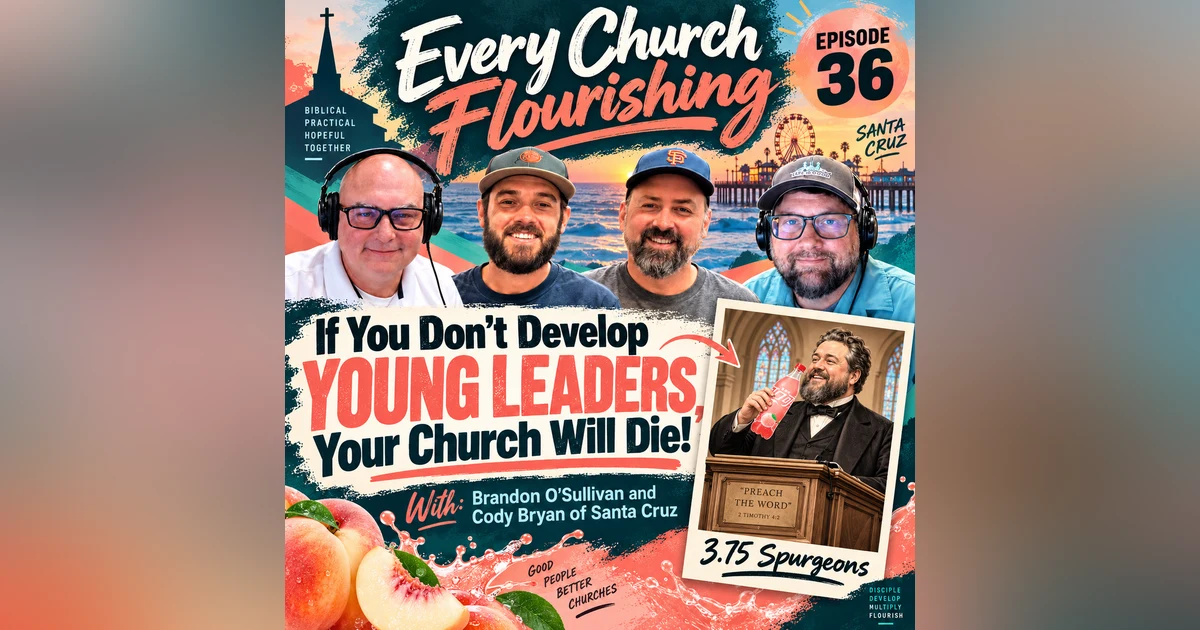
Cody Bryan and Christian Challenge Santa Cruz: Brandon O’Sullivan at Gospel Community: How can young ministers and leaders in the church avoid controversy and offense so that they can be fruitful and flourish? How can churches have...

 Apple Podcasts
 Spotify
 Amazon Music
 YouTube
 Youtube Music
 iHeartRadio
 Podchaser
 JioSaavn
 Castbox
 Gaana
Gaana Cody Bryan and Christian Challenge Santa Cruz: https://challengeucsc.com/affiliations/
Brandon O’Sullivan at Gospel Community: https://www.gospelcommunitysc.org/leadership
How can young ministers and leaders in the church avoid controversy and offense so that they can be fruitful and flourish?
How can churches have deeper and more fruitful partnerships with parachurch ministries?
How simply making disciples creates opportunities in ministry.
“A peach is an orange sort of thing, but this bottle is a blue sort of thing…what gives?”
Episode 35 How Can Parachurch and Church Ministries Work Together?? The Kingdom of God is Not Competitive, But Cooperative.
How Can Churches Make Room for Young Leaders and Not Stifle Them? Why is it CRUCIAL for churches to make room for young leaders??
How a Bible-Believing Church Can Make Disciples and Thrive in one of the most liberal Cities in America.
College Ministry at U.C. Santa Cruz
All about Christian Challenge College Ministry
Episode 36: Raising Up Young Leaders & Campus Ministry Partnerships
Hosts: Dr. Chase Thompson & Pastor Christopher Cole
Guests: Pastor Brandon O'Sullivan (Gospel Community Church, Santa Cruz)
Cody Bryan (Christian Challenge, UC Santa Cruz)
[EPISODE TEASER]
CHASE THOMPSON:
We're talking to Santa Cruz Pastor Brandon O'Sullivan today and College Minister Cody Bryan about the importance of raising up and releasing young leaders into church life. As well, we're talking about how a church and a parachurch ministry can not compete with each other, but enhance each other and strengthen each other. Along those lines, our guest Cody Bryan of Christian Challenge discusses the importance of being part of his local church.
CODY BRYAN:
Having a church family—a family of believers I'm genuinely invested in and connected to, where my wife is invested, and my children are connected—provides an incredible amount of stability for me, my family, and my staff members and their families. I think it frees us to be even more focused and sold out for making disciples and raising up laborers on campus.
[INTRO]
CHASE THOMPSON:
"...together to build up your local fellowship and the broader kingdom of God."
Join hosts Pastor Chris Cole and Dr. Chase Thompson from the Great Commission Association, led by Dr. Mike Stewart, as they explore the frontiers of ministry and aim for the goal of making every church flourish.
Hello again, everybody, and welcome to episode number 36 of the Every Church Flourishing podcast. We are brought to you by the Great Commission Association of Southern Baptist Churches located out west in Central California.
My partner Christopher Cole and I have a great show for you today. We're talking with Pastor Christopher and Pastor Brandon O'Sullivan of Gospel Community Church in Santa Cruz, California, and Cody Bryan, college director of Christian Challenge Santa Cruz—an SBC college ministry targeted at UC Santa Cruz, the Banana Slugs.
We're discussing reaching the next generation, raising up young leaders, and how churches and parachurch organizations can work together. No need for a huge, long introduction—let's dive right into it!
[PART 1: INTERGENERATIONAL DYNAMICS & RAISING LEADERS]
CHASE THOMPSON:
All right, Cody, question for you. The joke often is that Millennials and Gen Z are thin-skinned and easily offended, so you have to walk on eggshells around them. I find the reality, at least in the church, is that older people are often more likely to get offended. They can be far more easily triggered and grumpy. I hope I can say that!
CHRISTOPHER COLE:
We're going to get in trouble for saying this, but "yes and amen"—that has been my experience as well. Proceed onward, brother, knowing the comments are coming!
CHASE THOMPSON:
Probably so! But I'll say this: I truly value the older people in our church. Our leadership team has members in their 80s and members in their 20s. We need both.
Cody, I bet you've seen that dynamic too. What are some hacks, tricks, or approaches you've used or seen that a young leader listening to this could apply? How can they get more involved in the life and ministry of the church without stepping on so many toes?
Younger people are often more adaptable. Rather than lecturing older members to be more accepting, what would you say to younger leaders to help them transition smoothly through the door to do kingdom work?
CODY BRYAN:
For young men and women seeking to see God use them in ministry, our primary focus should be the core command of the Great Commission: make disciples. You don't need a formal title, position, or human approval to do that.
As you go out and make disciples, you're participating in what God wants to do in saving the lost, creating something that wasn't previously there. You naturally create your own ministry pool of people you're investing in. You do this in cooperation with the broader body of Christ—definitely not as a solo act, which wouldn't be healthy.
I haven't had many issues stepping on people's toes because I haven't spent my time angling for positions or existing turf. Instead, seeking to make disciples creates its own opportunities for ministry. When you reach people and invest in them directly, you rarely step on anyone's toes. If you try to build your thing on top of work someone else is already doing, that's when conflict happens.
CHASE THOMPSON:
That answers a parallel and crucial question. I've been a senior pastor for roughly twenty years, but my background was in youth and college pastoring for ten or twelve years. I had many youth pastor friends whose senior pastors or church boards suppressed them and treated them like second-class citizens.
Your answer is great: don't obsess over politics; go make disciples. You don't need the approval of the old guard if you have the approval of the Head of the Church, Jesus, who commanded us to make disciples.
And to older leaders listening: if you don't develop young leaders, your church will die. This is a 911 emergency for the American church.
CHRISTOPHER COLE:
Yes, amen.
BRANDON O'SULLIVAN:
To add to that from another angle: a lot of young people have never had someone call out their gifting, connect the dots, and set a roadmap showing, "Here is how you can pursue what God put on your heart."
It sounds cheesy, but I love the "I-C-N-U" conversation—saying, "I see in you this gifting." Calling that out is powerful; many people have never had someone look at them and say that.
On the practical side, many young believers don't have any concept of how they could actually pay the bills doing full-time ministry. They assume anyone in ministry is completely destitute. Walking them through how to get the right education, enter ministry, or raise support makes a huge difference. People need that roadmap laid out for them.
CHRISTOPHER COLE:
That road-mapping and intentional calling out of gifts is essential. From our perspective here at Every Church Flourishing, there is a crisis in the church because of a failure to obey Scripture on this point.
Second Timothy 2:2 makes it clear: we must always think about four generations of leadership in the church. Paul says to Timothy: "The things you have heard from me [generations 1 and 2], entrust to faithful leaders who will be able to teach others also [generations 3 and 4]."
That vision of four generations of leadership development and doctrinal shaping is vital.
[PART 2: CHURCH & CAMPUS MINISTRY IN PRACTICE]
CHRISTOPHER COLE:
Let's talk about the practical side. What does the partnership between Christian Challenge and Gospel Community Church (GCC) actually look like on an ordinary Tuesday or Sunday? Brandon, want to kick us off?
BRANDON O'SULLIVAN:
As a pastor and leader, if something is working well, don't mess with it! Cody is exceptionally competent, and his team is excellent. Leaders often feel the urge to interfere and put their own stamp on things. I don't see any need for that. They reach the campus far better than I could. Praise God for that! The question is simply: how do we support and feed into it?
Challenge is great about actively promoting the local church; we are all members of the same church family. For our congregation, supporting them involves financial partnership, helping cover staff salaries, and having our pastoral staff teach at Challenge retreats and events.
In return, Challenge students and staff serve throughout the church constantly. Whenever a volunteer need arises, nine times out of ten it's met by someone connected to Challenge. It is a genuine, interdependent partnership.
CHRISTOPHER COLE:
Cody, what does that look like from your perspective? Where is the overlap beyond the financial or logistical side—particularly in discipleship and leadership?
CODY BRYAN:
No single one of us has every gift or is good at everything; we all have weaknesses. Because our campus ministry is very focused and niche, that naturally leaves gaps in strengths and where we spend our time. Partnering closely with GCC has been a massive blessing.
For instance, I'm not gifted at preparing weekly sermons, but I organize a weekly large-group meeting on campus and coordinate the speakers. My strengths are better utilized in one-on-one discipleship, evangelism, and leadership development. Because of our partnership, Brandon and the pastoral interns he's training frequently come speak at our large-group meetings. That frees up my bandwidth to invest where my strengths lie.
Personally, my relationship with Brandon is invaluable. He provides pastoral counsel, scriptural guidance, and wisdom for navigating complex life situations. I also draw on the wisdom of older men and women in the church. Brandon doesn't run a one-man show; he empowers people.
If I tried to be an isolated campus director running everything on my own, I would have burned out long ago. Having a loving church family where my wife, children, and staff are deeply connected gives us stability. That stability is what frees us to be sold out for making disciples on campus.
CHASE THOMPSON:
Brandon, what does Christian Challenge give Gospel Community Church that the church couldn't easily reproduce on its own?
BRANDON O'SULLIVAN:
First is targeted campus outreach. To be truly effective on a college campus, you must be embedded there. As Cody said, the best people to reach college students are other students—just like the best people to reach police officers or healthcare workers are their peers.
Beyond that, Challenge keeps evangelism on the front burner for our entire church. It prevents complacency. When older church members see someone who has only been a Christian for six months sharing their faith and leading someone to Christ, it provokes healthy reflection: "When was the last time I shared the gospel?"
Seeing college students read, study, and know their Bibles deeply challenges mature believers not to coast. And long-term, we are seeing the fruit of these students stepping into church leadership. As we aim to plant and revitalize churches, many of those future leaders will be raised up right here—moving from lost, to laborer, to leader.
CODY BRYAN:
Can I plug college ministry for anyone listening? When I was in college, I thought I would do overseas missions—traveling village to village, preaching the gospel, equipping leaders, and moving on. I'd still love to do that if God calls me to it.
What I realized in college ministry is that I get the blessing of a stable, local church family, while every single year a "village" of 5,000 brand-new, largely unreached people moves right onto my doorstep!
I get to stay rooted in one community while reaching a new village every four years. There is an intentional urgency because you only have four years to equip them before they launch into the world as seasoned laborers who know how to disciple others.
[PART 3: REAL STORIES OF TRANSFORMATION]
CHRISTOPHER COLE:
At the end of the day, ministry is about lives transformed by the gospel. Can you share a story of a student whose life was dramatically changed—someone who came to faith, grew, and stepped into ministry?
CODY BRYAN:
A student named Koa comes to mind. His roommate, Julius, is a guy I've been discipling for about two years. Julius came to faith right before college through a YouTube video, with zero church background. He arrived on campus, plugged into Challenge and GCC, and I began discipling him.
Julius naturally assumed that sharing your faith was simply what Christians do! When new believers are surrounded by an active evangelistic culture, they don't know any better than to share Jesus with everyone around them.
Julius began sharing the gospel with his roommate, Koa, who also had zero church background. Eventually, Julius brought Koa to our large-group meeting. Afterward, they walked up to me, and Julius said, "Hey, you know how you disciple me? Koa wants that. Could you meet with him?"
That rarely happens—people asking you directly to share the gospel with them! The harvest is plentiful. I met with Koa, walked through the gospel, and he placed his faith in Christ.
He was instantly hungry to grow. This past summer, he attended our summer discipleship training program and spent every week doing initiative evangelism on the beaches. His obvious joy in Christ is infectious. Seeing someone move from hopeless to full of eternal life renews everyone around them.
BRANDON O'SULLIVAN:
We see that multiplication constantly. At a recent church members' meeting, Diego shared his testimony: David had discipled him, someone else had discipled David, and so on. You could trace four spiritual generations right there in the room!
Another great example is Henry, who is now a missions resident with our church. When he first arrived at UC Santa Cruz, he was wandering and spiritually lost. He ended up committing his life to Christ, diving deep into the Scriptures, and getting grounded in church community.
Now, he's preparing to use his linguistics degree to take the gospel to unreached people groups and Bibleless languages worldwide. We're getting to incubate and equip him before sending him out.
[PART 4: ADVICE FOR PASTORS WANTING TO REACH CAMPUSES]
CHASE THOMPSON:
I love this. In our area near Salinas, we have Hartnell College with thousands of students, plus Monterey Peninsula College nearby. If pastors in California or elsewhere are listening and want to reach local campuses, how do they get started? Can they partner with Christian Challenge, or do they need to launch their own ministry?
BRANDON O'SULLIVAN:
On our end: give us time to train up more workers! If I were an outside pastor, I'd ask: "How can our church partner with and financially support campus leaders right now?" Building laborers is slow, patient work, but it multiplies. By partnering, you get into conversations about where trained leaders can be sent next.
CODY BRYAN:
One practical avenue: we run summer discipleship training programs. Pastors could send graduating high school seniors or college students to spend a summer training with us on campus ministry methods, regardless of where they attend school.
Long-term, I would love to host one- to two-year interns sent from local churches, train them, and send them back to start campus ministries in their hometowns.
Another critical piece for pastors looking to partner with a campus minister: avoid poaching leaders. One reason our partnership with Brandon works so well is that he never swoops in to absorb our top student leaders into church programs at the expense of the campus.
Campus ministry is only sustainable if your top leaders remain focused on reaching the campus. If a church pulls them away to run Sunday programs, the campus ministry crumbles. Brandon trusts me, and I trust him completely.
And for any church asking how to reach students: examine what happens when a college student visits on Sunday. Do they stay? If not, why? Do you have church members intentionally on the lookout to invite students to lunch after service and mentor them?
College students are hungry for a higher calling. If the church doesn't cast a compelling biblical vision for their lives, the culture will hand them a hollow substitute. Point them to Christ's mission, and you'll be amazed at how many rise to the challenge.
CHRISTOPHER COLE:
That distinction between centrifugal ministry (spinning people out on mission) and centripetal ministry (trying to suck everyone in for your own programs) is everything. In the economy of the kingdom, the more a church sends, the more God blesses it. When you walk into GCC, that vibrant ethos is obvious.
[PART 5: SODA REVIEW & WRAP-UP]
CHASE THOMPSON:
Before we let you guys go: on this show, we review a unique soda every week. If you were forced to host a review segment on something, what would you review?
BRANDON O'SULLIVAN:
It might not be very Southern Baptist-approved, but probably wine! I don't know much about it, but it sounds fun.
CHASE THOMPSON:
Send your emails to Brandon O'Sullivan! Cody, what about you?
CODY BRYAN:
I'm a simple guy—sports. Maybe something niche, like reviewing college coaches' sideline outfits.
CHASE THOMPSON:
Like the "Preacher Sneakers" Instagram account! Love it.
Brothers, thank you so much for your time, your friendship, and your partnership in reaching what Princeton once ranked as one of the least religious campuses in America. May God continue to bless the work!
BRANDON O'SULLIVAN:
Thanks so much for having us.
[SODA REVIEW: JAPANESE / CHINESE PEACH COCA-COLA]
CHRISTOPHER COLE:
All right, Pastor Chase, time for our soda review. On May 8, 1886, Dr. John Stith Pemberton brought his newly invented Coca-Cola syrup to Jacob's Pharmacy in Atlanta to sell for five cents a glass.
In January 2018, Coca-Cola introduced a special seasonal variant in Asia: Coca-Cola Peach, formulated around sweet white-fleshed peaches. That's what we have today.
CHASE THOMPSON:
I was skeptical because the packaging is pink rather than classic Southern peach orange, and I can't read the Asian characters on the bottle! But let's crack it open.
CHRISTOPHER COLE:
It smells like classic Coke with a subtle, sweet peach aroma.
[Tasting]
That is delicious. It's not overpowering. You get classic Coca-Cola on the front end, followed by a crisp, authentic fruit finish. Refreshing, with zero unpleasant aftertaste.
CHASE THOMPSON:
"Smooth" is the word. Very smooth from front to back. In fact, translated text on the bottle supposedly describes the flavor as "romantic"—and honestly, it makes me want to go hold my wife's hand!
I'm giving this a solid 3.75 out of 5 Spurgeons. It's a reliable starter—maybe a steady third baseman or an all-star setup pitcher on your team.
CHRISTOPHER COLE:
I was leaning toward a 4, but I'll lock in with you at 3.75 Spurgeons. It's balanced, crisp, and avoids the syrupy overload of many flavored American sodas.
[OUTRO & ANNOUNCEMENTS]
CHASE THOMPSON:
Thank you, Coca-Cola, and thank you, peaches!
Be sure to visit everychurchflourishing.com for show notes, transcripts, and photos. Check out our sponsor, the Great Commission Association of Southern Baptist Churches, at gcasbc.org.
If you are in California or the West, don't miss our annual GCA Missions Conference this October 9th–10th in Seaside, California. It is always a high-energy time of worship, biblical teaching, and fellowship.
Next week, we'll be joined by Bob Bickford, Director of the Nashville Baptist Association. Until then, good day to you, and Godspeed!