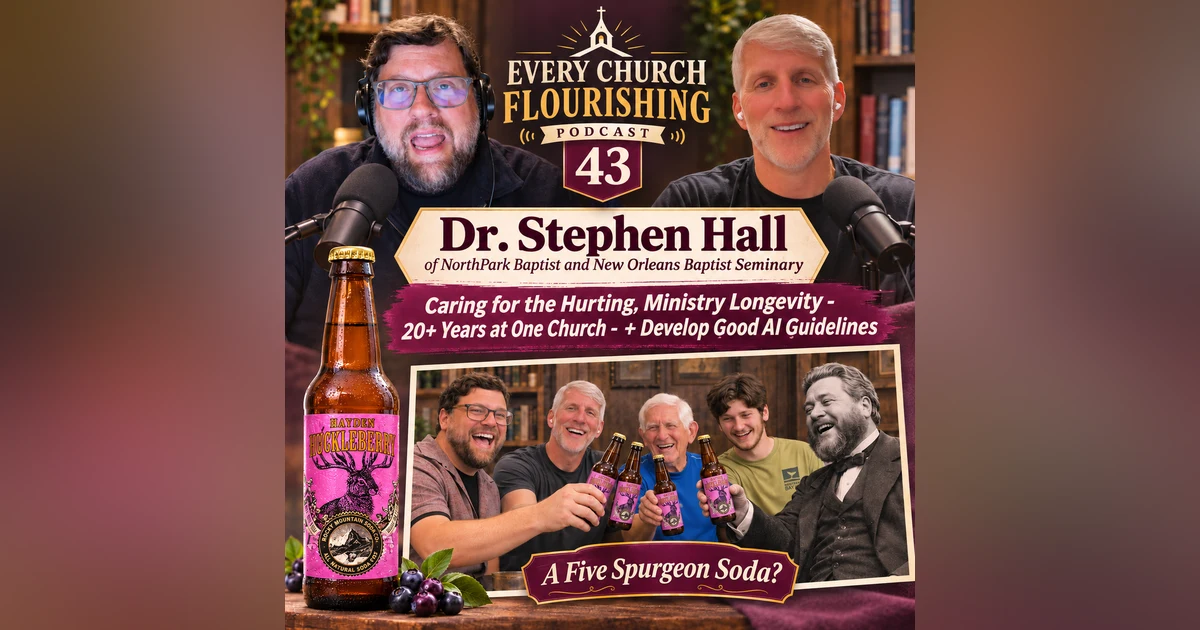
How Churches Can Care for Hurting People, Ministry Longevity - 20+ Years at One Church - and How To Develop Church AI Guidelines.


 Apple Podcasts

 Spotify

 Amazon Music

 YouTube

 Youtube Music

 iHeartRadio

 Podchaser

 JioSaavn

 Castbox

 Gaana
Dr. Stephen Hall of Northpark Baptist Church and the Director of the Birmingham Extension of New Orleans Baptist Theological Seminary.
Pastoring for 20+ Years in the Same Church: How to Avoid Conflict in Church and Cultivate Longevity.
How to develop AI guidelines for the church. What is absolutely NOT ok for church AI use, and what is acceptable?
Hayden Huckleberry Soda By Rocky Mountain
How to win your critics over and help turn them into allies and friends.
It takes two to fight, so be incredibly choosy about your fights in the church.
Fellowship means much more than sharing a casserole with a religious person.
The dangers of sporadic church attendance without any sort of small group connection. You will feel lonely!
No matter who you are - Pastor, church leader, church member - we want to help YOUR church flourish.
How can a Pastor or Church leader cultivate longevity at their church? How can pastors stay long at their churches?
Ministry Longevity and Caring for the Hurting.
Dr. Stephen Hall, Executive Pastor of Northpark Baptist Director of the Birmingham extension of NOBTS and adjunct professor.
0:00 We've got Dr. Stephen Hall on the podcast today, and we talk about some really practical ministry things, such as how to have the longevity to be pastoring at one place for over 20 years. We're also going to talk about how the church can better minister to suffering families, how new pastors and ministers can integrate into their first spot of ministry. But I'm just going to be honest with you. Probably the best part of the whole interview, which I think Dr. Hall does a fantastic job, is the very end where he shares about his daughter Sadie and her testimony, which is so powerful. And you're going to hear him say: "She talks in her testimony that the Lord placed her in hospitals for a reason. Those rooms are no longer a room of suffering, but a room of ministry. She said, 'It's my version of a mission field.'" Broadcasting from the north central coast of California... encouragement, practical advice, soul care, and resources that work together to build up your local fellowship and the broader kingdom of God. Join hosts Pastor Chris Cole and Dr. Chase Thompson from the Great Commission Association, led by Dr. Mike Stewart, as they explore the frontiers of ministry and aim for the goal of making every church flourish.
1:40 And hello everybody and welcome into episode number 43 of the Every Church Flourishing Podcast. We are a podcast with the Great Commission Association, located in the Central California area. And we are all about helping churches become healthy, flourishing, fruitful, and faithful. And we have a great guest with us today. His name is Dr. Stephen Hall. He is the executive pastor of NorthPark Baptist Church in Trussville, Alabama. He is the director of the New Orleans Baptist Extension Center, which is in Birmingham, Alabama. And what's more, he is my brother-in-law and a guy I've known for decades. So Stephen, tell us about your journey into ministry and about how long you have been at NorthPark Baptist.
2:32 I was called to ministry when I was an Auburn student studying physics. Took a route that I didn't expect. Really involved in a church there, being discipled there. Fantastic. Chase, you know my home—grew up in a home that followed the Lord and very blessed by that. As far as NorthPark, I've been at NorthPark for 21 years, came in April of 2005 as the student minister—high school minister, to be precise. Got the opportunity to serve in several roles during that time. And it's a beautiful church. We didn't discuss this beforehand, but when was it that you knew you were being called into ministry? Because I know physics major at Auburn, Air Force Academy appointment—it looked like your life was going in an entirely different direction. What happened?
3:22 I was involved at Lakeview Baptist when I was in college. I was discipled by a guy named Tommy, then the college pastor, Cliff Knight, and just got really involved. I started doing Evangelism Explosion, which is a Sunday night class, and then Tuesday night going out door to door with a team of three. Fantastic. Learning to share my faith, having conversations with others. And so I was very, very involved in church, following the Lord. And so I guess that would be the biggest thing. It's that I chose, even in what I was doing, to be one who was following after the Lord. I think that was the most important thing. I was driving from Birmingham to Auburn on a Sunday afternoon to go back for a training in evangelism. I was listening to 93.7, the Dixie Gospel Caravan.
4:15 That's a blast from the past. It is. I was listening to that because that was all I had to listen to. And so I was listening to Sunday Afternoon, Dixie Gospel Caravan. Any Birmingham listeners would be very familiar with that if they were around in the '80s and '90s. This was in the mid-'90s. And as I was listening to the music just in the background, I was praying and the Lord just—not audibly, but impressed on my heart a different direction of life. And I remember debating with God because I did not feel equipped at all for ministry. Even when I went to my home church, Hilldale Baptist—you're familiar with it—I shared a few weeks later that I'd been called to ministry. A church leader came up to me and said, "Are you sure about that? You mean you're going to be a pastor?" And it was so deflating because I was not sure about that, but the Lord guided the process. I remember thinking about the Exodus 3 story of Moses and his reluctant drive into ministry for what God was calling him. And I took comfort in those words. And I told the Lord that, "Hey, if you want me to head towards a life of ministry, I'm most certainly happy, honored, willing. But this has got to be something that you do, because I did not see that as my skill set."
5:45 Wow. Well, so we have known each other for well over 30 years, and I have never heard the Dixie Gospel Caravan aspect of your call to ministry. That's right. And I haven't heard the other thing, too. This is something you and I have in common. We were both at Hilldale Baptist Church at the same time, and the idea of me going into ministry—you and I both have been in ministry for over 30 years—caused a leader there to laugh out loud at the idea of me being a pastor. At the time, I didn't take it hard at all. It wasn't deflating to me. I never thought when I was in college that I was going to be a pastor. I was going to be an FBI agent or something like that.
6:30 I remember those days. Yeah. When a senior leader at that church laughed at the very idea of me being a pastor, I was laughing right there with him. But yeah, strange how that's worked out and how many people from our college group—I don't know, over a dozen, right?—are in ministry. It's incredible. It is. Yeah, the Lord did a really special thing. And I guess that goes back to before that time when I was at Auburn, there was a year I spent in the college ministry there at Hilldale, and the Lord really had his hand on things. And I guess that's probably the most important part at the call of the Lord calling us: we were following after him in a way that many college students don't. And so it was a special moment to be a part of. It was just pretty special.
7:25 It was special. And we had—this is weird. I say this because there's going to be some older pastors listening to this or older people in church and thinking, "My time is up in ministry." We had a guy, his name was Hayne Sandefur, and he was a retired pastor. He was mid-70s. He wore his pants up to his shoulder blades, roughly. High Pockets Hayne. High Pockets Hayne was what he was called by his family. Nobody was making fun of him. He was dying of cancer unbeknownst to all of us, and not a cool person. You know, we were young and he was an old dude, but he taught our college Bible study at your house, Stephen, and just poured into us. And somehow, some way, almost half the people in that group have gone on to go into ministry. And it's just a remarkable testimony of the amazing way that God moves.
8:25 Yeah, those were some special days. We would sit in the basement with a group of folks and he had a yellow legal pad that he would write his notes down on, maybe from an old sermon. And it wasn't about the delivery. He would sit and he would lay that legal pad in his lap and he would read from it. And then every once in a while, he would look up and catch eyesight. And it wasn't anything groundbreaking. He said things like, "Hey, if you really want to follow the Lord, I have 100 Bible verses and you need to memorize all of them." And so he gave us a list. Chase, not too long ago, I found that list. Nice, right? Yeah, I'm pretty good at throwing random things in books. And like most pastors, I have a lot of books. And so I found that list in a book. So if I can find it again, which is doubtful—I know it exists, though—if I can find it again, I'll try to send it your way.
9:25 Please do. Hayne Sandefur is the guy that convinced me to start memorizing scripture when nobody else could. And it was because he had that old-person saint aura. You couldn't not do it. I still remember the Mark passage: "Where their worm dieth not, and the fire is not quenched." Because, of course, we had to memorize in the King James Version. We did. Oh, yes. Yes, we did. Yeah. Great times. Great blast from the past. You have been at NorthPark Baptist Church in Trussville for 21 years, which is, depending on the statistics you read—some people say the average pastoral tenure is three years, some say it's five years, I've even heard under two years. However long it's been, you've been there five, six, seven times the average. How can a pastor or church leader cultivate that kind of longevity? How have you been at the same church for that long?
10:25 Well, the credit is the Lord and the amazing church. NorthPark is a special place. It's a joy to be with people like that. And we're most certainly not a perfect church—I'm a part of it. But I've had the joy of serving in a couple of different roles there: student ministry, associate pastor, missions, discipleship, and now the executive pastor role, which is administration. And so I've been able to grow with the church and I've been able to be in different places, be accepted in different places. And I've made a lot of friends, a lot of what I would call family. The NorthPark family is a special thing. And I think any church can be like that. I'm not the only one with longevity of tenure there. Our financial assistant is maybe the godliest woman I know. Her name's Sharon Terry. Two weeks ago, she celebrated 42 years as our financial assistant. Wow. Yeah, she's absolutely amazing. Our lead pastor, Bill Wilks, came in '99, so he's been there 27 years. So he and I have worked really closely together. And our associate pastor, he was the student minister after me, and now he's the associate pastor. He's been there 15-plus years. So it is a place where people come and stay. And a lot of that deals with just a lack of choosing to have conflict within church. Sometimes we unintentionally or unfortunately run to conflict. And now I'm not saying that we should not take bold stands, because we live in a day when the church needs to take a bold stand, the pastors need to take bold stands. That being said, we have a lot of hills that we think we should die on that we just shouldn't. And a lot of it is realizing what is most important and what's peripheral. And there's been good wisdom with the church, and just with our time there, we're able to keep that main thing the main thing—and that's obviously our focus on Jesus.
12:34 That's awesome. I'm going to ask you in just a second—there'll be young pastors and church leaders listening to this—I'll ask you for a couple of Dr. Stephen Hall tips on staying in the same church for over 20 years. I'll give you one of mine. I've never been in a church for over 20 years. The last church I pastored, I was there for over 10. The current church I'm in, it's approaching nine years. So that's above average. It's nothing crazy like what's happening in your life. I think you were close to being the longest-tenured pastor at both of the churches you pastored. Am I right about that? I think so. And I've got to figure out a way to prevent David McConnell at Agape Baptist in Pinson, Alabama, from taking my record.
13:17 He's a great man. Because he is a great man, but I don't want to give up that record. It's like dropping the heavyweight championship of wrestling. I'd hate to do it. But here's my tip. It's along the lines of what you were saying. I don't know if conflict avoidance is the right thing, but if you will see your critics, young pastor—especially early on when you're young and you think you're right about everything and you think old people in the church are kind of stupid and backwards and all that (look, that's where I was when I was in my 20s)—if you will see your critics as potential friends and allies and helpers, and basically typically refuse to quarrel with them and invest yourself in them. I'm thinking of specific people—I'm not going to name their names, especially when I was a youth minister—that I thought initially were just going to be the worst thorn in my side and big trouble, parents of youth. And we just wouldn't argue with them. We kept cultivating that relationship, and eventually they became staunch allies and helpers and crucial players in the youth group. And it takes two to fight. So I would say be incredibly choosy about your battles in the church. I don't fight people in the church unless it's an issue of a predator or a real heresy. And I don't mean a real heresy like Calvinism versus Arminianism or something like that. I mean a real heresy. What would you say to that young pastor listening, Stephen?
15:07 Yeah, you've given some good wisdom. That's it. It doesn't mean you're not going to have hard things. A couple of months after being at NorthPark, I had a key committed youth worker that took Kelly and me out to eat. And we were becoming close to this individual, whose name I will not share now. You'll see where this is going. I thought it was social. I thought it was just connecting. And it wasn't until we finished the meal and then he turned the conversation. And there with his wife, he and his wife shared with me, with my wife sitting next to me, all the different things that I was not doing well. Oh, it was terrible. So a couple of things that I came out of that with. One is I told Kelly that I would never allow her to be in an environment like that again. I was young. I was 29 when that moment happened and old enough in ministry to learn how to get out of it, but I'd never experienced trying to get out of a situation like that—which, of course, I don't allow myself to be in those situations now. Like, if you're going to critique me, hey, critique me all day long. I've got thick skin, but you're not going to bring my wife into it. But what I did, though, is—he was wrong in his approach. However, some of the things that he said were not terrible. Some of the things he said, I was like, "Okay, well, I probably could work on that." And so I chose to take the high road and befriend him. And so I guess this would be the thing to the young minister, the young pastor: the people you're having conflict with are people that God called you to pastor and minister to. And so develop that mindset of a pastoring heart. And a pastoring heart fixes so many things. My goal in ministry is to help people take steps forward toward the Lord from wherever they sit. And so if that's my goal, then my approach is very different than if my goal is to be right about everything. I don't have to be right about everything. Not too long ago, an elderly lady asked me a question about Gog and Magog. And the way she asked it, I knew what answer she wanted. And I also knew that it was different than the way that I would approach that scripture. And so what I did, instead of getting into an eschatological debate, I just kindly referred her on to somebody else who would answer the question in the way that she wanted it answered. Because it doesn't matter. I also realized, "I'm not dealing with that." I mean, it does not hurt my feelings if someone wants to think differently about Magog than I do. I lose zero sleep on that. That's the unfortunate part—is that some ministers would lose a lot of sleep on that.
17:58 They would. And that's the difference between developing a pastoring heart and developing a heart that just wants to... I don't know how to describe that. Make disciples of yourself rather than disciples of Jesus. Well said. Yeah. Yeah. So I find in my own ministry life, I was that kind of young guy in the '90s in my first few years in ministry where I was like, "I'm pretty sure I'm right on these things and you older people are behind the times, and so I want to confront that and help correct you," which is very foolish and arrogant. And I praise God that a lot of that got beaten out of me by just making dumb decisions. You don't have to make those dumb decisions when you're young. You can actually go into ministry and be humble and wise. But then the dynamic you talked about, Stephen, with the couple that took you out in front of your wife—older people kind of have this, you know the Progressive insurance commercials where they try to not become your parents? Older people often become their parents and forget how hard it was to be corrected on everything. And we don't need correctors in the church whose primary job is to criticize. There's not a spiritual gift of criticism. Everybody can see weaknesses really, really well. Everybody's good at criticism. What we're not so good at is building up, encouraging, and helping somebody overcome their stuff. So you don't have to fight in the church. You've been there 20 years. Any other tips on longevity that we should hear?
19:41 Build great long-term connections. The idea that you can't have close friends within the church is a really dumb idea. Chase, you've probably heard people say that. What I would say is I want to minister through really, really close relational connections. And so the deeper the connections are, the greater the ministry. It's beautiful the number of weddings, marriage counseling, funerals—when you're at that place where a lot of the key leaders within our church are folks that I have officiated their wedding. And that's just a beautiful picture. The conventional wisdom is pastors can't be friends in their church, but you're an executive pastor of a very large church, I'm a pastor of a small- to medium-sized church, and I will say: if you're not going to have deep friendships in the church you're pastoring in, you're not going to have deep friendships almost at all, because you're not going to have time. Who has time to pastor and lead a church and then also have this huge social life afterwards? If you try to do that, you're probably going to come across a little standoffish. And I recognize you open yourself up to risk if you have deep relationships in the church, but there's just no other way to do it. I think it's anti-biblical to have that sort of mindset. So, Stephen, we had a discussion this week, a couple of days ago, about one of the things you do at NorthPark: you're involved in the onboarding process of new ministers. And so over the years—21 years—you've onboarded a lot of new ministers. Give us some practical advice for pastors that are starting for the first time at a church, a youth pastor starting for the first time at a church. Give us some practical advice for young and new ministers just in general that they need to hear.
21:31 Oh, yeah. Some of the conversation came recently. We've hired several staff members: a new worship pastor who came from being at several different churches, a new student pastor, and then a girls' minister. The girls' minister was a minister at Shades Mountain, which is a really big church in Birmingham, and First Baptist Hendersonville, which is an even larger church in the state of Tennessee. And so bringing them in, I really felt some struggle of, "Okay, I've got to do this onboarding thing right." We have great longevity, which means I don't onboard a lot of folks. And so I don't really have a system set up. And what's interesting is in the current culture, especially in the job market, a lot of attention is given to proper onboarding, especially in large companies. And I feel ill-equipped to do that well. And some of my thoughts of trying to make sure that I do onboarding well came out to some conclusions that I had about the onboarding process in general. When I started doing ministry, nobody told me what to do. They just said, "Hey, you're our student minister. There are the students." And then there was just an expectation that I would just inherently know. And I do realize we can go too far down that. But I would even say when I stepped into every role of ministry that I've stepped into, nobody has onboarded me. Nobody said, "Hey, look, here are the five keys that you need to know." There's a lot of it that my generation of ministers, we just figured out. And we just said, "All right, listen, we're jumping in. We're going to do ministry. And if we don't know how to do something, we'll figure out how to do something." We'll find a mentor, somebody. We'll listen to a buddy. That's why buddies in seminary are fantastic to keep track with, because you'll talk to somebody and you'll find out how another church does this well. Now, in the world that I live in, dealing with rewriting our policies for maternity leave—I've recently found out that our policies are antiquated because they're mostly written by men, for men. Now, all of a sudden, we have several young women on our staff team, and I realized, "Okay, well, this is not effective." So some of the communication of how we do insurance, how we do retirement, how we do these things—we want to be professional. But what I would say, again, to the minister starting out is: hey, don't expect a lot. In the same way that for generations men and women have been called to ministry and the Lord just directs them to that ministry, adopt that mindset. Adopt that mindset of, "Okay, I'm called. That doesn't mean that it's fantastic, but I'm called and I'm going to dive passionately in with great gusto into whatever ministry the Lord has put before me, and then take some direction along the way."
24:38 Yeah, that's a good call. So young ministers coming into churches: if you're not onboarded—which I think is a great idea—ask questions and learn. So much of it you're going to figure out on your own, and that's normal and natural and probably even healthy. But if you try to figure all of it out on your own, chances are you're going to run afoul of several deeply held church traditions and practices that you would not be able to recognize from the outside. So I think it's very wise to onboard ministers if you're able to do that as a church. And if you don't get onboarded, ask a lot of questions. You want to do it well, but at the same point in time, if you're a young minister, don't expect somebody to tell you everything.
25:23 No. Yeah, really what it comes down to is you want to figure things out. The way you figure things out is you barge into your pastor's study. You barge into another minister's study on your team. Or if you're just a pastor by yourself, you sit down, you get to be buddies with whoever the chairman of whatever leadership team you have—whether that's personnel, stewardship, deacons, or all three of them. When I stepped into my role as executive pastor, my giftedness is more towards pastoral leadership than it is towards administrative leadership. And so I felt it really funny when I stepped in—and that was nine years ago—I was like, "Okay, you want me to be the admin guy at the church? That's extremely scary." But what I did was I pulled a couple of guys onto the personnel team who I really, really trust, and a couple of guys onto the stewardship team or our finance team who I really, really trust. And Chase, what I would do is I would just watch them in meetings. I would begin to imitate them. And I would say, "Okay, well, this is how this guy operates around people around this topic. Okay, I'm going to start using his phrases." He's a VP for a huge construction company. And another guy, he's VP for Alabama Power. These guys probably know a thing or two. And so I'm just going to get close to them and hope that some of that rubs off. So again, my mindset for onboarding is, "Hey, I want to lead people in that same way." Instead of "Let me tell you everything first off," it's, "Hey, let me pull you in close, and then you're going to pick up things of how we roll." Now, there is some knowledge that you need to share, I guess, though sometimes that can get overthought.
27:12 Yeah, good answer. And if you're a new minister coming into a new situation, there's no need to pretend like you know everything or you know how everything works, because you don't. People are going to know you don't. That's right. Let's shift gears—pretty radical gear shift here. Stephen, because I know you deeply and personally, I know that your family has gone through extended seasons of medical crisis. And ultimately, we want to talk about what you learned through that about being ministered to, and what you learned about ministering to other people going through extended times of crisis. But first of all, I want to give you an opportunity—as much of the story as you want to share or not to share—tell us a little bit about some of those crises if you want to.
28:01 Oh, absolutely. We've got four kids: three kids biologically, and one kid adopted. So Sydney, Seth, Sadie, and Maya are our four kids. They're all fantastic. We love them. They're all doing well. It's great. Sadie, when she was born—she's 17, she's a senior now in high school—when she was born, she was born with a really rare disease, rare as in 50 kids in the world with it. And it was a disease that caused her to bleed and then continually bleed. So the first year of life, we kept her alive through blood transfusions. As you can imagine, it was absolutely grueling. Chase, I don't think I've told you: at one point in time, Harvard reached out. They're like, "Hey, we want you to be in a study." And my wife, Kelly, and I got really excited. We're like, "Hey, this is going to be great. Maybe we'll find out some things about the disease. We'll find out some things for help." And so we filled out the paperwork and then we realized, "Wait a second. This is a study of mortality." They're looking at one thing, and that is: is she still alive? And so we're like, "Oh, well, that's not exactly the study we want to be in." But yes, she's still alive. She's thriving as a senior. It's Sunday night as we're recording this. She and a couple of her friends have started what they call house church. And so each Sunday night, they go to a different place and have a Bible study. It's all student-led. It's beautiful. It's a lot of fun. I think they're having a bonfire as we speak. But her first year of life—really, really tough. And so we made it through those first times. Her life has been a lot of doctors. She still has some bleeding struggles, but also she's got chronic pain. And that's probably the thing that's been tougher in the teenage years. Teenagers with chronic pain—that's not something that every teenager faces. And so it's also an internal chronic pain; it's not a visible thing. And so because of that, life is hard in a lot of ways. But she follows the Lord. It's a beautiful thing what the Lord has done and continues to do in her life. That being said, I'd love to take away pain and pain struggles. But her goal in life is she wants to become a nurse and be a nurse at Children's Hospital in Birmingham, which is the place that she was cared for in a big way. So that's all beautiful. We walked through this terrible thing with our church's support, and the beautiful aspect was not about the struggle of the disease, but there was a beautiful thing in the way the church cared and ministered to us throughout that process. And I realize probably quite a few listeners to the podcast have had health battles within their family, with their kids or their personal life, and they've seen their churches rally to them. It's a beautiful picture to see that and to see how the church—well, just the church being the church and caring for people. The church is the most caring group of people on the face of the earth. I realize there are some people who don't believe that because they've experienced sad things in the church, and I hate that for them. That being said, it's true. The church is a beautifully caring place. And we really experienced the love of Jesus in a lot of different ways during that.
31:37 So when you guys went through that, I remember the season, and I don't know if I've shared this with you before. I myself learned a lot about pastoring and ministering from being tangential to that situation. I don't remember the dates like you would, but it was right before I became the pastor of Agape in Alabama. And for months, probably even a year or two, there would be seasons where things were very touch-and-go with Sadie, and Janet and I would be praying and talking about it every day, asking about it every day. But I remember I have a natural shyness in me, which is weird because I'm generally a very extroverted person. But I have a hesitation to insert myself into situations that I'm unsure about. And I feel like going through that period when Sadie was touch-and-go so much, coming out of that, when things got better and she was doing better, I would have graded myself as a friend and a pastor very low during that period, even though in my heart and in our conversations, we were praying and talking all the time. And what I've tried to do is learn from that: that when people are going through extended crisis, praying is great, and it's important and it's crucial, but it's not enough. One of the hardest things people have to deal with is loneliness. And one of the loneliest times you'll ever feel is when you're going through a crisis and you feel like nobody cares. So you guys went through that. It wasn't a week. It wasn't a month. It was years you guys went through that. What did you learn about being cared for by the church and about caring for people as a pastor through those difficult years—which in some sense, I don't want to sugarcoat it, are not over?
33:49 Oh, yeah. No, it is not as visible. There was a point in time when Sadie was less than one, she was vomiting blood continually and getting blood products to keep her alive. So it's not visible in that way. But yeah, there are tough days still, even now. What I would say is having people in a church that fellowship—we use the word "fellowship" a lot. Many times when we think fellowship, it brings up the idea of some sort of casserole that was made at somebody's house. And I'm fine with that; those are good things. Really, when I say fellowship, though, I mean biblical community. I mean the church being the church for people, surrounding people with love and support. And we get to witness that. We get to see that. We still see that. Finding your group at a church—at NorthPark, we have life groups and discipleship groups. The small group structure is critically, critically important. At our church, we tell you, "Hey, listen, if you join our church and you don't land in a life group, you probably will not be here a year later. Something's going to happen in your life and you're going to realize that you're alone, and then you're going to go search another church because you haven't made connections here." And that's with any church. Our church is a large church—we're not a megachurch by any means, but we're a larger church—and it's an imperative to connect with one of those groups. And I would even say, I tell people, when you connect with a group, you don't connect with a group so that they'll do something for you. "Hey, let me connect with a group because I'm going to go through something bad and I need somebody around me. I need somebody to send me some Chick-fil-A when life is rough." No, that's not it. You connect with a group so that you can do that for somebody. The heart of Christianity is an others-focused mindset. You connect with a group for the purpose of ministering and loving people well. And when we connect with that mindset, everything changes. Again, we're a small-group-focused church. Eighty percent of our worship gathering is in what we call life groups on Sundays at NorthPark, which is an incredible percentage. And then on top of that, we also have discipleship groups. And because of that, I've seen people walk through the worst of the worst things, and I've seen their small groups carry them through it. We laugh about it a good bit: when somebody's going through something at our church, the pastors never make it to the hospital or to the home before their life group or their discipleship group is there. And we're typically the second call. The first call is to that group that they're connected with. And what I would say is that is the most healthy thing. It's beautiful. Now, again, that's where we want it; it doesn't always work that way. We still deal with disconnected people, and it's a struggle. But the groups are critical. Finding your people in a church is critically important to care.
37:19 Yeah, I completely agree. And I want to give you an opportunity in just a minute to reiterate that, because this is something we were talking about earlier. And I think it's so important for pastors to understand and for just church members to understand. And that is, if you look in the book of Acts, the church was getting together literally every day, and oftentimes it sounds like twice a day. And okay, maybe that's not uber-realistic for America in 2026, but I was listening to J.D. Greear talk a couple of weeks ago with some other pastors, and he quoted a statistic that the average evangelical in America goes to church 1.6 times a month. Compare that to what you see in the Bible, and you're going to see a significant disconnect. And I was talking with our church today about the problem of evil and the problem of suffering and church hurt. And I would say—this is obviously just a seat-of-the-pants statistic—60 or 70 percent of the church hurt situations are somehow, some way related to people feeling lonely, unseen, unnoticed. And oftentimes it's because they go through a crisis unseen and unnoticed. And they're in a church, but they're probably just in a church 1.6, 2.0, whatever times a month. And they're like, "This is my church. I'm here." I've had people out here in California that'll see me out and about and that will introduce me to their friends, and they'll be like, "This is the pastor of my church." And I'm like, "Oh, well, I mean, I know who you are, but I haven't seen you in a few months." And I don't take attendance or anything like that, but it's like going to the gym twice a year and wondering why you're not really fit and ripped and healthy and you got abs. Well, you're not really rooted and grounded in the gym if you're going just 1.6 times a month. And somebody that has the idea that as a church member, they can go on Sunday mornings to church and have the kind of connections with people where they can either, A, minister to somebody when they're really hurting, or B, be ministered to when they're really hurting—Sunday morning does not lend itself to in-depth, real relationships. I'm not saying it's not important. It's super important. Worship is the most important thing we do. Listening to the Word is really important, but it doesn't build relationships unless you're incredibly intentional about it. And I think it's very wise to say it's very important for somebody in a church, whether it's a large church like NorthPark or a smaller church like Valley Baptist Church, to be plugged into something beyond just the Sunday morning thing. So along those lines, you've been in ministry for three decades. You have been on both sides of the aisle in terms of receiving care from the church and giving care. Give us some wisdom on how the church should take care of the wounded in various ways, and especially when that crisis or that wounding is like your situation with Sadie: it's extended. It's not just an acute, over-in-a-week crisis. It's a long, long-term thing.
41:02 Yeah, those are the tough questions. Prayer for people—number one, absolutely, we want to pray for people. But it is that, and it's taking the initiative to check in. Now, again, in any church, man, if it's the pastor who's trying to check in on everyone, that's just a system that's not going to work. Now, let's talk to pastors for a second. To pastors: one of the greatest things that we can do is continually check on people who are struggling. Going to the hospital, showing up at somebody's house, sending that text message, making that phone call—those are all really good things that we need to continually do with great eagerness. We need to look for moments to do those things. I have groups of people that I pray for in the church on a regular basis. And what I'll do is I'll check in with those folks, let them know that I'm praying for them just in general, and see if there are ways I can pray specifically for them. So that's important that we as pastors own that, because some of the owning of that is not that we're going to do it all, but we're going to model that. We're going to model that and we're going to lead people within our church. If I'm checking on key leaders or groups of people in certain ways, they're going to, in a sense, see that model of what it means to shepherd, to pastor people. And our small group leaders, we want them to do the same. But it's not just small group leaders—our church people. We want to create a culture of people who are checking on, praying for each other, caring for each other. We have a care group structure within our small groups, within our life groups, for that. And those things are just critically important. So I guess the deal is there are some things that we as pastors and leaders need to own and we need to set the pace for. But then also, man, there's a drum that we've got to beat of small groups. However your church does it, there's got to be that small group focus where we almost beg people, because if we don't compel them to be a part of that, it's not going to work long-term.
43:31 Yeah, they will be disconnected. All right, well, I got one more question before we go into a soda review. I think the modern church in 2026 and the last few years, we've lost something the early church had, and even the church when we were growing up had: we've lost testimonies. We don't do that as much as we used to. And earlier today, you shared with me a testimony from your daughter, Sadie, and I have been thinking about it this whole conversation—what a powerful testimony it is. This is a young lady who has faced hardship probably beyond what you're understanding from just listening to this brief conversation. And recently, you told me she wrote up her testimony to share with—what was it, an FCA group?
44:24 It was First Priority. Yeah, it's the before-school Christian club. Tell us a little bit about her testimony. Yeah. It's a beautiful story. She shared some of the Luke 8 story of the woman who was reaching out to touch the hem of the garment of Jesus. And Chase, you'll appreciate this—this is typical kid. Sadie is leaving—I see her in the morning, I'm drinking coffee, she's heading off for this club. And then I received a text from somebody else: "Hey, I heard Sadie's speaking at First Priority." I had no idea. And so then I looked on the social media page for First Priority at Hewitt-Trussville High School, and I saw, "Oh, well, Sadie's sharing her testimony today." And so, of course, I then sent it to a couple of people, like, "Hey, pray for Sadie. She's sharing her testimony." And they're like, "Yeah, I know. I'm praying for her." It's like, "Okay, I guess just Dad doesn't get to find that out." And that's all right. That's beautiful. She shared that story and she wrote it out. I was like, "Hey, tell me what you said." And she's like, "Hey, I wrote it out. Here, just read it." And as a dad, it's encouraging and heartbreaking at the same time to read. One is you never want to read about your kid struggling. But there are the Psalms of lament where the psalmist is reaching out to the Lord and laying the laments before the Lord. But in every psalm of lament, there's always a moment of trust where the psalmist says, "Even though I'm in a place of struggle, I trust in you." Every psalm does it in different ways, and those are fascinating to study through the Psalm book. I'm certain that she did not realize that that's what she was doing, but she writes out and says things like: "I'm not going to lie, it's been hard. It's hard to believe someone cares for me"—talking about the Lord—"because why would I hurt this bad if someone did care? I grew up going to church all the time, constant back and forth between 'God loves me and would do anything for me' and the other question of 'Why doesn't God care enough for me to heal me?'" She said she would look at healthy kids and wondered what she did to deserve to have the struggle. She said that she would continually beg God for healing, but it never came. So those are hard words to hear as a dad. And again, that's still a struggle that she has. But she talks in her testimony that the Lord placed her in hospitals for a reason. Those rooms are no longer a room of suffering, but a room of ministry. She said, "It's my version of a mission field." When the doctors and nurses see her, they don't just see a teenager in pain; they see a living testimony to the Lord's supernatural strength that proves that his grace is always sufficient. The Lord does that in the struggles that he carries us through. He continually shows that his grace is and forever will be sufficient. As a 17-year-old, I don't want my daughter to have already understood that great idea, but I'm thankful that she does.
48:01 Well, that's powerful. And I appreciate you sharing that. And may the Lord bless and use Sadie for his glory. And may he bring healing and relief to her. Well, Dr. Stephen Hall, thank you for your time. Why don't we go here in just a minute, grab a couple of people—your dad, my son—and let's have a soda review together. Yeah, that sounds good. I like it. Let's do it. It's time for a soda review, and we've got a wild one here today. This is Hayden Huckleberry Soda with full cane sugar and real huckleberries. I got my son, John Cademan, here from Cal Baptist. I've got Dr. Bob Hall, former director of the New Orleans Baptist Theological Seminary Extension in Birmingham, Alabama, and a professor at NOBTS. And I got Dr. Stephen Hall here, my brother-in-law, current director of the Birmingham Extension Center of New Orleans Baptist Seminary at Birmingham and also a professor at NOBTS. So, guys, we're going to taste some soda. Let's do it.
49:05 Yeah. Let's smell it first. We've already opened it. It has a really fresh, clean smell to me. Yeah, it smells good. Okay, so what is a huckleberry? I don't know what that is. Have you guys ever had huckleberries before? Heard of huckleberry pie. I don't know about that. Huckleberry Finn. Yeah, Huckleberry Finn. "I'm your huckleberry." That's right—Doc Holliday, Tombstone. That's good. By the way, do you know what creature this is on the label? This is a rabbit with horns. Yep, which is called a jackalope. This is a jackalope. Yeah.
49:46 Okay. And this is the huckleberry. There's two different kinds: there's a Southern and Eastern huckleberry, and there's a Northwestern and Western huckleberry. Full of antioxidants, supposed to be good for you. When I was a kid, I had a huckleberry tree in my yard, and I used to eat them, and they were not great, but probably better than durian. They're a little nut shape. They're little bitty. They look like cranberries, just purple. At least that was the Alabama version. Where did you get this from? I'm glad you asked, because this was from a church member, Amy Zubiaga. Shout-out to you, Amy! She gave a whole case to the podcast for review, and we're drinking a quarter of it right now. So thank you, Amy, you're the best. All right, I think we should try it. That's good. That's sweet. Yeah, that's really sweet. Sweet in a good way.
50:34 I like it. I like it too. I like it too. I could drink this. In fact, if I was going on a picnic tomorrow, I would want to drink this on the picnic. This tastes like a picnic in a bottle to me. Yeah, similar to Grapico, but different. Yeah. Grapico is a good call. Do you know what color it is? That's actually a great question. I think it's clear. It looks clear to me. Oh, it is. Clear is a good call. Yeah. This is solid. I don't want to know how many calories it has in it because I'm afraid it's a lot. The label's too small. I'm going to guess 150, 170. Okay, how much sugar do you think is in this, Cademan?
51:20 38 grams. You're close—36. Okay, I did not cheat. I was not cheating. Well, you got a good drink. Amy did a good job. This is a winner. Is this her favorite drink? I don't think so. She knows we review sodas on the show. Just the most random thing she can find. Just the most random thing she can find. I don't even know where you get this, so it's very rare. I've never seen this soda. Yeah. I've never seen a jackalope in the wild either. I was going to say, it's got great artwork. It's got a great bottle. It looks drinkable. It doesn't look like a nasty bacon ranch soda drink. Nothing disgusting like durian. Yeah, that's good. I'm happy about that.
52:01 Do you know if it's widely distributed? I don't. That's actually a great question. It's from Denver, Colorado, so it might be a Western beverage. I assume you guys haven't seen it in Alabama. That's a big negative. I've never seen it anywhere, so I don't know. We may have jackalopes. So I've heard you do. Cool creature. Well, hey, before we give our review in Spurgeons, you were talking to us earlier about AI stuff. Yeah. You're developing an AI policy with a bunch of Birmingham pastors. Tell us what is in your policy. I did think about just letting ChatGPT write it. That was my first thought, but then I thought better of that.
52:45 Okay. Yeah, just some different churches, some executive pastors got together, and it was the topic of discussion. We're talking about how AI is something that we use a lot in all of society now. So it is the question of what guidance can we give ministers on our team that would give clear boundaries for when it's appropriate and acceptable and when it's absolutely not? What is an "absolutely not"? Absolutely not is like creating your sermon. Completely writing it. That's easy. That's a zero. And then everything else, there's different temperature in different rooms about it, like helping edit your bulletin announcements. That's for the most part an absolute yes. It gets to be a gray area of: do you let it fully write your bulletin announcements or social media announcements or whatever? And so we're basically thinking through the process of where are the lines of "absolutely not," "hey, this is the green light," and "hey, this is a section of let's have some thoughtful consideration of whether these are good uses for AI or not."
54:00 Dr. Hall Sr., do you use AI in your life very often? You know, I use it accidentally. Oh, that's interesting. Working on a special project—it's called Storytell. Okay. And sometimes when I'm getting a submission of Storytell, as I do my corrections, they have an option to use the AI to check my grammar. I wouldn't want them to write it for me because it wouldn't be personal. Just to check my grammar. And sometimes it wants to reword it. And when they ask me to do that, I usually deny that, because I like my own thoughts rather than AI's thoughts.
54:48 Well, so that is the interesting thing of preserving your voice. So if I'm allowing AI to create content for me—now, one, if it's for a social media post, typically that's not carrying my voice. But with written form, journal entries, then there's gray area: email. All right, well, what level of email? There's some things that I really may want to let AI help me with and some things I'm like, maybe not. Preserving your voice is a big deal because AI flattens everything. What about you guys in school, JC? How rampant is AI use?
55:29 It is—yeah, everyone's using AI. I think there's really ethical ways to use AI and there's bad ways. One of my favorite uses of AI is actually to have a completed project—maybe it's an essay or even a sermon manuscript—and what I'll do is I'll get ChatGPT to grade my assignment and it points out areas that I need to work on. And it just gives me advice on that and gives me an overall assessment on my assignments. So it doesn't do my work; it just kind of is a professor online that will tell you if this is good or not. I use that with a grain of salt. So how would you feel if a professor used Chat to grade your assignment?
56:11 Yeah, that's a great question. I mean, I know some teachers—not me, but some teachers—will have hundreds of students. Usually they get a grader at that point. Still, it's fascinating. Yeah, that's true, it kind of flips it on its head. The big thing I've been using AI for lately that I think is ethical, though I've struggled with it, is grading my sermon. Once the sermon's all done, I'll submit it to Chat or Claude and say, "Hey, what do you think? Find any errors." And I will say probably one in every three sermons, I will have a wrongly transposed verse reference or something like that—maybe one in four. And it catches all of those, which I'm very grateful for. It catches any sort of factual errors I make, which I'm very grateful for, like a date or anything like that. And it pushes me on my theology because it knows enough about my theology; it will push me on certain things and make me think, "Do I really want to say it this way?" And I don't rewrite my sermon based on ChatGPT, but it has really been thought-provoking. It's almost like having a professor of preaching sit down and spend an hour and a half with my sermon and say, "Okay, let's think through some of these things."
57:27 The only problem with your professor of preaching is he's a middle-aged man in Silicon Valley, probably not with our same worldview. You know, that's true. But I will say, my ChatGPT is saved and has a very similar worldview! No, they will take on your persona. This is dangerous when you're asking for counseling because, in a sense, you're going to counsel yourself. My ChatGPT has a very Baptist theology, but not 100% of the time. And so sometimes it will slide into something completely unbiblical. So it's something to be aware of. Very interesting uses. A couple of years ago, we brought a minister on our team who is incredible with people— An AI minister?
58:14 No, he is human! Incredible with people, but not good with communication. And so the first thing we did was we installed Grammarly on his computer and made it go across all of his devices and set it up so he could not send a nonsensical text message. And then we gave him some parameters of, "Hey, when you're sending out communication to groups of parents, send it through Grammarly." That's awesome. That was helpful for him, but also there is a consideration that that does change his voice. Yeah. But Grammarly not as much as, "Write this for me, ChatGPT." So that's important. Okay, well hey, I think it's time to rate our soda. A five-Spurgeon soda is the pinnacle of sodahood. It's the very best. It's the Tom Brady of sodas. A one-Spurgeon soda is almost nauseatingly bad. And if it's an Osteen, it is nauseatingly bad—like you would not drink it unless you had to in order to save somebody's life. So JC, let's go youngest to oldest.
59:26 Yeah, I'm going to have to give this four Spurgeons. It's very solid. It's not my favorite drink, but yeah, it's still pretty good. Four Spurgeons, that sounds good. Dr. Stephen Hall, the younger? Yeah, it's good enough to be a soda that I would drink. It would not make my top-tier soda list, if that makes sense. So by definition, that puts it at four—maybe a 3.9, I don't know. I would say that because of Grapico. Grapico I would put above this, yeah. But this is good. I would give it a 4 to a 4.25. And what keeps me from giving it a five: it's got great mouthfeel, it's got a great smell, it's sweet—I want more huckleberry flavor.
1:00:16 Oh, yeah. And the reason it doesn't have more huckleberry flavor is because it's real huckleberries. It's organic. So to give it more huckleberry flavor would be to add artificial flavoring to it, so I understand. But I want it stronger. What do you think, Dr. Hall Sr.? Well, one thing that I noticed about it is you picked up on the color of it. It's clear. It is clear. That's nice. As some kind of reflection on our discussion of AI, we want to clearly set some boundaries. Hey, nice, nice! And I really like the taste. It has just the perfect taste for my taste buds. And so I would rate this a five.
1:00:58 A five! Wow. Five Spurgeons. Okay. And it's in a glass bottle. Yeah, that's something. Yeah, that takes it up. Yeah. Unfortunately, in California you have to pay extra for glass bottles. You got to pay like a deposit tax. In fact, I bought something and I had to pay $2.50 just for the bottle. You get money back. I don't know how to get money back! I know how to get money back for aluminum cans and plastic bottles. I don't know about this big glass bottle that I paid for, so I might just own it for life. There we go. All right. Thanks, guys. Cheers. Huckleberry soda—what a world we live in! Well, we've got some great shows coming up for you. We're going to be talking to Nick and Lisa Jenkins about how to navigate through the most devastating grief possible and how the church can help minister to grieving families very soon. We've also got Samuel Knowles, who's going to come on as part of Vintage Marriage to talk marriage and the church and how the church can help marriages. And we've got the brand-new executive director of missions of the Great Commission Association, Dr. Se J. Won. We're going to interview him and get to know him, and we're going to have a discussion with him and Dr. Mike Stewart, the current leader of the Great Commission Association. That will all be between now and the end of the year, so stay tuned. Tell your friends about the show. Check out our website, everychurchflourishing.com, as well as our association website, the Great Commission Association of Southern Baptist Churches, gcasbc.org. Good day to you, and Godspeed.