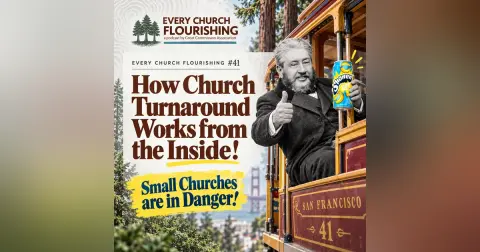
How Church Turnaround Works from the Inside...Small churches are in danger! Soda Review: I Want Grandma's Banana Cream Pie, Not Her Socks.

 Apple Podcasts

 Spotify

 Amazon Music

 YouTube

 Youtube Music

 iHeartRadio

 Podchaser

 JioSaavn

 Castbox

 Gaana
Every Church Flourishing Episodes 41 and 42 with Lisanne Huber and Jerry Watson.
Title: How Church Turnaround Works from the Inside! Small churches are in danger. What can be done? Soda Review: I Want Grandma's Banana Cream Pie, Not Her Socks.
The Shonen Banana soda review: Delicious, but more sugar than three bananas or one slice of banana cream pie.
Roughly 30 percent of Americans claim zero religious affiliation - a vast increase from the 1980s and 1990s. A typical church congregation is roughly half the size it was at the turn of the century. Small churches are vulnerable.
As small as we were, we still believed that God had a plan for us there.
How Santa Cruz Baptist is helping Foothill Baptist.
When your church goes through a renewal process as part of an association, you learn that you have way more brothers and sisters out there than you thought.
EPISODE IDEA: HOW CAN OLDER CHURCHES REACH YOUNGER MEMBERS AND FAMILIES??
Renewal: ordinary last quote of Lisanne at very end.
TITLE: ASKING FOR HELP IS NOT AN ADMISSION OF FAILURE. SILENCE DOESN'T PREVENT CHURCH DECLINE.
Advice: Avoid touching your desk or microphone if at all possible so we don't have many knocks. Try to talk into the microphone.Headphones if possibleFeel free to call a timeout. We might go off script. Feel free to pause and think if you need to, I can delete it.
Chase, Brief Open.
Jerry Watson - Red Oaks
Lisanne Huber - Foothill
America still contains tens of millions of committed Christians and thousands of healthy, growing churches. But the ecosystem around the local church has fundamentally changed. Christianity's share of the population has fallen from 78% to 62% since 2007; nearly three in ten Americans now have no religious affiliation; only one-quarter attend worship weekly; the typical congregation is roughly half the size it was 25 years ago; thousands of Protestant churches close annually; and only about one in five newcomers to the average growing church was previously unchurched. At the same time, attendance, baptisms, volunteering, and congregational health are showing encouraging signs of recovery. The American church is not without hope. But thousands of churches will not become healthy simply by continuing to do tomorrow what they did yesterday. Renewal is not an admission of failure; it is an intentional effort to recover mission, discipleship, evangelism, leadership, and spiritual vitality for a changed mission field.
Pew's massive 2023–24 Religious Landscape Study found that 62% of American adults identify as Christian, compared with 78% in 2007. Protestants declined from 51% to 40% of the population during that period
Lifeway's newest analysis estimated that approximately 4,000 Protestant churches closed in 2024, while roughly 3,800 opened.That is substantially better than 2019, when approximately 4,500 churches closed and only 3,000 opened, but closures still exceed new congregations. The 4,000 closures in 2024 represented approximately 1.4% of all Protestant congregations in the country
SBC membership fell another 3.07% in one year, from 12.72 million to 12.33 million, continuing a two-decade decline. The number of churches also declined by 268 congregations.
0:00 The statistics on church growth in the United States of America are sobering. 80% of churches are plateaued or declining, and small churches are particularly vulnerable. Today, we take another look inside the local church from a member's perspective of how churches that are in decline can turn around. One key to that, according to Pastor Christopher Cole. Is thousands of churches will not become healthy simply by continuing to do tomorrow what they did yesterday.
0:59 Fellowship, and the broader kingdom of God. Join hosts, Pastor Chris Cole and Dr. Chase Thompson from the Great Commission Association, led by Dr. Mike Stewart, as they explore the frontiers of ministry and aim for the goal of making every church flourish. Hello, everybody, and welcome in to episode number 41 of the Every Church Flourishing podcast. We are continuing this week our discussion of church renewal and church revitalization from the pews, from the inside, from church members. And we again have members from Red Oaks Church and Foothill Church. And you might be asking, why are you guys focusing so much on church renewal and church revitalization?
1:45 Isn't church planting the thing? And I'll say, absolutely, church planting is critically important. But over the last 20 years or so, the strategic leaders of the church in America have realized, in addition to church planting, how important church revitalization and renewal really is. America has churches that are biblical and bearing a lot of fruit, but, In the last just 20 years, and I'm not talking about the last few years since COVID, I'm talking about in the 21st century, the share of the population who identifies as Christian has dropped from 78%.
2:26 In roughly 2002, I'm sorry, 2007 to 62%. And we've gone to a place now where about 30% of Americans claim zero religious affiliation. And that number would have been easily in the single digits when I was a younger guy in the 80s and 90s. So things are just rapidly changing in the church landscape in the United States of America. The typical congregation is roughly half the size it was at the turn of the century. And churches that are small are, in particular, very vulnerable.
3:10 They're shrinking, they're struggling. And so church revitalization and church renewal has become, critical strategy for making disciples and maintaining church help in this current era that we're in. So, Pastor Christopher, why don't you introduce our guests personally and tell us where we're going tonight? You know, I'm so excited to welcome these two guests because they are courageous, they are wise, they are loving, they are prayerful, and they are enduring. And we have these amazing guests on our show today, Lee Sanhuber from Foothill Baptist Church in Los Altos, California, and Jerry Watson from Red Oaks Baptist Church in Santa Maria.
4:00 And I just want you guys to know, I just love this brother and this sister in Christ. Over the past few years, our GCA Renew strategy has gotten to come alongside these two churches and work with them through an intentional process of renewal. And our guests today are at different stages. Their churches are at different stages of the renew process. But we're so excited to share with you their experience. We wanted to have an honest, real conversation as we talk about how churches move from a place of stagnation or decline or atrophy to a place of health and flourishing.
4:43 And that doesn't happen accidentally. Thousands of churches will not become healthy simply by continuing to do tomorrow what they did yesterday. And these two churches have made the courageous choice to go through a difficult process of renewal and strategic change. And so we're excited to share with you their stories, their experiences. I'll tell you just a little bit of something about each of our guests today. Lisanne Huber has been a part of Foothill Baptist Church her entire life. There's a church member there that has very clear memory of Lisanne being led to the front of the sanctuary to play the piano for the first time when she was four years old.
5:32 And she still continues to play the piano whenever she's there at Foothill Baptist Church and plays beautifully. So, Lee Sam, we're so glad you're here to share the Foothill story. And Jerry Watson is a longtime coach in the Santa Maria area. He's renowned throughout the community for his coaching ability, for his friendships. There's not anyone in the Santa Maria area that I have even come close to connected to where Jerry doesn't say something like, oh yeah, I know his uncle or I know His brother or her friend or something like that. He knows everybody. He's deeply connected. He's deeply passionate about the Red Oaks Church. And by the way, this guy is literally the best church drummer I think I've ever heard.
6:20 And he will deny it all day long. But I remember the first time I heard him playing, I was like, dude, you are ridiculously talented. And I'm so there, there are a lot of fun. We're going to have a good time here in this conversation. So when we talk about church renewal and church revitalization, one of the things we're kind of implicitly saying is that something's wrong and it needs to be repaired. That's a hard conversation and it almost sounds negative rather than positive. But if you think about it, if you go to the doctor and every time you go to the doctor, all he does or she does is give you good news and kind of buries the things that really need work.
7:02 Or if you're a player on a team and your coach never corrects the negative things, you're probably not going to become a great player. You're probably not going to have great health if your doctor doesn't kind of identify the things that are going on. So in the midst of revitalization, it's this kind of grueling sometimes process where you have to confront things that are negative. But before we get to that, let's open up with some encouragement. So Jerry, I'll go to you first. What are some things about your church that you love and you cherish?
7:45 Well, we have a small congregation, obviously. We're going through this process for many reasons, but we've gone through a lot. We've had a church that's gone in different directions. We've had division in our church, all these things, but we've remained together through all of this, and we've rebuilt the church because of that. Physically, it's been rebuilt. We want to fill the pews, but really, my love for my church is just my congregation. It's the people that we've gone through together. We've prayed together. We continue to pray together. It's just, it's our faith. It's everything that we, it's basically our faith is our foundation. It's a place where at one time we weren't sure where we could meet to worship. And this was, this is our sanctuary. It's there for us.
8:26 Fantastic. Well, Zalysanne, you have been at foothills your whole life. And there has to be some things that have kept you there beyond mere perseverance and faithfulness. So what are some things you love about your congregation? Well, Foothill has been in the Los Altos community since the 50s. So Foothill's been around for a really long time. We're going on over 70 years right now. And as we discussed, yes, I've been at Foothill since I was literally in the nursery. So in some ways, I don't know anything any different than being at Foothill.
9:08 But like Jerry, we are now a small church, and we have had a history of very faithful members that have worshiped and cared for one another over the years, and they really are my church family. So that's what keeps me there. And that's been, I think, the experience of so many people that have gone into both your churches. They're loving congregations. You love each other. You care. For one another deeply. And your churches share something else in common. You guys have a desire to not only return to a place of health, but to a place of flourishing, a place where you're impacting your community.
9:55 And both of your churches started with that story, with the desire to reach the communities that God had placed them in. Now, somewhere along in that journey, though, something began to maybe not be so healthy. Things began to change. Dynamics began to shift. And from your perspective as church members, at what point did you personally begin to realize, not anybody else, but you personally just came to, it was a moment of revelation or realization or something that you slowly came to realize something about our church's future has to change or we're not going to make it.
10:43 So, Lisanne, did that come to you in a moment of epiphany? Did it come to you as something slowly that you began to recognize over a season? How did that come about? No, this was not just one moment. This has been realization probably for many, many years. As you know, and what the listeners might not know, though, is that Foothill has been in this state of decline. You know, we had over 400 members in the 60s. And then in the 80s, it dwindled down to, I think, 82. And then in the 2000s, it dwindled down to 2030. And with my history in the church, you know, I've been a part of the church when it was what seemed alive and active and growing and thriving.
11:33 And I've now also seen it decline to, you know, the numbers that we've had over the last couple of years. But within the last five to 10 years, we lost our pastor from cancer, and then we had COVID. So Pastor Jim passed away during COVID, and then the church closed for COVID, and we... Lost a lot of members during that time because we weren't having services. And we also lost a lot of active members of our congregation during that time from death, my father included. And when you're already running numbers of like 10 to 15 on a Sunday, and you lose your pastor, and then three deacons, and then you have two members that move away just because of aging, that's basically like half of your congregation.
12:29 This wasn't just something that happened overnight. This was a series of events that happened in the life of our church that has kind of brought us to where we are now. Foothill Baptist Church, by the way, for our listeners, they have such a great story, and they were part of the Southern Baptist Million More in 54 church planning strategy. In 1954, Southern Baptists decided they were going to enroll 1 million people into Sunday school in a single year, and they didn't quite get there, but you know what? They enrolled hundreds of thousands, and they planted dozens and dozens of churches, and Foothill Baptist Church was one of those churches, and in 10 years' time, they were running right at 500 people.
13:18 And then began a process of decline and a series of challenges. And then the more recent things that Lisanne shared. Jerry, how about you guys over at Red Oaks? At what point did you begin to realize, hey, something about our church's future has to change or we're just not going to make it? Well, like Lisanne, we have a church that's, I want to say, it's built in the early 60s. And when it was built, I have a member in the church who actually attended that church. Her father was the original pastor of this church. It was full. And over time, you know, we've had the need for pastors before. That came up. We had a pastor that was relocating for family reasons.
14:01 But not only that, when you walk into a church with such a big congregation that you don't notice if somebody's there or not, it's different when you walk into a church our size and you know us immediately. It's something difficult to deal with in some sorts. And we've lost them through, yeah, moving, through death, through multiple reasons, as Lisanne said. Same for us. It's been real hard to deal with that. I think when we needed a pastor this last time and he had moved, I really knew then, if I didn't know before, that we needed to do something. We needed to make a change. We had tried many things in our church to build a church, and we simply needed another direction, and we needed help. Going through that process of recognizing you need help and seeing the church go from a place of thriving to a place of real struggle is kind of hard.
14:51 And I'm wondering, Lisanne, you first, when your church. Kind of first Got the understanding that they were going to go through the GCA renew process, you first learned you were going to go through this whole revitalization thing. And maybe you started to realize it's not going to be a quick fix. It's going to take some time. What was your immediate reaction? Positive, negative, kind of a mix? How did that get you? I would definitely say it was a wide range of emotions, not just one. I think there was, on one hand, a little bit of hope that maybe somebody was finally able to offer us some help.
15:34 I would say that up until that point, we were just merely surviving. We were basically just... Because we had limited people left in the church that could do such things like run the sound system for a service. And so we were just doing the bare minimum, if you would say, to keep the doors open. And so it was on some way there was, I had some hope like, okay, there's actually someone, something out there that is going to be able to help us to get us in a better place than what we are now. But there was definitely fear.
16:14 Definitely fear and uncertainty. What's this going to look like having to obviously release some control over what happens and who makes the decisions at the church? That part was scary. And just the overall not knowing. Yeah. Kind of a follow-up on something you said in your last question really struck me. You said your pastor died during COVID and you lost some of the deacons and you guys completely shut down. The doors closed. So how long did that last? It's almost like hearing a story of a person whose heart stopped for 15 minutes or so and somehow resuscitated and they're okay.
16:54 How long did that closure last and what happened to reverse it? How did you guys essentially come back from the dead? Well, that was definitely not an easy process. Part of being closed was because we felt that obviously the state mandated, right, for us to not have contact. And that coupled with the fact that we just didn't have the means. We didn't have anybody to do a sermon for us. We didn't have anybody or anything to lead music. So, Chris might be able to say exactly how long that period was that we were closed, but it was substantial in which not only did we lose a lot of people during that time that we were closed, but we lost the people that just never came back after we reopened.
17:46 Yeah, I'm not sure that I know the exact number of months. I believe it was just over a year of hard closure, which is a long time. It was a long time for sure. Yeah, well, look, I think it's fantastic. And I think it's a great testimony. There's pastors out there that'll be listening or they'll know churches that are going through this kind of everything appears lost. You know, if you're in the middle of COVID, some of your deacons die, your pastor dies, the doors literally close and the church isn't meeting. That just seems like it's time to throw in the towel and give up. And I think you guys are giving us this testimony that even that doesn't necessarily mean the end.
18:31 And I recognize there's sometimes that it's helpful and healthy for a church to close in some ways and be reborn. But this is really an encouraging story to me. I'm glad to hear that part of it. Jerry, for you, what was it like when you first heard your church was going to be going through this renewal process? How did you react to that? Honestly, at first, I didn't know what the renewal process was. It had been mentioned several times, and it was really just through being educated From Chris Smith, our mission strategist, and Chris Cole that we were starting to learn about this. We didn't know there was a direction we could go. We didn't know, we weren't sure if there was a direction, what direction that would be.
19:14 There was times where I thought that our church would close simply because of what we were going through. Not necessarily COVID. That was, I thought that might have been the end. I think I'm listening to what Lisanne went through and we definitely had to deal with all that. It was through discussion. And at that point, our members are older. We had to have a lot of discussion about this. About as you, there's things you give up. There's control you give up. There's things you want to discuss. But deep down inside, I think we all knew when we looked at each other that we needed to do this. This is what God wanted us to do. There was a lot of prayer in this. I mean, it continued prayer to this moment to make this happily. I was uncertain at times. I was skeptical.
19:55 I knew that we needed something. Getting to know Chris Cole as well as I did in Chris Smith, those were our blessings. Those were our questions were asked all the time. We would look at each other as a congregation, and we'd sit around like we had another question. And every time the question, it was answered. And we knew at some point this was a direction we needed to be going in. And we didn't need to plant a church. Our church was there. We needed this process. We needed to renew our church. We needed to fill these pews. We needed worshipers. Fantastic. One of the things that many of our listeners, especially if they're not from within GCA, but even a large number of our listeners within GCA sometimes have a hard time realizing is exactly how big our association is geographically and how diverse it is socioeconomically and in areas like education.
20:54 So just for our listeners to get a quick insight snapshot, Red Oaks Church is 230 miles from Foothill Baptist Church in Los Altos, 230 miles in distance, which is a long way, right? It's over four hours of just pretty consistent driving. Red Oaks is on the edge of Santa Maria in a largely agrarian section of a highly Hispanic dominant culture city. Historically, Santa Maria was the large community adjacent to the north end of Vandenberg Space Force Base.
21:37 And the Tanglewood community, where Red Oaks facility is currently located, was a bedroom community while Vandenberg was thriving and then has undergone tremendous Socioeconomic shifting and is a 98% Hispanic community where their facility is. You contrast that with Los Altos, which is one of the most expensive communities in the very heartbeat of Silicon Valley. Foothill Baptist Church is about 15 minutes or so from Stanford, 10 minutes or less to Google and NVIDIA, less than 10 minutes to Apple's headquarters.
22:20 So it is a dominantly high tech, high education, bedroom community, very nimby, very much don't build it in my backyard, but I want my carbon fiber bicycle and my Tesla in the driveway. And so these are radically different communities, and that means that every church that enters into our Renew process is on a very different Renew journey. When we built Renew, we didn't want it to be a one-size-fits-all solution. We wanted it to have enough consistency and set of tools, but we recognized that we had to take each church on their own unique Renew journey.
23:03 So, Lisanne, catch us up just a little bit. What has the Renew journey been like for you guys? Because you guys were pretty early in our Renew strategy. So what were some of the steps that you took and where are you at? Right now? Sure. What I do want to mention really quick, as I was a little bit remiss in not mentioning this in my last question, but one of the first steps that did help us to get out of the stage we were in when we closed for COVID is Pastor CJ Wan had reached out to us and said, hey, you know, we'd like to help you with providing pulpit supply. So that is how we kind of started easing back into having services again.
23:50 And I'm going to try not to look like I'm jumping all over the place to answer your question. Praise God, we do have a pastor right now, Pastor Jeff Wilson-Hum, who we called last year. And so he has been in place, And it's going really well, but it was not an easy process to get to that point. So after we started having services again, GCA, Mike Stewart, and Pastor Chris Cole had approached us. And like Jerry said, we were in that position where they basically said, these are your options to either close the doors of Foothill or to enter into this renew process. and We were simply just not ready to let the doors close on Foothill.
24:47 We still had a core group of people that have been there for decades. As small as we were, we still believed that God had a plan for us there. And there was a little bit of this, okay, we'll try this one last thing, you know, and yes, we do realize that still could happen if this doesn't work, but we still wanted to try. And that's when we entered into that process. And we were told that, you know, they were, the GCA was going to look for a foster church for us. And we entered into the relationship with Santa Cruz Baptist Church. And that has been just, I think I would say life-changing, not just for me personally.
25:35 Sorry, and I knew that was gonna happen today, but also life-changing for the church. We entered that relationship with Santa Cruz who decided to take us on. And for a church that it's a 45-minute drive over the hill to come to us, in our first couple Sundays that they started coming to Foothill, I had members of their church that would come up to me and say, are you the one whose father just passed away, Vern? And I said, yes. And they would say, I've been praying for you. And to have a complete stranger come up to you and tell you that repeatedly, it just, it meant so much to me.
26:20 And so what we gained from Santa Cruz, not just, you know, yes, they obviously helped us financially in this time. They helped by providing people to lead music, to do sermons for us. But we gained another church family in that process. And I'm so deeply grateful to Pastor Drew and the Bradberries and everybody else from their church that came Sunday after Sunday and just offered their love and their support and just said, hey, we're praying for you. And that has been, I think, a really important part of this renew process is having Santa Cruz that came together.
27:02 You know, alongside us and supported us in this process. We love to connect in the Renew process where it's possible. We love to connect churches to other churches that can help walk the church renewal journey for them. And we call it fostering because they're not doing a takeover. They're not trying to manage your church, but they are coming alongside as a sister congregation to help your church reach a place of thriving. And it creates that interim stopgap of being able to help provide pulpit supply, musicians, and strategic input on your board, and all of these other things.
27:44 We create these renewed boards that have foster churches on them as well to help provide oversight and strategy. And those boards help provide the pastor search. In the case of Foothill, the NAMM-approved replanter pastor that we did call, Pastor Jeff, so excited he's there. It took us over three years to get there. That was a really challenging process and included some disappointments in that journey. But God has been faithful, and the church has been faithful, and we're seeing God do some amazing things there so far. Now, Jerry, just like at Foothill, you guys are very different community, but you guys also have a foster church.
28:30 We did a discovery process with you early on, and then we got you connected to a foster church. Tell us what that process has been like for you from the Pew's perspective. Well, through GCA, we didn't have a pastor. So we first reached out to get help in that direction. So we were provided and had, interesting enough, when you have multiple pastors, you have different sermons, you have different deliveries. You know, when you go through that, it's not one person that you might have been used to your whole life. And through that, we were Glenn Myers, Pastor Glenn Myers, who retired from Shoreline and Morro Bay had pastored multiple times wonderful man, a great guy great sermons He was one guy that kind of went back to his church and said, hey, we got this church down there. And I think they were aware of us that they didn't need our help.
29:24 And through public supply, through pastors, it's a multiple members of that church have come down and done sermons with us. That's been our blessing. And, you know, I think when you think you're alone in this thing, you're not. What you do learn and what I've learned through all this is just how many brothers and sisters we do have out there. And I wouldn't have said before I would have thought that. But going through this, we have, and we've been blessed to have other churches reach out to us. And you wouldn't know that they know your plight or what you're going through, but they do know and they do understand. So having this church adopt us and be along with us, and it's beyond anything our expectations or what we knew, and it's helped us out so much, and it's eased our pain at times.
30:11 We're going through this process now, and the last four or five months, we actually we're now, we're interviewing pastors. So we've gone to, to the point where we're, our hope is extremely high. We, at times when we thought we were sure what direction we were going, and as I said earlier, maybe even our doors closed, we're at the point where we have people that are, are reaching out to us from out of state. And, and, and Chris is, well, where this is of what we've been going through and, and doing all this. But I know when you, when you go through this, you just realize there are people there to help you. And, and you go through a lot of stuff to go through this process. You have to review a lot of stuff you may not always look at in your church, things that have to be revised, things that have to be adopted.
30:54 I had not at any point going through this process that I feel that we weren't loved through this process, that we weren't listened to, that our needs weren't met, weren't paid attention to. They all were. It's a beautiful thing going through this. I think when we were down in our lowest point, we got lifted up to our highest point. I want to share with anybody that's going to listen to this, that if you're in need of this, this is what you need to do. This is the direction you need to go. Talk to your congregation and reach out to them. Don't be afraid to take this step. Wow. And thank you for that encouragement because we loved it. I just want to give a big shout out to two of the foster churches that we've been talking about, because Lisanne mentioned this, Santa Cruz Baptist Church, which is in Aptos, California, they are fostering a church that is about 38 miles away, an hour's drive, because you have to go over the mountain.
31:47 And then Calvary Shoreline, Shoreline Calvary, I should say, in Morro Bay, is it's over 50 miles to get to Red Oaks. And they send people every Sunday. Yes. They send their own people. They lose that capacity at their own church in order to give that capacity to someone else. And I think it's one of the most beautiful expressions of the active love of the body of Christ when churches come alongside churches and say, we don't have an agenda for your future except your health, and we love you, and we're going to pray for you, and we're going to sacrifice, we're going to give, we're going to go, we're going to come alongside you, we'll weep with you, and we'll rejoice with you, and we will fight for your health and your survival.
32:40 And so big, big shout out to Pastor Drew Cunningham, Pastor Ed Compion, and Pastor Glenn Myers at Shoreline Calvary. We are so grateful for them. Yeah, and to explicitly connect that to the podcast, you guys should know that we had Pastor Jeff of Foothill on episode 29 and 30, along with Pastor Michael Denton. And the very next two pair of episodes, we had Pastor Ed Compion from Morro Bay Calvary Chapel. I just think it's fantastic. And if you have not heard those episodes, probably worth going back and listening to because they were solid and great insights from the other side of the aisle, from the pastoral side of the aisle and from the foster pastoral side of the aisle, looking into the whole thing of church renewal and revitalization.
33:31 So I think it's a good time now to take a break. We'll hit the rest of the interview next week. Let's have a soda review. Well, Pastor Christopher, I've got the shakes a little bit, a little bit of, PTSD from last week's soda, which, I'm not going to lie, is a little bit of a traumatic experience for me. But I'm a little more excited, I think, about today's soda, but I'm going to let you try it first because I'm not sure I can. Well, sir, if you and I are honest, you might recall that last week you actually failed to drink the soda and pretended to drink the soda while making me consume my grandmother's dirty socks.
34:25 I would say it's faced with a choice of do I drink the equivalent of grandma's dirty socks or not. I made the right choice and I stand by it. You stand by your decision to betray me and to let me suffer. I see how this particular thing works. Well, Pastor Chase, you are often saying how envious you are that I did not get to drive the General Lee and jump it over rivers and eat watermelon and fried chicken and all the deliciousness that is in Alabama, part of your boyhood experiences there.
35:06 But what would happen if you were a person who grew up as a child in Japan, but years later came to California and you had a deep nostalgia for Meiji Ole Banana Milk? That's a question I ask myself all the time. What would it be like if instead of growing up in Alabama, I grew up in Japan and moved to California? And I got to say, if that were the case, the very first thing I would do is find or invent a banana flavored beverage. What? Prior to what? That's exactly what Ryan Hashimoto did. That is incredible. And by the way, I grew up watching anime and stuff like that.
35:51 Ryota, Ryan Hashimoto, that sounds like the perfect name of somebody who flew around, you know, giant space robots that fought giant space monsters attacking the world. I love that. Absolutely. Ryota Hashimoto. Yeah. Surely a ninja or a shogun or something. So today's soda is from the shonen, which means in Japanese, I understand. I don't read or speak Japanese, but I understand is means boy or youth. And this is their banana cream soda. Now, our last fruit soda, based on the king of fruits, did not go well. Oh, don't talk about it.
36:33 It did not go well. I've heard this particular soda tastes like banana taffy. That sounds fantastic. I'm excited about this one, Pastor Jake. I am. Are you excited about it too? I'm trying. Look, we talked a long time about Lester's Ranch soda and how gross it was. But for all that fun we had with that soda, the durian soda was traumatic. It was horrifying. I was epiplectic after drinking it. It caused a kind of reversion of my DNA to something more primitive and bad. It's really...
37:21 So I hope this washes that taste out of our mouth and out of my memory because that was disgusting. Well, what do you think banana milk was that I mean, what what inspired Ryan here? I don't I don't even know what banana milk is, but I know that that there was a product that that Ryan Hashimoto enjoyed called Meiji Olay banana. I apologize to all our Japanese speakers and listeners. And he apparently, as a little boy, loved this drink, which was supposed to have like a banana flavor. And that's the inspiration for this cream soda.
38:04 Okay. It says that it's supposed to be like a banana taffy flavor. When I was a kid, man, I loved Laffy Taffy banana flavor, which tastes nothing like a banana. Right? It's funny, banana flavor and bananas are two wildly different things in terms of flavor, but I love banana flavor. I grew up on quick, Nestle quick, strawberry milk, and I know they make banana milk and I've had it a little bit. It's really good. Oh, so you know banana milk. Yeah, it's good. It's really tasty. I've never had banana milk. I love quick. I loved quick when I was a kid. So I am sort of excited. it. I like bananas and one of my favorite desserts.
38:50 And if any of our listeners out there are accomplished chefs, I like banana cream pie. Oh, I do too. Banana cream pie. It's so good, right? Yes. So good. Phenomenal. So if this has any of that banana cream pie flavor, I'm going to be very excited about this. Me too. Me too. Look, if this tastes better than And methamphetamines and rotten bodies in grandma's disgusting socks, I'll be fine with that. I have a low, low bar right now. Right. Well, as some of our listeners may know, we tend to record these soda reviews in clumps. And I just want to say that we're recording this one not too long after we did the durian soda, and my office still has a distinct odor to it.
39:38 It's going to take some airing out to address from that service. At least you have air conditioning in your office. I'm in my home office, and you don't need air conditioning in Salinas 99 out of 100 days. But the last two days are that one in 100 day. It's hot, and durian molecules are clinging to me. And I'm very sad about that. Your current temperature is a mere 75 degrees, Pastor Chase. In my office, it's probably more like 88. You can probably tell looking at me, I'm sticky, sweaty. My hair, which is normally pristine and perfectly placed, is all wacky.
40:21 Well, we've had days of 95 plus temperatures here in Morgan Hill. Yeah, it was 95 yesterday in Salinas. Yeah, you guys are like at a relatively chilly 77. It is 90 degrees here in Morgan Hill. So I'm glad we do have AC, but I say we get right to this Shonen cream soda. Now, are you going to actually drink this one? Oh, you bet I am. I'm no coward. Hmm. I don't smell the banana. It's clear. It's a clear soda. You smell banana? Maybe all my smell buds are blasted from the durian. I'm getting banana. I'm getting kind of a banana cream. Yeah. I just have brain damage then.
41:02 Yeah. It's a very pleasant It's a very full beverage They did not leave any room on the top I mean, it's It is mostly clear, a little cloudy. Yeah, a little bit of a substance. This smells like banana pudding. Oh, I smell it better now that I started up. Yeah, it does smell a little like banana pudding. It smells like banana pudding. I love banana pudding and banana cream pie, as you say. Oh, my. Yeah, buddy. That is yummy. Wow. Yeah. Only 170 calories per can. which explains some of that good taste.
41:42 Yes, it does. And it is high fructose corn syrup. So we know that's good for you. It's good for your life. Oh, yeah. Really healthy. The high quality stuff here, folks. But quick early review. I want to take a few more drinks. This is a spot on soda for banana pudding or a banana cream pie. If you if you said i want grandma's not her socks but her cream pie bananas banana cream pie i want to put that into a soda this very well could be it that's what i'm saying I want grandma's banana cream pie not her socks is a pretty good title for this episode.
42:25 Absolutely i think that is the title for this episode. You know, it does. The more I drink it, it makes me feel youthful. Yeah, I get that. You know what the best thing about this drink is? It has no weird aftertaste. It does not. It's clean. It's clean. Yeah. Unlike your grandma's dirty socks. Yes. Yeah. Yeah. Oh, man. I don't know much about the Shonen Soda Company. We haven't tried any of their other products. We have not. Pastor Chase, I'm curious, though, now. Bring them on. Yeah.
43:06 Some of our listeners out there, if you want to send us a Shonen Soda flavor, Even though it is a California-based company, I'm not even really sure how we got this particular one. I know they have a orange cream and a pineapple cream soda as well, which is very interesting to me. I think both of those would be fascinating for us to try on a future. And hey, total sugar, 43 grams. So it's a lot of grams of sugar. Yeah, it is not for those of you who would like a diet flavor. No.
43:48 But if you want something, if you're walking down the street and you are nostalgic for your grandma's banana cream pie or your auntie's banana pudding, this is a spot on substitute for it. It's hard to explain how much this tastes like that. I agree. It's a phenomenal beverage, and it has the sugar of three bananas. The sugar of three bananas. That would be a good slogan, huh? Did they fit three bananas in here? I don't know. Here's some interesting news, Pastor Christopher. Yes, please tell me something.
44:31 A typical slice of banana cream pie contains between 12 and 30 grams of sugar. Nice. I love it. Love it. So this is almost pure sugar here. This is delicious. And there are reasons that it's delicious. Yep. And you know what? We don't review based on nutritive impact. We do not. We review based on smell and taste. Smell and taste. And color. Oh, color, yes. Presentation. And in can, presentation, all kinds of other factors go into our highly complex reviews of sodas. We're grateful for those listeners that have sent in sodas for us to try.
45:17 And we're thankful for you guys sending us wonderfully good products for us to try. Yes, we are. But those of you that are looking for the next generation down of durian sodas, please, please do not send those to our studios. We're good. We're good there. We do not need that experience again. Exactly. Yeah. So I think I'm going to give this banana cream pie sugary delicious soda four and three quarter Spurgeons. It's got a great can, got a good smell. It's got a great taste. It is not good for you unless you're hypoglycemic, but it sure is tasty.
46:00 I, too, really enjoy sort of the Japanese-style artwork, the presentation, the tall can, and the flavoring. And, yeah, absolutely. Not that we know anything about that. I just made it up on the spot. Right. And there's no artificial colors, by the way, as well. Well, that's something. We should point that out. They didn't make it yellow. They could have done that, but they did not. No, DNC yellow number five. Guess what, Pastor Chase? I'm going to go right up there with you. I'm going to go with a 4.5. A 4.5. Okay. Just because if I was lacking dessert at the end of the day, I've had a delicious meal at the end of the day, and I needed dessert, but I didn't have any cream pie around.
46:48 And I saw this sitting in my fridge. I think I'd open it up. I'd enjoy that. Well, go bananas. Absolutely. The end of an era. Well, I hope you enjoyed that Soda review. As we close out, I want to point you to our website, gcasbc.org. And if you want to see what's going on in the Great Commission Association, you can go to gcasbc.org slash newsletter to read our current newsletter. And if you're interested in joining and partnering with us in becoming a GCA church, you can go to gcasbc.org slash membership.
47:30 Thanks for listening. Back for more of our great interview next week. Good day to you and Godspeed.