How Can Churches Recognize and Address Weaknesses? Tim Challies' Leadership Advice. +Review of the Worst Soda In the History of the World.

 Apple Podcasts

 Spotify

 Amazon Music

 YouTube

 Youtube Music

 iHeartRadio

 Podchaser

 JioSaavn

 Castbox

 Gaana
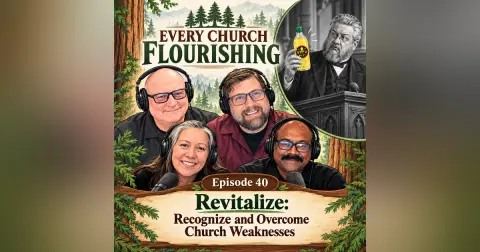
Every Church Flourishing Episode 40 with Tammi Smorynski and Samuel Kommu
Title: How Can Churches Recognize Their Weaknesses and Do Something About Them? Tim Challies ' leadership advice. How does the church go forward from a human perspective?
The worst soda ever conceived. Absolutely disgusting. Made from a fruit banned from multiple airlines, and a fruit that shut down an entire government building just because of the smell.
"Durian fruit, when it is incredibly ripe, has a cross smell between methamphetamines, dirty socks, and rotting bodies."
Tim Challies for anyone in a leadership position:
"The apple does not fall far from the tree" applies not only to fathers and their children, but also to founders and their organizations. This is the first lesson: just as a founder's strengths will be embedded in the organization he creates, so will his weaknesses. Just as his strengths may be integral in causing that organization to rise, his weaknesses may be integral in causing it to fall. Thus, a wise leader tries to gain an awareness of his weaknesses and in some way to oppose or mitigate them, perhaps through policy, through limiting his position, or by hiring people whose strengths counter his weaknesses."
Why do churches sometimes hate the process of identifying weaknesses, and how that process can actually be helpful and encouraging.
In the Bible, Jesus Assessed Seven Churches, so we should not run from that process.
What does it feel like for members of a church to go through a significant decline?
When we focus away from the consumer mentality of church, we will recognize that it is not just the pastor's job to build people up, but the privilege of every church member.
Greatest secular equivalent to who a pastor is might just be a football coach.
From a human perspective, the church goes forward by the Holy Spirit-empowered ministry of extraordinary church members who are equipped for ministry by the pastors and leaders of the church.
What do pastors and denominational leaders not understand about church health from the inside?
Samuel Kommu from Calvary Baptist Church in Santa Clara
Tammi Smorynski from Oak Grove Baptist Church in San Jose
0:00 Today, we're continuing our conversation with Tammy and Samuel about how churches turn around, how they identify their weaknesses, how they go from slumping and dying to renewal. And I was really struck by one of the things that Samuel said in the middle of the conversation. And I think if we start focusing away from being consumers to being a church, renewal would follow, revival would follow.
0:44 Leaders, and pastors find health, encouragement, practical advice, soul care, and resources that work together to build up your local fellowship and the broader kingdom of God. Join hosts Pastor Chris Cole and Dr. Chase Thompson from the Great Commission Association, led by Dr. Mike Stewart, as they explore the frontiers of ministry and aim for the goal of making every church flourish. Hello, everybody, and welcome in to episode number 40 of the Every Church Flourishing podcast. My co-host, Pastor Christopher Cole, and I are discussing church renewal, church revitalization with two church members that are going through the process themselves, Samuel and Tammy.
1:27 We're going to pick up that interview right in the middle. Let's go. Pastor Chase, what would you like to know next? So I'm kind of fascinated by the whole process of recognizing your weaknesses and doing something about it. People aren't good at that. Churches aren't good at that. I don't know that any of us likes to be made aware of our weaknesses. A guy I really like is Tim Challies. And Mark Halleck, who is somebody that Chris Cole really likes, posted a quote from Tim a couple of days ago, Which he said this, and it applies to pastors and leaders. He says, the apple does not fall far from the tree applies not only to fathers and their children, but also to founders in their organizations.
2:15 And this is the first lesson. Just as a founder's strengths will be embedded in an organization he creates, so will his weaknesses. Just as his strengths may be integral in causing that congregation to rise, his weaknesses may be integral in causing it to fall. Thus, a wise leader tries to gain an awareness of his weaknesses and in some way oppose them or mitigate them, perhaps through policy, through limiting his position, or by hiring people whose strengths counter his weaknesses. And I think a wise church would do that kind of thing as well.
2:55 And certainly a wise pastor, whether or not he's founded the church or not, should do that. And a big part of that is knowing your weaknesses. And I don't think I wanted to know my weaknesses in my 30s. In my 40s, I started to realize, hey, there probably is some things you're good at, and there's some things that you stink at, and it's hindering the church, and we need to fix this. And I guess my way of fixing that is to try to recruit people who have strengths in areas where I have weakness and just let them run in those areas of strength. But the part that's fascinating for me, especially for you guys, is the identification of weaknesses. So let's talk a little bit about that.
3:42 Tammy, first to you, was there anything you heard during the renew process, especially the early stages that you didn't want to hear, but maybe later realized that probably is true. Talk about that question and maybe the difficulty of examining a church's weaknesses. So having been a part of corporate America for 32 years, I mean, we get annual reviews where we're constantly being, you know, banged over the head for our weaknesses and then praised for our strengths, right? So I'm used to that process. So going through the discovery phase and evaluating how the church has been doing to me was like part, you know, part for the course, right? It's not a big deal. Having said that it was hard to see how it was impacting the other people, especially people who had been there for a long time because they felt like the, there was a lot of negative feedback that came back from the congregation, from the people that we were asking to fill out the surveys that were kind of showing that there was, that people weren't happy.
4:38 And even though they were coming and loyal, or. That they weren't happy. And, and, you know, I think there was, I definitely sensed that there were people that were not happy about that. And that, and they felt also like, Hey, we're still here. The people that causes problem aren't here. Right. Why, you know, why is it being placed at our feet? And I think we've had to be, I think pastor Chris and I have had to work hard, right. To just kind of talk about, look, like there's, we're, we're not, we're not focusing on placing blame. What we're trying to say is this is an issue. We need to fix it. Now let's focus on moving forward. But if you don't identify the issue, then you don't fix it, then it's going to keep being an issue. So I'm not mad at anybody for where we are.
5:20 I'm not mad at the mistakes that were made. What I'd like to do is now that we know, if we don't do anything about it, then I'm going to get mad. If a year from now, we're still in the same problems, I'm going to be upset. But now that we know, let's do something about it. So to me, that was kind of the process that we had to, what I liked about the discovery was that it forced that evaluation. It would not have happened otherwise. And it forced people to, they, I don't think everybody has fully bought into that. We need to make changes. That's the funny part, right? But they know, they know, but they're not bought in yet. Right. So we're still going through that process because the church knows, like we, because we shared the data with the church, right? So the church knows, and it's small enough that everybody talks to each other.
6:01 So everybody knows like, we need to make changes. So coaches, teachers, business leaders, like you're talking about, personal trainers, all of these kind of people sort of delight in this process of identifying a weakness and strengthening it. But it seems like churches just hate it. It's almost like, hey, give me five bad things about your kids. We take it so personally, but there's actually some great benefit to finding a weakness and turning it into a strength. So Tammy, what would you say to churches who are avoiding the process of renewal because of the fear of pain or hurt feelings?
6:41 I mean, churches are made up of people and if everybody's resisting, then that's a problem right there, right? So, you know, if you're a church that firmly believes that you've done everything you can, but for whatever reason, things just aren't working, then going through discovery process is going to give you information. It's not meant to point the finger. It's meant to give you information so you can have, you know, an understanding of things that you can do to improve. And I think that every year, how many times do you do something and then you get a survey? It's so annoying, right? We're getting surveyed to death and they're like, what was good? What was bad, right? Everybody does it, but you're right. Churches don't want to do it. It's like, look, even Jesus came and he graded seven churches.
7:23 So like, it's not like you shouldn't be graded. And the key is that, are you willing to, there's a scripture that talks about like a wise person will take, I don't remember the exact words, but it's like a fool won't listen to discipline, but a wise person will take it as something good, right? So we need to lean into, hey, we want to be around. We want to be salt in light. We want to help people. And if we're not growing, then we need to lean into the fact that we need to learn and grow from that. Unfortunately, there's a lot of people that come to the church and they all say things like, well, I'm doing what God wants us to do. I'm listening to the spirit and God must weep. I'm sorry.
8:06 He must weep because he didn't send a son to die for us to have little churches that are dying. Like that's not what he did or. What he wants. No, I agree. I totally agree. And I think you're referring to Proverbs 12, 15. The way of a fool is right in his own eyes, but a wise man listens to advice and a wise church listens to advice. So Samuel, over to you. Talk about the pain process for you guys. How painful was it? Was there things you heard during the process that kind of hurt? But later on, you're like, yeah, we needed to hear that. This was a good thing. And what would you say to churches who are avoiding the hard questions and the process of renewal because of their fear of pain or hurt feelings?
8:49 Our situation is a little different, right? So if Pastor Chris, let's say, came to us in 2016 and said, hey, I'm going to something is wrong with your pastor search, we would have had a really strong pushback. But we've gone down that route like four times. So to be honest, like, I mean, even before any survey came out, we knew. And then Pastor Chris was saying, like, I mean, he asked us once during in that whatever corridor, but he actually asked us in different situations three, four times the same question. Why do you keep choosing the same pastors, like different backgrounds, different theological stances? Like, why do you do this, right?
9:33 Why do you do this to yourself? And we have no answer, right? The problem is, like, for us, I think this was one of those areas that was really painful, I guess, to look at, right? Because you have to honestly evaluate yourself in terms of why did we land here? I'm going to speak for myself, okay, because I think the church as a whole has been diligent. But the fact is, I know on a personal front, We have kind of ignored some of the red flags and things like that because we are basically thinking either we're kind of thinking in terms of a mob.
10:16 Hey, everybody else seems to be saying yes. Maybe we should say yes and not worry about this one aspect that is like really bugging. Are not listening to each other enough when somebody is like raising real concerns, right? Because again, we want to kind of like go with this, hey, let's all unanimously agree to this, right? Some of those things are like, see, ours is an older church and as an older church in the sense, like most of the congregation is retired, most of the congregation, right? So honestly, we're always looking for younger people and especially if they have kids, we love the fact that, oh, we can start this ministry again, kind of thing, right?
10:58 And all of the last four pastors, young, young with kids, but we don't have any kids ministry or any of that sort today, right? And we ignored everything else because we got this. And One of the things, again, like last week when we were studying experiencing God, about God's will, right? Really understanding and knowing what God's will is. Tammy, you were saying like you can just go off into 10 different paths and just feel very productive. I'm doing this, this, this, this at church and completely miss out on what God actually wants you to do. And I think we have unfortunately been down that path and it's hard to kind of re-examine ourselves. It was hard last Sunday to just rethink, hey, is this ministry that I love so much? Is it God's will?
11:49 Right so so those kind of questions were difficult and actually you you go to a doctor and sometimes they give you bad news but that helps you to become better right and try to fix it and so on i think we shouldn't be afraid to get ourselves diagnosed in fact maybe romans 12 is about that Constantly renewing, constantly checking, constantly re-examining, and I think not just individually, but as corporately, as a church, I think we should continue doing that and keep that fear aside and see what we can fix.
12:30 By the way, because I've been part of a really, really small Bible study and it never grew, right? And I was always like, Lord, why isn't this Bible study growing? And then he kind of made me realize, because he wanted it to be small, to be a place of refreshment and fellowship with this small group of people that we could support each other in a deeper way than if we were a big group, right? And so I remember thinking, well, maybe churches are just supposed to be small, right? And one of the things that I've realized is that if a church is not growing and it's dying, right? And going through this process has made me realize that. Churches are different than like a little Bible study. You can have a small Bible study that goes 20 years, it's fine.
13:12 But for a church to be 20 people over 20 years, I mean, people are going to die, move, it will die. You have to be in this constant state of, you know, renewal and bringing in younger people. And I just, I mean, it was happening at the big churches I was at, but I never thought about it for this church until we went through this process. So even though maybe it didn't work out, Samuel, I mean, I do think that the focus on the younger generation to me is definitely key. I am loving this conversation that we are getting to have with you guys. In part, a lot of our listeners are pastors and church leaders. And I want to just be very honest here and say that I am deeply familiar with with what it feels like to a pastor to walk into a church and see the same six people there again.
14:06 And I know what it feels like to watch a congregation shrink rather than thrive or to grow. And I know the feelings that are associated from the pastor's side when we watch a church decline. But the reality is most people in the Christian world are not pastors, and they may not hold various really visible leadership positions in the church. So I want us to talk briefly about what does it feel like? You're a member of a church. What does it feel like to experience a season of decline or to realize that you're in decline?
14:50 And what do you think pastors, denominational leaders, guys like me that you think, man, you just don't know what it feels like. What do we fail to understand about the experience of the church members there in the pews? Samuel, what do you think? Pastor Chris said you wanted an honest answer. I want an honest answer. Yeah, give it to us. Here we go. We like honest conversations here on Every Church Flourishing. We give honest soda reviews, and we have honest conversations. That's right. Your slogan. To me, I think it's very broad, but I think there are two types of, two categories of folks, right?
15:37 And when I say folks, it's all of the church, including the pastor. One basically says, like, you know, I'm going down with this ship, okay, wherever it goes, right? And the other is basically like, I'm out of here, right? And the folks that I find, like, you know, again, this is all very limited experience, right? The folks that I see are ready to go down with the ship are the ones who are ready to do anything. They are ready to ask for help. They're ready to... Try out different things, give up things and so on, right? And try and see how and what could help and pray versus, this is the unfortunate truth, versus folks who actually just leave because they're not really invested into the church.
16:28 Maybe they've not developed that level of relationships and so on as members. But from my perspective, I think the most disheartening thing is the pastors who just look at the signs and then the first thing they do is just exit, right? And to me, it's almost like as if, are pastors looking at this as a job or as a call? The Developing Christ-Centered Church book was like a bomb to our soul, just going through and understanding how churches should function and so on, right? And just looking at that, I wish we had more pastors like Pastor Henry, who would be like, hey, I'll call to Calvary.
17:14 I don't care whether you pay or not. God will take care of that. I'm going to minister here because that's my call. Versus, yeah, what we see is almost, to me, it almost feels like it's disheartening because it feels like John 10, 12, except the first moment you see a wolf. So from a denominational leader's perspective, I mean, this is almost like a church problem, right? So I think I like the fact that a program like Renew is helping churches like us to put policies in place that are healthy, right? Maybe another thing to do would be to actually not just as part of Renew, Any church being able to reach out and say, hey, can you just go look at all the things that we're doing?
18:05 And since you have access to like hundreds of churches, are there things that we could do better? Maybe that's one way to look at it. There's maybe, I mean, autonomy is a big deal, right? So maybe if there was a way to basically say, hey, this is a service that you're providing, just let us know who your pastors are and we could help you kind of like validate like pastors coming in and we could help you validate and stuff like that, right? And maybe those are some of the things that, you know, as at a denomination level, maybe they could help. The real thing that can help is pastors without a call to pastor.
18:47 Amen. Well, I couldn't have paid Samuel in six packs of our favorite soda better as a setup. I did not, but I do want to say for our listeners who are listening to this, if you are listening to this and you go, hey, I don't know that our church needs a renew process. This. We talk on our Mission Advance team about four core strategic priorities. And our third strategic priority is what we call STIR. It's an acronym from Hebrews 10, 24, where we want to stir up one another to love and good works. And STIR is an acronym for strategy, training, insight, and inquiry.
19:32 And guess what? We do offer those same tools that we offer in a package format in our renew process, we do offer them to churches. We can coach your pastor search process. We can give you the assessment tools, and we do do that with churches. So thank you, Samuel, for that setup. I don't think that was deliberate, but I'm grateful for that. Tammy, back to you. What does it feel like as a church member to watch the process of decline, experience it, And what do you think pastors and leaders aren't getting about how it feels as a church member? So I want to go back to what you guys were just talking about, which is that I think that if we would have run the discovery part of the renew process in 1970, 1980, we might have put in place the processes and never ended up where we ended up.
20:24 So I would encourage any church, even if you consider yourself healthy, I think that every, I don't know if it's every year, but every couple of years that you should go through this process of this, the stir thing that you're talking about, or the discovery part of the renew process to help you understand when you're sort of becoming too insular, right? To understanding like kind of how the world is changing and the things that you're going to need to do to matter to people. Right. And as somebody in the pew, you know, I actually had an opportunity to be part of a church that went from 400 to a thousand. And, and then I think it even got maybe as high as 2000 people. And I remember that was really exciting. And I wanted to invite people and there was a lot of ministry going on.
21:06 And, and I was, to me, it felt really like a happy time. And the only reason why I probably, like I said, that I even stayed at Oak Grove was because we were in the COVID lockdown. I was with my mom and my stepfather and I was just being with them. I wasn't necessarily being at the church, but I was being with them at the church. And I had matured enough in my faith that I could kind of get fed the word the way I needed it because I wouldn't say I was getting that at church. And I so but I will tell you it's sad it's sad to be in the pews and to see an you know a, church it's empty and then and then you have like you have critical mass let's say you have 30 people and all of a sudden it's 25 and then it's 20.
21:47 And you and you're sitting there going how do we survive this and you know for our church we were fortunate in that we were able to do some rental stuff to, because without that the church would have died years ago right so so we god really i i believe god wants our church to be thriving because he, He's keeping the doors open. He's keeping us alive. But this is our opportunity to do something. Like we're, you know, we're kind of running out of time because as Pastor Chris knows, you know, our congregation is getting older and older by the day. So we got to do something soon, right? Or we got to do it now. So yeah, it's a bummer. It's a bummer. And like I said, I kind of thought that it was okay for a church to be small, but I kind of realized through this process that churches, that is not true because as the church declines, the ministry, your ability to do ministry declines.
22:38 If you don't have the ability to do ministry, people aren't going to want to bring people to those churches. Yeah. Two words that we use rather than small or big or some people, I've even been accused of this. We had a church pull out of our renew process because I happened to use a megachurch as an illustration. And their argument was that I was trying to tell them they had to become a megachurch. So I just want to clarify for our listeners that what we want to talk about are, is your church sustainable and is it persistently fruitful? And so there can be sustainable congregations that are being fruitful that are not big. They're not huge, but there are.
23:22 They need to be a certain size, right? I mean, like, I feel like if you started saying, hey, you know, if you can get to 200 and sort of retain that level and you have younger families coming in and you're watching sort of your age of your population of your church. Like, to me, that's that's that's that's good. Right. But once you get below 50 and especially when you don't have any younger families. Like it is you are you are naming those dynamics so, so well. It is exceedingly challenging. We've sort of set a benchmark for minimal sustainability in the Bay Area at around 120 people actively attending the church.
24:03 You've got to be somewhere between 120 to 150 active attendees to really be sustainable. But at the same time, you want to say, hey, some churches are just going to be very good churches at 200 people. And they're going to raise up leaders, they're going to multiply, they're going to reach out, they're going to multiply. But it's very hard to do that once you start reaching below that 120 person line. And the reason why is just because if you only have four people on your child care team and one gets sick on a Sunday and one Has to leave for work somewhere and then one of those other people moves suddenly, now all of a sudden you're in crisis in that department.
24:44 And it happens over and over again across the church, right? And so while we want to emphasize the idea of sending capacity, churches reaching to a place where I'm like, hey, listen, you want to get your church to the place where you guys are raising up the next generation of pastors, missionaries, replanters, and those things. And that can happen at 120. It can happen at 150. It can happen at, praise God, there are churches that do reach that 1,500 and beyond, and that's great, but that's not most churches. And we're not talking about becoming a megachurch. We are saying we want you to flourish and we want you to be sustainable in very real, pragmatic ways.
25:28 Pastor Chase, what's this conversation stirring up in you? What? What kind of things can an ordinary church member, not a pastor, not a leader, you know, well, hopefully a leader of some sort, but not a pastor. What kind of things can an ordinary church member do to help renew a declining or plateaued church? I think the biggest problem that I see right today is how people perceive church in the sense. Unfortunately if you think of church as something where you consume it could be consuming preaching right it could be consuming services it could be consuming i mean you could take just about anything child care right like recently i was seeing something but as If we continue in that posture i don't think it is healthy at all instead for every single one of us i liked how Tammy started off this by saying God placed her in this church, and I think every single one of us has been placed in the church that we are at for a purpose.
26:42 And the question is, what is that purpose, right? What is God's will? What does God want me to do in this church in doing it? I'm not saying go do 100 projects or something, right, like start different programs. No, not really. But why did God place me in this church? What does he want me to do here? Because at the end of the day, there's so many verses, I think, even Hebrews or Colossians that talk about, we are here to build each other up. And it's not pastor's job, right? Like to build every single one of us up. It is every single one of our job to make sure that all of us are building each other and growing together.
27:24 And I think if we start focusing away from being consumers to being a church, renewal would follow. Revival would follow. That's great, Samuel. And I will say this before we go to Tammy, just give me just a second to jump up on my soapbox and holler and get all activated. I sort of intentionally put ordinary church member in there to be antagonistic Because I don't think there's any such thing as an ordinary church member. One of the things that I firmly believe in the church is that sometimes we're way too pastor-centric.
28:05 And I think I can say that as a pastor, somebody who's been in pastoral ministry for 30 years, The pastor, I think the greatest secular equivalent comparison to who a pastor is, is a football coach or any kind of coach. Because Ephesians 4, one of my favorite chapters in the Bible, Ephesians 4, 11 and 12, Paul says, God, the Holy Spirit gave some to be apostles, prophets, evangelists, pastors, and teachers. What's the role of the pastor and teacher? to equip the saints for the work of the ministry to build up the body of Christ. Now, how much of an impact is coach Nick Saban going to have on the game on a Saturday morning?
28:49 Well, a lot when he was coaching, but he's not going to actually be out there in the trenches blocking, tackling and throwing and catching and all of that. And so many of us have this idea that the church hinges on the pastor, but the pastors are not the primary players. They're the primary equippers. Yes, they should do ministry too. They should clean toilets. They should evangelize all of that. But the bottom line is the church goes forward by the ministry, the Holy Spirit empowered ministry of these extraordinary church members who were equipped ideally by the pastor and teacher. So there is no ordinary Christian. There is no ordinary church member.
29:33 Same question over to you, Tammy. What can extraordinary church members do to help declining and plateauing churches? This question actually kind of made me exhausted because that's what I sit in the pew all the time thinking, what can I do? What can I do, right? And to me, without, and I know Pastor Chris and I have talked about this, but without having a pastor kind of setting the stage setting the strategy and and rallying the troops to do stuff I just feel like we're kind of listless and I I, I just feel like, so what can they do right now until we get a pastor, a full-time pastor in place, is I know they need to pray for us and pray for the church.
30:16 I know that they need to get informed, so know what's going on, so when we're voting on stuff, that they can be prepared to vote. Because we had some contentious conversations. We had even voting to do the renew process and the replanter process. We weren't, Pastor Chris and I weren't completely convinced we were going to get the votes, right? But thank God people were paying attention, right? So it's paying attention, understanding, and then trusting that the leaders that you've picked are working through the mechanics of getting stuff rolling, right? I liken it to you need to let them fix the engine before you can all get in and go somewhere, right? And the engine is corroded. It's falling apart.
31:00 It's got major issues of things we need to fix. And I'm really grateful for our congregation because I don't know why, but a lot of them trust me. I don't know why, because I don't, I, they've been here decades. I just showed up, but I think they sense that I'm really trying to help the church do what's right. And I have no other, I, I'm not, I don't get paid. I have, this is all volunteer. This is just that I love the Lord and I would like to see this church. I wanted to go back to being 200 people where they had a children's ministry. Like, we actually have the facilities for it. You know, we have the rooms. And there's another church that read from us that uses those rooms. And that's wonderful. But I'm like, my goodness, it's like this church used to be a vibrant church. And now it's not. So I don't know what's going to happen. We'll see.
31:49 But yeah, so I just think pray, be engaged, pay attention. And then when the pastor or the group ask, you know, for you to help, if you can, you should. But like I mentioned, we have serious health issues going on in our church right now. So it's hard to get stuff done. Guys, I have so loved this conversation that we are having. I am conscious, though, that our time for recording is drawing to a close. So we're going to wrap up with a final question. As you look into what is happening around you right now at your church, what signs of genuine renewal or signs that give you hope have you already seen?
32:31 And I'm, you know, it'd be fine if you want to give us, you know, some practical things. But what, when you look at it and you just go, I think God's beginning to do something here. Well, I think God is beginning to move in a way that we hadn't seen before. If any, what signs might you be seeing right now in your church context that you go, I think God is on the move and God's doing some things that we didn't see before. And I'm excited to see where this is going to go. Tammy, we'll start with you. Okay. So maybe, maybe signs of some hope is that we got the process approved and we got a board and we had our first board meeting. So like that was long time, you know, waiting for that to happen.
33:14 And that's not a, that's not a small thing. No, it was, that was a lot. It was, it was a lot. And then I know this is going to sound really trivial, but we decided the board agreed that we should remove this playground. And I loved the feedback about, you know, it's not a good idea to do that, that people are going to feel like you're abandoning families, we should put up a sign. And so then, you know, one of the pastors, he has a, and they kind of asked me to do it. And I'm like, I don't have design skills, you know, like I was kind of like, why am I getting asked to do this? But anyways, one of the pastors on the board was like, I'll make it for you. And he did. And it was, and it's wonderful. And hopefully we'll finally get it. It took, there was, there was a couple of issues. And so hopefully we'll get it soon.
33:55 But that to me felt like, even though it's a very slow start, like it felt like, okay, there's some, something moving and that I wasn't there, but I heard they recently baptized somebody who would come to our church in the last six months. I mean, that's something, you know, but I still, we're still a church in decline, right? So until, you know, I feel like until we get that first young family that comes and actually stays that we're a church in decline and we'll see. All right. This is God's property. So let's see what he wants to do. That's awesome. Samuel, how about you? Early signs of genuine renewal, hope, things that go beyond just those ordinary things we might count?
34:41 So a couple of things, right? A few things. From a service point of view, I think, in a sense like the way we conduct worship service and so on, things have changed a lot to focus more on rare, especially from the point of view of Renew. We started incorporating corporate prayer as part of worship service. And this was just before we, I mean, a few months before we had to make some decisions, especially around Renew. And we were thinking we should pray as a church. And what better time than let's do it during the worship. And it's kind of strange, but we had a complete random stranger show up suddenly in our church.
35:26 And he attended for a few months, maybe, and he wanted to become a member. Apparently, someone told him, you must go to Calvary. He came from Europe or something, he says. And someone said, you must go to Calvary. And I have a doubt, maybe they meant chapel, but he was here with us. I had an opportunity, like, since he wanted to become a member, I had an opportunity to sit down and talk with him. Like, you know, what does he even know? What does it mean to become a member? And so we had that conversation and he decided and he got baptized the pastor joshua baptized him he's moved to florida but that was very strange coincidence while we were going through so to me there are probably a bunch of things like that which are it might look small like i was trying to quantify some of these things being a very small church if let's say one person says, I want to do more than what I'm already doing.
36:27 And I'm not talking about the core. The core is always ready to do way more than what any single person should do, right? I see that too. And I love the fact that people are actually stepping up and trying to see what else they can do, what else they can help with. So yeah, so lots of lots of positive changes. And of course, The best one, I think, is we don't have to call 911 for pulpit supply. Yeah, praise God for that process. Guys, I think this has been a very beneficial conversation for us. So often, I'm a history guy, and so often the story of battles in history is told by the higher-ups, but not necessarily by the people in the trenches who are doing all the work and making all the sacrifice and pouring out their blood, sweat, and tears.
37:24 So I think what we have today is letters from the trenches, observations from the front lines of the battle, to not have to be too dramatic, of the church renewal and revitalization process, which is not an easy process. It's fraught with peril, but absolutely necessary because the alternative is just to wither away and die. And I can tell both of you, Tammy in particular, you are resistant to that idea as well you should be, especially in a time right now when so many churches are closing. I really do think, barring a clear word from the Lord, church members who are in declined churches should not just go gently and quietly into that good night, but they should seek the light of Jesus and the ministry of the Holy Spirit and actually do everything in their human power and in their praying power to See a turnaround happening.
38:27 And I'm so glad to be part of a association that values that and understands that. The importance of churches not fading away, but doing the necessary work they need to do to step forward. So thank you guys for your time. Thank you for your efforts. May the Lord bless the revitalization process at both of your churches and make it fruitful. And maybe in a year or so, or six months, however long it is, we'll have a catch up and see how many further stages you guys are down the road. Thank you, Pastor Chase. Thank you, Chris. This has been really educational.
39:08 And Tammy, I have a bunch of follow-up questions, But thank you. All right. God bless you guys. On to a soda review for Pastor Christopher and I. So, Pastor Chase, what is the king of fruits? The king of fruits. We know about the king of kings, the lord of lords what is the king of fruits lion fruit no the king of fruits coconut is is no no no the blue whale fruits no the king of fruits is the dorian the dorian now i don't have you ever had dorian Now you're not talking about that disgusting fruit that in april 2018 18 evacuated an entire Melbourne university library of five or 600 people because there was one durian that was smelling bad?
40:11 That is correct. And it's not just one durian that smells bad. All durian smells bad. In fact, the durian fruit is banned from all Southeast Asian airlines. You cannot open it up. You can't bring it on board the aircraft. Singapore's public transportation system prohibits durians being transported there. And most hotels ban it. In any of their public lobbies because the odor lingers there of the durian fruit. So you picked this beverage and I have a question for you and I charge you to tell the truth.
40:52 Did you pick this beverage? Because about three weeks ago on the podcast, I called you out for your comments against a Chinese beverage and gave your address to the Chinese Communist Party. Is this payback for that? It might be payback. It might be. I will tell you that I grew up having to eat occasionally durian ice cream, durian candy, and durian fruit as a child. And this is one of those things you would not want to have experienced in your childhood in Alabama. Yeah. Another Indonesia is a lot cooler than Alabama story.
41:33 Yeah, it is. It is so not cooler. I promise you, there is not a fruit in the state of Alabama that tastes as bad or smells as bad as durian. Durian, when it is incredibly ripe, has a cross smell between methamphetamine, rotten socks and rotting bodies. What? Why are we drinking this? Because it is one of the most popular fruits in all of the world. The market in China is exploding around durian and farmers in Vietnam and Thailand and Malaysia are having to expand their durian crops. The Musang King crop.
42:22 Variant of the durian fruit coming out of Malaysia is very expensive. People will pay ridiculous amounts of money for this fruit. I don't believe you. Have you not, Pastor Christopher, had enough in your lifetime, enough rotten bodies and methamphetamine? I have never had the methamphetamines, however. Okay. But you have had a few rotten bodies? I've had. That's telling. I've been around a few of those. It's also famously been compared in both odor and flavor to a very sharp cheese, like one of those really stinky European cheeses, crossed with a mushy onion.
43:04 Why would we drink this? Are you a sadist? Is this your way of getting out of purgatory, like you mentioned a few episodes ago? Well, because, Pastor Chase, a fruit is so popular around the world that this fruit is, I think we have to try it as part of our objective soda tasting. You know what else is popular around the world? What's that, sir? Murder. Leprosy. Murder. Schistosomiasis. Tuberculosis. I have no idea what that is. Cancer. Those things are popular. I don't want any of them. Well, you know, can I just tell you a few more facts here that would steer you away from this fruit?
43:49 Wonderful. They are massively heavy and the trees are quite large. The mature fruits can weigh, you know, 20 pounds, 15, 20 pounds. So it can kill a person in a variety of ways. Right. And the word duri that is in the front part of durian is the word for thorn or spike in both indonesian and malay so it is a cupboard in spikes fruit that smells like death and drops from trees on top of people yeah And not only that if you look at the bottle Itself it just looks Like it's filled with little globules of cutrescence and bacteria and anthrax and pus. And it's got that. This is terrifying.
44:39 I'm going to have to go to my counselor after this. Yeah, probably. So this particular version that we were able to source comes from a very old Japanese beverage company, the Tomomasu Company. It's in the Saga Prefecture on the island of Kyushu, and they have more than 120 years history making beverages. So they are specialists in this, and they are famous, wait for it, Pastor Chase, for incredibly realistic fruit sodas. You mean they use chemicals to mimic their fruits? Well, there is no, It says zero juice in here, but they are known also for making their beverages with very good water.
45:31 That's great. What percentage of rotten bodies and methamphetamines is in the soda? Does it say on the label? It does not say what percentage of that. But the good news is that it has carbonated water, high fructose corn syrup, thank you, and artificial flavors. But if it is flavored like the durian ice cream and candies I was forced to eat as a child and discovered my lifelong lack of durian flavor. I do want to say this. I have many friends who love, love, love the taste of durian. And if you are a listener and you love, love, love the taste of durian, I apologize for Pastor Chase's insensitivities tastes here, even as I seek to describe this soda accurately.
46:22 Also, I'm sorry that I don't like something that tastes like methamphetamines in rotten bodies. But we haven't tasted it yet. Yet. Pastor chase okay that's that's true you know what i'm gonna man up and i'm gonna give it a try let's do it Here we go let's do it let's give it a twist here Yeah buddy Oh oh it's it's very carbonated It stinks yucky Oh my god I don't i don't know yeah i'm not sure i'm ready to taste that Oh it smells just like the durian fruit it does It's totally like i imagined This is and don't you love the glass bottle of this oh yeah It's uh i can barely breathe right now It's authentic you should you should definitely save some of this for your family To try i'm gonna save a lot of it for my family they're gonna be so excited but hey let's pour it out Are you ready?
47:24 Yeah, you pour that out and you take a big... Okay, whoa, that's just kind of clear looking. Oh, okay. I'm going to go ahead and let's try it now, Pastor Chase. Let's try it. Let's try it. Cold, cold. Yeah, that's about as gross as a legend to me. That's the worst soda I've had in a long time. Oh, gross. Hey, hey, wait a second. Let me try some more. Wait, you've got the lid on the bottle. What? That's crazy. No. You're not drinking this. It's open, see?
48:04 That's not a bottle. That's a can. We're drinking this out of a bottle, and you don't have that bottle. Oh, but you've closed it up, so you don't even have to smell it. I wanted to save it for my kids. No. No, no. You are going to taste this, because I have now taken two swigs of this delicious Tomomasu in Rio. Please. There you go. Oh, God. There you go. It's so bad. I'm so bad oh stay stay over there let me get my phone i'm gonna dial in nine one and hover my finger i'm not pouring this into my cup i don't want my cup to smell like this Hey brother fill your cup and let it Overflow No. Oh.
48:59 Take another whiff of it. It really helps. Oh, God. It's bad. What? It's a clear soda. No, it's not. It tastes like the thing I said it smelled like. Exactly. I mean, I've never tasted one before, but it tastes exactly like I would think one of those tastes. This is gross. This is one of the most popular flavors in the world. People are crazy. People love this. I think in a future episode, I need to get some Musang King actual durian, and you and I need to eat it on the show together for the joy of our listeners.
49:40 Okay. Well, let me know. That'll be like my lethal weapon day before my retirement as a podcast host, so I'll go out. Okay. Now, I'm just going to say, here's my evaluation. The smell is worse than the taste. It does have, having tasted, unfortunately, a good bit of durian, both as a child and as an adult missionary, where I was forced to, for politeness sake, eat durian. It does smell authentically like a mild durian, by the way. This would be very mild. And it does have the sweetness, the custardy sweetness that can be found in the durian fruit.
50:24 That being said, it does taste like chewing your grandmother's socks. Come on, Earl. How would you know, Pastor Christopher, what that tastes like? Inquiring minds want to know. Is this an Indonesian custom? I don't know that I can find too many other things to parallel it to. Okay, fair enough. But, Pastor Chase, what are your tasting notes? I'm curious. You've got to give that a really good taste. Let me give you my smelling notes with a little bit of a story. Sure. I did something about 15 years ago that I regret to this day.
51:05 My daughter, Abby, and I were walking around Trustville, Alabama. My oldest daughter and Abby's sister, Chloe, was practicing soccer. And Abby and I were waiting for her to get done. We were walking around Trustville, Alabama. We found ourselves in a historic cemetery in Trestle, Alabama that had graves dating back to the middle 1800s. And again, stupid things do. We found an above-ground crypt. Of a person that was buried in the late 1800s and somebody had knocked a hole in it very tragically. And I put my nose up to that hole and smelled.
51:50 And what I smelled, I remember, and it smelled exactly like this beverage from the seventh floor of Hades. And I have never forgotten that smell and how stupid I felt after doing it. And now this is a great reminder to not do stupid things in terms of the taste. It does taste better than it smells, but that's, that's like saying the bite of Eastern diamondback rattlesnake is slightly less toxic than the bite of an Eastern brown Australian snake. I mean, it may be true, but you don't want to be bit by either one of those things. You don't want to drink this beverage.
52:34 Even if, this is worse to me, Pastor Christopher, than Lester's Fixin's Ranch Soda. Wow. Okay. All right. So that is a big gauntlet that you have just thrown down. And now I am here to affirm that this, in fact, is worse than the Lester's Fixin's Ranch Soda. I think we need to take one more taste. Give it one more whiff here, Pastor Chase, before you cap that. I'm no coward. Oh, yeah. Give that a good, deep breath, deep breath smell. So bad. Well, folks, we're not exaggerating here. Oh, no. We invite you to try the Tomomatsu. It tastes horrible.
53:16 Well, Pastor Chase, I've got one more durian story for you. I got a bunch, but I'm going to give you one more here for our listeners today. And on September 5th, which was September 5th, obviously just this past week, right? Right. 2005, September 5th, 2005, I was working in Maidan, North Sumatra, coordinating the INB's disaster relief response for the tsunami that had occurred the year before. And right near my office, a Boeing 737-200 attempted takeoff and crashed literally half a kilometer from my office.
54:01 500 yards from my office. It was a huge tragedy. 149 people were killed. There were 100 people on board the aircraft and 49 people were killed on the ground. Now, what does this have to do? This tragedy of Mandala Airlines flight 091 have to do with Durian? The reason the plane crashed in the middle of a crowded city was that the governor of North Sumatra had been called to Jakarta and had shown up late at the airport. With a present he wanted to bring to all of his governing friends in the capital city of Jakarta.
54:43 And do you know what that present was, Pastor Chase? You're not going to tell me it was two tons of durians. It was two tons, 2.2 U.S. tons, 2,000 kilograms of durian. In fact, of the entire cargo load of 2,749 kilograms, 2,000 kilograms of durians were on board that aircraft. Now, although the Indonesian version of the NTSB later cleared the durians from fault, according to everybody on the ground, the plane was struggling to take off with that much durian on board. Either that or the pilots were gassed out by the durian and unable to extend the flaps on the aircraft. So a real tragedy caused by 2,000 kilograms of durian.
55:36 So Pastor Christopher, you had us drink a beverage today that has literally killed people and cleared out university libraries. I appreciate that. I award you no stars, and I award this beverage negative five Osteins, the lowest possible score, the absolute zero of sodas. I am going to withhold that moment because I feel like there might be some future soda. I'm going to give this a negative 4.5 Osteins. This is a challenging beverage. If you are looking for a challenging beverage, to consume. Or if you have friends or family members that you want to entice into a miserable experience, I think you ought to pour them a glass of this particular beverage and they can consume dirty socks, rotten onions, all kinds of other things.
56:37 And by the way, one thing this has successfully replicated, if you eat fresh durian, it causes you to belch and this soda does too. Oh, boy. The only soda, Pastor Christopher, I could think that would be worse than this one in terms of future scores is Grandpa Strychnine's 100% Pure Arsenic and Cyanide Soda, which I would score slightly lower. I've heard that cyanide and strychnine have an almond flavor. It probably would taste better than this. It might hurt you more, but it would probably taste better. Oh, I think we ought to cap these things and share it.
57:22 Do you have family members at home that you can invite into sharing this experience with you? Not any family members that I hate, Unfortunately. Oh, man. Well, some that might have made comments about how you dress, in fact, might be. Oh, good plan. Good plan. Well, I think that's quite enough out of us for now. Next week, we have more interviews from people who are on the inside of church revitalization. I think you're going to learn a lot about church renewal, church regrowth, and addressing weaknesses then. Between now and then, check out our website, gcasbc.org.
58:06 Good day to you and Godspeed.