Help For Pastors and Leaders That Are Struggling: The Mental and Emotional Health of American Pastors and Why It Matters. “Tired of Plain Old White Chase.”


 Apple Podcasts
 Spotify
 Amazon Music
 YouTube
 Youtube Music
 iHeartRadio
 Podchaser
 JioSaavn
 Castbox
 Gaana
Gaana Every Church Flourishing with Jason Kovacs, 33-34.
Guest:
Jason Kovacs is not simply a biblical counselor who works with pastors, but even that is pretty special. He has also been heavily involved in church planting, pastoral ministry, adoption/orphan-care advocacy, nonprofit leadership, counseling-center development, trauma-informed care, and ministry to burned-out pastors.
Jason Kovacs is the founder and Executive Director of the Gospel Care Collective, a ministry devoted to gospel-centered, clinically-informed counseling, equipping, and consulting for individuals, pastors, families, and churches. For more than twenty years, Jason has served across a remarkably broad range of ministry settings, including church planting, nonprofit leadership, orphan and adoption advocacy, pastoral care, and biblical counseling. He previously served as a Pastor of Counseling and also founded Redemption Counseling Centers in British Columbia.
Jason earned his M.A. from Reformed Theological Seminary, is a Certified Biblical Counselor through the Association of Biblical Counselors, and has specialized training in trauma and foster/adoptive family care. He currently teaches biblical counseling as an adjunct professor. His counseling interests range from marriage, parenting, anxiety, and depression to trauma, addiction, leadership struggles, and the particular pressures faced by pastors and ministry leaders.
Jason and his wife, Shawnda, have been married for more than 20 years and have five children; four of them were adopted. Today, much of his work focuses not merely on helping people survive crises, but on helping churches develop cultures of care and helping weary pastors recover a healthy identity and life rooted in Christ rather than simply pushing harder and working harder in ministry.
Quote of the episode: “After 30 years, your wife may be tired of plain old white Chase; she may want blue Chase.”
“I sometimes get tired of plain old white Chase too!”
Notes:
Beginning your day with the news is bad for your mental health.
How the never-finished task of pastoring is bad for your mental health in some ways.
Spurgeon's depression and physical issues and the “Minister’s fainting fits,” How Spurgeon taught the pastors under his care about the emotional turmoil of pastoring.
What kinds of counseling care belong in the local church and what kinds belong with professional counselors?
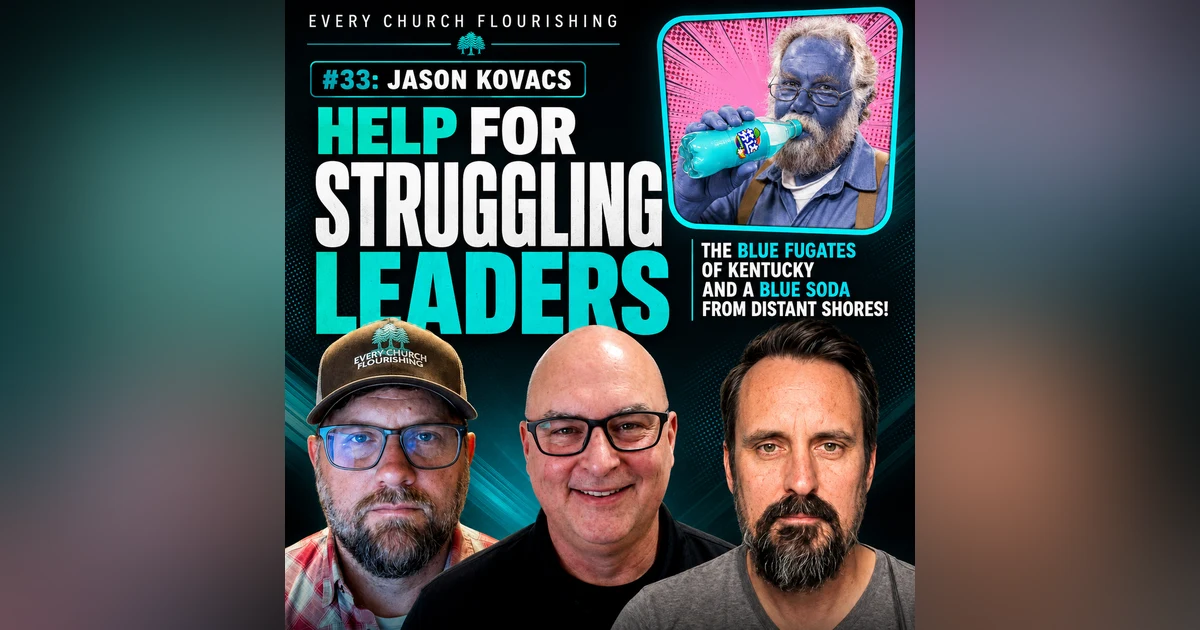
The Blue Fugates of Kentucky and a Blue Torpedo Beverage from China. This is a tea-flavored soda.
If I had to pick a cult, this would be on my list of cults to pick.
Creed Bratton famously stated on The Office that he has been involved in multiple cults as both a leader and a follower, noting that "you have more fun as a follower, but you make more money as a leader."
According to one counselor, pastors and church leaders are the most threatened and spiritually vulnerable people in the world.
There’s no other job that the Bible says you will be explicitly held accountable by God for other than pastoring.
Do pastors struggle more with anxiety and depression?
“We want to be real about the fact that Christians and need good counseling”
Just a few years ago, hardly anybody in the church was talking about mental health or anxiety. Now it is more common, thankfully.
The Current Mental and Emotional Health of American Pastors and Why it Matters.
EVERY CHURCH FLOURISHING PODCAST - EPISODE 33
Interview with Jason Kovacs: Mental Health, Counseling & The Church
Hosts: Dr. Chase Thompson & Pastor Chris Cole
======================================================================
[DR. CHASE THOMPSON]
Today, we're talking with Counselor Jason Kovacs about the state of mental
and emotional health in the church, how counseling should be a part of the
church, and how pastors are doing post-COVID. What do you think, Jason?
[JASON KOVACS]
I think it is fair to say that pastors are struggling in a way that we
haven't been before. Like, I think there was a marked difference through and
post-COVID. Some of this is we're talking about it more. It's part of the
cultural conversation. But I think it's also a recognition. Like you said,
the Psalms are full of honest lament. And we have more books being written
on lament over the last 10 years. So there's just, I think, both culturally
and then within the church, more conversation happening alongside just real,
real challenges.
[DR. CHASE THOMPSON]
Encouragement, practical advice, soul care, and resources that work together
to build up your local fellowship and the broader kingdom of God. Join
hosts, Pastor Chris Cole and Dr. Chase Thompson from the Great Commission
Association, led by Dr. Mike Stewart, as they explore the frontiers of
ministry and aim for the goal of making every church flourish. And hello,
everybody, and welcome into episode number 33 of the Every Church
Flourishing podcast. We have a fantastic guest for you today. His name is
Jason Kovacs. Pastor Christopher actually knows Jason, so I'm going to kick
it over to him for a more formal and detailed introduction.
[PASTOR CHRIS COLE]
I am very glad that we have the chance to have this conversation with Jason.
I think it's going to be a great blessing. To all of our listeners, and our
prayer, our hope is that this will be used by God to encourage you and equip
you. Jason and I crossed paths several years ago as we were meeting and
talking about a variety of issues, both in the Southern Baptist Convention,
but related to counseling, and I have come to deeply respect him. I know a
good number of pastors, even in our association, who also have friendships
and relationships with Jason, and they love him and they've been blessed by
him, encouraged by him through his equipping ministry to churches. Jason is
not simply a biblical counselor who works with pastors, but he's also been
involved in a wide variety of ministry, everything from church planning,
pastoral ministry, adoption and orphan care advocacy, nonprofit leadership,
counseling center development. And because that's not enough, he went to
found and become the executive director of the Gospel Care Collective. And
we're going to put in our show notes a reference out to the Gospel Care
Collective. We refer people all the time to the Gospel Care Collective,
which is a ministry that's devoted to gospel-centered, clinically-informed
counseling that's for individuals, pastors, families, and churches. And
Jason has a tremendous background in this particular ministry for more than
20 years. He's worked in all of those different settings. He even founded
another counseling set of centers in British Columbia. He's Canadian. Maybe
we'll get to jump into that as well. He has his MA from the Reformed
Theological Seminary. He's a certified biblical counselor through the
Association of Biblical Counselors. He teaches even at our own Gateway
Seminary, biblical counseling as an adjunct professor, and he functions and
operates all the time as a Counselor himself, helping out families, parents,
working with different individuals, and of course, ministry leaders. He and
his wife Shonda had been married for more than 20 years, and they have five
children. And four of them were adopted. So there is just a lot to admire
about my brother in Christ here, and we are so glad that he is on our show
today. And, you know, we hope that one of our goals for having some of our
friends, like Emmanuel Marsh, who was on the show previously, one of our
goals on Every Church Flourishing is we want to be real and honest about the
idea that Christians can have and need counseling. So, Pastor Jason, did I
miss anything in all of that intro to you?
[JASON KOVACS]
Man, you did a great job. I can't think of anything else other than I love
good coffee, a good cup of coffee.
[PASTOR CHRIS COLE]
He loves a good cup of coffee. Okay, we're going to have to follow that up,
Chase. And so let's just start here maybe with this question, Jason. We took
all of those different pieces of your background. We had to try and list
that on like one page of our show notes that we were using here. What is the
thread that God used to pull all of those different experiences together to
lead you to the ministry that you're in right now?
[JASON KOVACS]
Yeah, that's a great question. Something that I ponder because there's many
ways I look at where I am today and I go, how did I get here? This was not
my plan 25, 30 years ago. I'm almost 50. And so, you know, it's wild to talk
to friends and go, you know, from high school, I still have friends and
we're like, yeah, remember like, oh, 30 years ago when this happened? And it
doesn't seem like it's been that long in many ways. But I do think about,
yeah, how did I get here? And a lot of times where the Lord brings me is to
Proverbs 16, 9. It says, in his heart a man plans his course, but the Lord
establishes his steps. I went to a small Bible college, felt a call to
ministry early on. But it really was, I was thinking pastoral ministry,
church planting, or missions, and counseling. Counseling, if you had asked
me then, could you ever see yourself as a pastor of counseling or as a
counselor? Where on the list of possibilities is that? It would have been
not on the list or very low on the list, maybe number 20. I probably would
have put youth pastor before counselor or anything else. So it just wasn't
on my radar. It wasn't something I was thinking about at all. But I can look
back and I could tell you stories of just how the Lord established my steps,
how different experiences that I had with church planting, pastoring in the
adoption world really shaped me and prepared me. To when God really led me
into more formal life. And spending more time in counseling.
[DR. CHASE THOMPSON]
So let's kind of talk about big picture counseling pastors because a lot of
the people that listen to the show, not all, I mean, but probably even less
than half, but most of the people who listen to the show are pastors, youth
pastors, church leaders in some form or fashion. I want to focus a bit on
anxiety and mental health. I am in my early 50s and I remember growing up in
Alabama in the church, mental health and anxiety and things like that, these
were not manly topics. These were not church topics. And when I was in
college or whatever, if I heard a pastor talk about his mental health
struggles, I think deep down, I would have just assumed he was like
literally crazy. And I know that this is a terrible way of thinking, but it
just wasn't talked about then at all. But now we're much more comfortable
talking about anxiety and praise God for that because you find that you find
anxiety and depression and real mental health struggles all throughout the
Psalms, all throughout the Bible. Just weird that we in Christendom went
through a period where it was just not at all talked about. How would you
generally speaking rate the mental and emotional health of pastors and
church leaders right now.
[JASON KOVACS]
Yeah, I mean, obviously this is subjective because I think it's really hard
to measure that and maybe subjective and a little biased because of, you
know, my perspective is from within, the world of biblical counseling. So
the people I'm talking to are predominantly, I'm talking to them because
they're struggling. But I do a lot of work with churches. I, you know, work
with a lot of churches that are all across the spectrum, healthy and
denominations. And I think it is fair to say that pastors are struggling in
a way that we haven't been before. Like, I think there was a marked
difference even through and post-COVID. Some of this is we're talking about
it more. It's part of the cultural conversation. But I think it's also a
recognition. Like you said, the Psalms are full of honest lament, and we
have more books being written on lament over the last 10 years. So there's
just, I think, both culturally and then within the church, more conversation
happening alongside just real, real challenges. So, you know, COVID was this
really unique moment in the history of the church, I think we can say. And
for a lot of pastors, it was really, really difficult because they had to
navigate a global pandemic. Health issues and governmental issues disease
you know, all of that which which you know who can who can understand that
right and if you remember i don't know if you guys remember but kind of in
that same season there was a lot of racial issues that oh yeah on the
forefront of, of in our culture and then not only that there was the issue
of gender and sexuality. That really peaked in that season as well. And then
politically, we've got everything that was going on as well. And so, I mean,
you just think about those issues. And if you're a pastor in that season,
those are kind of issues that back in 2010, 2015, you kind of think like,
hey, let's do a sermon series on something controversial. And you could plan
for it, prepare for it, you know, choose one of those. And it would, you
know, you'd have to do a lot of work on that because you know, it's going to
be, you know, stir up things in your church and be controversial, and you
got to be wise and discerning. But I find, I found for a lot of pastors or
churches in that season, they had to deal with it.
[DR. CHASE THOMPSON]
Oh yeah.
[JASON KOVACS]
People were, churches were dividing people in the church that, you know, had
been leaders for 20, 30 years in the church, good friends leaving because of
positions that were taken or not taken. And so you're dealing with just so
many, so many issues that have always been part of pastoral ministry in the
church, like loneliness, secondary trauma, the burden of pastoring a church,
the never finished task before us. Those are sort of these common issues
that pastors face. Well, I think that that season of COVID and sort of after
that just exasperated and, kind of took many pastors beyond their capacity
to navigate those things. So we just saw, I've still seen pastors that are
still recovering from that, and trying to make sense of it, trying to make
sense of what they experienced through that. And, you know, some guys were
unscathed. So there's those guys too, but for a lot, you know, and that's
one dynamic, but I think it's a pretty significant one that I've seen.
[DR. CHASE THOMPSON]
Yeah, I agree with that. My own COVID story. Growing up, I was pretty happy-
go-lucky, not stressed or whatever. When my kids were born, they had some
health issues related to asthma and lungs and stuff. And that was really my
first big taste of anxiety. But by the time I moved out to California in
2018, things were pretty settled, not anxious or whatever. And then in
January of 2020, I started, I'm kind of like a epidemiological hobbyist. I
don't know why I had this fascination with diseases. And I started paying
attention, a lot of attention to COVID. And I just had a sense just kind of
early on, hey, this might be something. As it got into March of that year, I
basically started this pattern where every morning, first thing I would do
when I got up, I would start reading about COVID before Bible study, before
prayer, before shower. I'd just grab my phone. I'd start reading the news.
And as a pastor, I was telling myself, hey, I got to protect the people.
I've got to be ready for this. As it got to the point where we were having
case tracking and death tracking, man, I was getting up every morning and,
and comparing the trends from that day to the day before the week before.
And I was keeping all this stuff in my mind, again, telling myself, I got to
protect these people I'm responsible for. Somewhere in like three quarters
of the way through 2020, I realized something's wrong with me. Like I'm
beginning to have all these physical symptoms, the heart skip beats, all
this kind of stuff. And I'm like, hey, physically I'm breaking down. I
wonder what this is. And long story short, it turned out to be 90 something
percent anxiety. And I had to change my habits because, hey, surprise,
surprise, you probably shouldn't begin every day reading bad news and
stressing about things. I feel like I really should have known better than
that, but I didn't. So along those lines, would you say pastors and church
leaders, mainly pastors, do pastors struggle more or less than the general
population with things like loneliness, anxiety, depression? I know that's a
big picture question. And also broadly, what kind of issues are you seeing
without specifics, obviously? What kind of specifics are you seeing in the
pastors and leaders you're counseling?
[JASON KOVACS]
Yeah, yeah. I talked about this before, and I'll talk about this online
publicly, the nature of pastoral kind of calling and how uniquely difficult
it is, I feel a little bit more freedom now, now that I'm not a pastor, to
be a little bit more bold and advocate for pastors and speak up for pastors.
It can feel, if you're a pastor, going, hey, my job is really difficult.
That's hard. It's like, you know, people look at that and go, wow, you're
just, you know.
[PASTOR CHRIS COLE]
Whining.
[JASON KOVACS]
Yeah, you're whining. But man, so I feel a little bit more freedom to stand
up and say, man, pastors really do have a unique role and calling that is
unlike any other job. And I don't like comparing and I'm not devaluing any
other job out there or saying other jobs aren't hard. But I'm just talking
about pastors. And you think about it, pastors are called by God to pastor
souls and to think eternally. And pastors are going to stand accountable
before God for how they shepherded the souls of the people that God
entrusted to them. Yes. Like God's going to judge, you know, he's going to
hold them accountable. There's no other job that explicitly in the Bible
says, hey, you're going to be held accountable before God. So just that's
one piece, right? Or one piece. Reality that I think is hard to totally
fathom. But I do, even now that I'm a counselor and not a pastor, I feel a
little bit of freedom. I think I'm still accountable before God, obviously,
but the weight on me. I don't have the authority as an elder in shepherding
the people I'm counseling. Elders have this divinely given authority that is
also a protection for them, and accountability. So all that said, I think
pastors have the hardest job in the world, you know, because they've got to
handle so many issues. They're always on. They're carrying burdens that are
unlike any other sort of job you can imagine. And so I think they do
struggle more than others, you know, and obviously there's exceptions and
you could probably argue against that and but but that's that's my position
i think you know i i i believe also to take that you take think about this i
think if we believe in spiritual warfare we believe in how satan is a war
you know he wants to, seek to steal kill and destroy the number one target
of satan are pastors, He's going to take out, so he's strategic, Satan's
smart. He's going to take out those that have the most influence spiritually
in the church. He's going to take out the generals. He's going to take out
the leaders. He's going to take out the ones that are proclaiming the
gospel, leading the church. So just, again, on that side, they're the most
spiritually vulnerable, spiritually attacked of anyone in the world. And
that's not to devalue, you know, the lay ministry, what anybody else does,
those who are faithfully serving Jesus, just to say that God, in his
infinite wisdom and sovereignty, has ordained pastors to have this unique
role. And so I think that helps us to recognize that, wow, you know. You
experiencing anxiety and the burdens and the impact that you are as a
pastor, is, God's not surprised by that. It's biblical. And I see it. I see
pastors more than ever having panic attacks, experiencing anxiety. I mean,
like you just described, you were exposed to so much more than we've ever
been in the history of the church as well. We have access to more
information than I think our brains really were designed to handle. So
you've got that as well. And yeah, so a lot more intense anxiety, more
intense depression, more intense impact like that that I've seen over the
years.
[PASTOR CHRIS COLE]
You know, I have kind of a couple of pet theories on this topic, and these
may or may not be substantiated, so feel free to react to these. So one of
my theories is that I really think God in his sovereign goodness, you know,
even when he's bringing some measure of, say, judgment or discipline in the
case of the church, that he's also, there's always this invitational
component. Right? That you see like throughout the Old Testament, right?
When God's bringing discipline upon his people, he's like, return to me,
right? There's this invitation. So I have sort of this belief that COVID and
so many of the environmental things that we are experiencing today, I'm not,
I guess I'm not yet convinced that the mental health challenges are new. I
think they're just being exposed. I think all of these environmental things,
we're getting our securities stripped away. The things, the false idols, the
gods and goddesses of the age, you know, it's, you know, if I can't just be
secure in my home, if my health is not all here, who am I, right? So I think
it It sort of cuts right to these heart-level idolatries that we, as human
beings, have established, right?
[JASON KOVACS]
Yeah.
[PASTOR CHRIS COLE]
Who am I if I'm not healthy? Who am I if I'm not productive? Who am I if I'm
not all of these things? And I think also that in the church, because there
is both this very clear biblical position of heightened accountability, say
for spiritual leaders in the church too, we also know that The other side to
that is that, you know, pastors, and I speak of the broad church family here
in this way, you know, people who step into the pastoral role are also given
tremendous influence, tremendous power, tremendous authority. Of
recognition, right? And I get it. We're not all Joel Osteens flying around
in our private. Can I say that, Chase? We don't have our private jets.
[DR. CHASE THOMPSON]
We have an attorney on the trainer. We should be okay.
[PASTOR CHRIS COLE]
Right. We don't have that. That's not the objective for most pastors. I get
that. And yet, I also wonder if this age of pastoral, heightened pastoral
anxiety, stress, etc., is really also just symptomatic of the fact that
maybe some unhealthy people were stepping into the pastorate and that people
who were not really well aligned spiritually in their value systems or their
practices were probably either in an underdeveloped role as a pastor. They
hadn't had the real discipling they needed, the equipping they needed to be
in that. Or no one had really dealt with some of the underlying character
issues that were there. So any thoughts about either of those things?
[JASON KOVACS]
No, yeah, I think you're right on. It's not new. Like you can go back to,
man, one of the favorite things to read is Gregory of Nazianzus from the
fourth century. So his story is really fascinating, but I'll read this quote
from him because I think about this all the time. And he's kind of talking
about the challenge of pastoral ministry and the complexity of it. And he
says this, this is again, fourth century that he's writing this. Who is the
man? The demands of pastoral office, of the pastoral office are
extraordinarily complex, leading even the most skilled individual surely to
wonder whether he or she is competent. Pastoral work involves a blending of
theological and spiritual knowledge on the one hand with psychological,
rhetorical, and pedagogical skills on the other. And the competent and
faithful pastor must know both God and the people in such a way that he or
she can interpret the significance of the gospel to meet every life
situation and every manner or person, all to the glory of God and the
eternal salvation of each person. These subtle attainments are not merely
clinical or technical skills, the exercise of which is the art of arts. So
actually, I think the first part was Gregory, the pastoral office is
extraordinarily complex, leading even the most skill to go, am I competent
to this? The rest was commentary from Andrew Purvis in his book, Pastoral
Theology in the Classical Tradition, which is a great book because it really
opens up that these challenges aren't new. The complexity, the burdens,
they're not new. I think we're in a unique moment historically that exposes
these things. But you could go to Spurgeon and in his lectures to his
students, he has a chapter called The Minister's Fainting Fits. Spurgeon was
a pastor that we all know, but he himself experienced depression and
physical issues, gout, and had to take long seasons of sabbaticals and. And
he was very open and honest and tried to teach the students in the pastor's
college there about these things. That, hey, you're going to experience
emotional distress in the ministry. And that's following Jesus, right? It
goes all the way back to Jesus. He says, in this world, you have trouble.
Jesus is the man of sorrows. Sometimes, I don't know, we can forget that.
Sort of live in this and speak a sort of emotional prosperity gospel
unintentionally, even though we would not agree with any kind of prosperity
gospel. But I think there's sort of an emotional prosperity gospel that if
you're following Jesus, if you're being faithful as a pastor, you're not
going to really struggle.
[PASTOR CHRIS COLE]
Before we started, we were kind of having a commentary on a couple of
pastors and sort of their reaction to the idea of counseling. And we won't
necessarily identify those guys right now, but it's something clarified for
me a couple of years ago. It's more than a couple of years ago now, but I've
just been reflecting heavily, I think, of the last couple of years. You
know, the Puritans said that there were two consequences of the fall, sin
and misery. Misery is this category of what has happened both in a fallen
creation, in a world of spiritual warfare. Where we are opposed, where there
is a thief that comes to steal, kill, and destroy, that's not necessarily
channeled through individual humans. There is real spiritual warfare that's
happening, right? Think of Job's afflictions, right? Satan's directly
afflicting him. He may or may not have used, who is it, the Nabataeans to
steal the camels or whatever, right? But the reality is that that tornado
that comes along, that big wind that wipes out, Job's kids. That's not sin.
That's Satan, right? So we've got a broken world, an opposed world, where
Satan is opposing us in this, right? And we have our own fallenness. And the
general misery that comes from living amongst sinners who are powerful
people oppressing the world, oppressing the immigrant, stealing for their
own great advantage or whatever, So we have those miseries that happen to
us. And I don't know, that has helped me sort of frame through and think
through this idea of recognizing both the need as pastors, as counselors to
be able to say to the church, yes, there is sin, and we need to address
that, acknowledge that, own it, confess it, repent of it, trust in Christ
for his transforming ongoing work in it. But also acknowledge there are
things that happen to people for which they are not responsible. And there
is misery that occurs in this world. And that misery can afflict us through
depression, psychological disorders, through circumstances that are
oppressive and weighty that cause us to lament and so on. So, Jason, we've
talked kind of a lot about a lot of big things here, but your organization,
the Gospel Care Collective, one of the things that you guys do is you help
equip the church. You help equip the church to provide care for people, and
your goal is to not replace the church, but rather equip the church with
this skill. So we know that one of the sides or temptations of what churches
can do today is they can sort of say, hey, we're just going to outsource the
counseling care to a class of professionals that are out there. Now, we're
going to talk about the other swing side of that here, too. But so what
maybe the question is, what kinds of care really belong in the local church?
And how well do you think most churches are doing in that sort of like we're
counseling one another in sufficient and good ways?
[JASON KOVACS]
Yeah, that's a big question. Here's how I would answer it. I think it starts
with our ecclesiology or theology or anthropology and our ecclesiology. So
how do we see the church? How do we understand the church? In particular
when it comes to the role of the church in care where does care fit into our
ecclesiology and i the way i put it i believe, is biblical is that well the
church is god's primary place for life transformation to happen for
salvation for sanctification and really for care to take place because care
is not meant to be done one-on-one but really in community and And that's
what the church is. The church is a community gathered by God to walk with
God, to walk in Christ and to grow in sanctification and to move
progressively to eternity. And where God will make all things new, where
he's going to restore wholeness and where we're going to have full
flourishing. We long for that. We dream of that. And that's really going to
happen one day. That's a good desire because God's doing that. Well, the
church is the context for that. Now, the church fails in so many ways
because it's just broken people, but it's still God's design. So because of
that, I would say that where does care belong or what care belongs in the
church? All care. Like, we're embodied souls, so the church ought to care
for the whole person and the whole life in Christ. Now, we have to caveat
that and say, well, that doesn't mean that, well, now someone comes and the
church has to do all medical care. Spiritual care, psychological care, like
care for someone's car. Like, the church does everything. Like, what are we
talking about here? Well, I think the church and spiritual leadership are
shepherds that we want to care for you by helping point you to Jesus and,
help connect you to the means of grace and the resources that we have in our
church and then where we can partner with people outside the church. So
that's where the church can partner with those who have more skills and
expertise in certain things. When we talk about counseling now, I love to
see churches grow and be equipped to do all they can in counseling at a
basic level, and even with more and more complexity training churches for
that, but sometimes it's helpful for a church to partner with those, that
they can trust outside the church to provide some of that supplement. I call
it supplemental care. The pastors in the church are primary. Some of that
specialized care is supplemental. That's how I like to think about it.
[DR. CHASE THOMPSON]
Okay, I think that's a good place to cut the interview in half. We're going
to have Jason Kovacs more next week. And I gotta tell you, man, he's so
chill and just sharing a ton of wisdom. I loved this interview. I love most
of our interviews, but it really got a lot out of Jason. And next week,
we're going to go even deeper into talking about issues related to anxiety
and emotional distress and how normal those things are and some of the ways
we can overcome them. But for now, it's time for Pastor Christopher and I to
crack open a weird, strange, but interesting beverage.
[PASTOR CHRIS COLE]
Pastor Chase, in 2021, in 2021, the Coca-Cola Corporation launched a mystery
flavor of Fanta, but only in mainland China.
[DR. CHASE THOMPSON]
OK, that's why I missed it.
[PASTOR CHRIS COLE]
And they revealed this flavor as jasmine honey peach, a soda that is more
delicate than the typical Fanta. Instead of being intensely fruity, it has
aroma and balance of ripe white peach jasmine blossoms honey with a light
carbonation and a clean, refreshing finish. And we're going to try it today.
[DR. CHASE THOMPSON]
So this is far and away the most unique presentation of a soda we've had. I
mean, for one, that label right there. I don't feel like that's Chinese, but
it is. I don't speak that language and I don't read that language, but it's
very striking. Yeah. And it's very blue.
[PASTOR CHRIS COLE]
Yes. Do they have
[DR. CHASE THOMPSON]
Blue peaches in China, Pastor Christopher?
[PASTOR CHRIS COLE]
No, they have the regular peaches, which you can see the peach on there. And
I don't really know what that other thing is, if that's supposed to be like
a jasmine flower.
[DR. CHASE THOMPSON]
Maybe.
[PASTOR CHRIS COLE]
It's kind of a, maybe my eyes are just not good. So I don't know why they
would pick blue as this, but it's supposed to have, interestingly, like a
light tea-like taste to some degree.
[DR. CHASE THOMPSON]
That sounds very appropriate for the Chinese market. Like a peach jasmine
tea. Okay. Okay.
[PASTOR CHRIS COLE]
So I'm kind of interested in this.
[DR. CHASE THOMPSON]
Well, looking at the ingredients, apparently the blue comes from a synthetic
organic compound called Brilliant Blue FCF.
[PASTOR CHRIS COLE]
Is this going to change our skin color?
[DR. CHASE THOMPSON]
Oh, we're going to be like the Blue Fugates? Have you ever heard of them?
[PASTOR CHRIS COLE]
No.
[DR. CHASE THOMPSON]
Okay. The Blue Fugates of Kentucky. It's one of the most interesting stories
in the entire world. I'm so excited. These are people, this really happened.
It's not very common these days, but colloidal silver was a health fad for
years. And some families in Kentucky, and I'm actually, now that I say this,
I didn't intend to talk about it, but I'm trying to remember if this was a
genetic issue or what. But you can turn blue from genetics and you can turn
blue from colloidal silver. And there was a family with the last name of
Fugate in Kentucky. They turned blue. If you Google it, and I'll try to have
a screenshot here for people that are watching. If you Google it, I'm not
exaggerating. These are Smurf looking people.
[PASTOR CHRIS COLE]
Smurf. Smurf looking people. Yes, so they would fit in well with this.
[DR. CHASE THOMPSON]
It wasn't quite as brilliant blue as this, as more of a gray blue, but
still, they don't look human in terms of their color. Hopefully, we will
avoid that fate. My wife will be very upset.
[PASTOR CHRIS COLE]
Yeah. Well, it might be interesting. How many years have you been married?
[DR. CHASE THOMPSON]
30.
[PASTOR CHRIS COLE]
30. So after 30 years, she might be tired of playing a white chase. She may
want blue chase.
[DR. CHASE THOMPSON]
I sometimes get tired of playing a white chase, too. I'm just not sure that
blue is the next best option.
[PASTOR CHRIS COLE]
So I was going to note the twist that they put at the bottom of this bottle,
which I think... Maybe that's symbolic. Maybe it's just a grip. I don't
know.
[DR. CHASE THOMPSON]
It kind of reminds me of a torpedo.
[PASTOR CHRIS COLE]
Oh, a torpedo. All right. Well, are we ready to try this Jasmine Honey Peek
Soda from China?
[DR. CHASE THOMPSON]
I am ready. I myself really like jasmine tea. That is a fine, delicate tea.
[PASTOR CHRIS COLE]
Well, let's give it a try here.
[DR. CHASE THOMPSON]
Takes a lot of twists to get off.
[PASTOR CHRIS COLE]
It does. Yep, yep, yep.
[DR. CHASE THOMPSON]
It's got a potent smell.
[PASTOR CHRIS COLE]
What are you getting on the nose there,
[DR. CHASE THOMPSON]
Chase? Something I'm not familiar with. This is not an everyday smell in
Chase Thompson's life.
[PASTOR CHRIS COLE]
Well, there is a peach smell.
[DR. CHASE THOMPSON]
A little bit of peach. Maybe a little bit of peach, a little bit of
brilliant blue FCF. I don't know.
[PASTOR CHRIS COLE]
It's something there, huh?
[DR. CHASE THOMPSON]
Something. Yeah, what is that?
[PASTOR CHRIS COLE]
I don't know. But I say we go for it.
[DR. CHASE THOMPSON]
Okay. Let's do it. Okay.
[PASTOR CHRIS COLE]
Here we go. Huh. That is not what I would have.
[DR. CHASE THOMPSON]
That's something, huh?
[PASTOR CHRIS COLE]
It's something. I'm not sure what to do with this.
[DR. CHASE THOMPSON]
I'm not. Yeah. You definitely taste the tea.
[PASTOR CHRIS COLE]
It is a tea flavored soda.
[DR. CHASE THOMPSON]
Absolutely. Yes, it is.
[PASTOR CHRIS COLE]
Mm-hmm.
[DR. CHASE THOMPSON]
The tea is strong. Jasmine tea is very gentle in my mind, but this is not a
gentle tea. This is a tea that has been working out for a few years and kind
of pushes you as you walk down the hall and glares at you across the room at
the gym.
[PASTOR CHRIS COLE]
Yeah. With its best friend peach beside it and jasmine on the other side so
that you're being bullied by the triumvirate of flavors.
[DR. CHASE THOMPSON]
A little bit. Yeah. It's definitely strong.
[PASTOR CHRIS COLE]
Yeah. Yeah. This is a strong flavored. I am not getting the delicate.
[DR. CHASE THOMPSON]
No.
[PASTOR CHRIS COLE]
No. Are you getting... And there is a lingering floral flavor. That is
definitely there. I'm getting that. That's stain.
[DR. CHASE THOMPSON]
This is definitely how my tongue feels after I've drank a cup of jasmine
tea, strong jasmine tea, maybe like three tea bags worth.
[PASTOR CHRIS COLE]
Oh, that's a lot of jasmine tea in one mug there.
[DR. CHASE THOMPSON]
Yeah, it probably is.
[PASTOR CHRIS COLE]
Do you do that often?
[DR. CHASE THOMPSON]
I mean, as I said earlier on the previous review, I do like strong flavors.
So i i will typically do two or three tea bags instead of one
[PASTOR CHRIS COLE]
Interesting wow i i don't really know what to do with this i don't i'm
trying to think of a context where i would just say i want to sip on the
jasmine honey peach soda and and i'm not coming up with it this would not be
good over poured over ice by the way yeah maybe if you had a straw would
that help this
[DR. CHASE THOMPSON]
I mean if you were trying to drink a drink to stay awake that didn't have
care. Like, let's say you're at the end of a nine-hour drive home. You're 30
minutes from home. As soon as you get home, you're going to get in bed, but
you're kind of naughty. Probably the best thing to do is pull over and go to
sleep somewhere safe.
[PASTOR CHRIS COLE]
That is absolutely the best.
[DR. CHASE THOMPSON]
Yeah, but if you're going to not do that. And if you're
[PASTOR CHRIS COLE]
Listening to this podcast and you're driving home and it's the end of a
nine-hour trip.
[DR. CHASE THOMPSON]
Pull over.
[PASTOR CHRIS COLE]
Please do pull over and give yourself some rest here.
[DR. CHASE THOMPSON]
A dumb person might say to themselves, I know what I'll do. I'll drink some
of this Jasmine Honey Peach Fanta that doesn't have caffeine in it,
presumably. I actually don't know. I can't tell. And it'll give me just
enough boost to get home. It's about 30 minutes worth of drinking, and it's
got the flavor profile that will stimulate my brain. But when I get home,
I'll probably be able to sleep.
[PASTOR CHRIS COLE]
Yeah.
[DR. CHASE THOMPSON]
That's a use case.
[PASTOR CHRIS COLE]
That's a use case. I don't know if it would be a pleasant use case. I'm
really kind of, it's not bad. There's nothing bad about this soda. I would
not, this is not a Lester's soda. This is not a, you know, like some of the
not great ones that we have tried or foreshadowing a soda that I know we
have forthcoming.
[DR. CHASE THOMPSON]
Yeah, we have a couple of scary ones.
[PASTOR CHRIS COLE]
Yeah, but... I'm really kind of in this ambivalent place. I don't mind
taking another taste of it, but I don't know what to do with this.
[DR. CHASE THOMPSON]
We don't want to offend our blue soda loving Chinese friends.
[PASTOR CHRIS COLE]
No.
[DR. CHASE THOMPSON]
But there's probably a reason why this particular one hasn't been imported
to America and become a bestseller here.
[PASTOR CHRIS COLE]
Yes. I'm kind of surprised that Coca-Cola would do this, but they are the
same company that released New Coke. Yeah. At one point. So, yeah.
[DR. CHASE THOMPSON]
I wonder how popular this is in China. Oh, it's a highly sought after
imported soda.
[PASTOR CHRIS COLE]
Highly sought after in the U.S. Okay.
[DR. CHASE THOMPSON]
Its popularity extends globally as a trendy exotic import. Oh, nice. So we
got something special in our hands.
[PASTOR CHRIS COLE]
We are trendy and exotic. This is exotic.
[DR. CHASE THOMPSON]
Yeah. Oh, check this out. It has gained a cult following on social media
platforms like TikTok and YouTube.
[PASTOR CHRIS COLE]
TikTok and YouTube?
[DR. CHASE THOMPSON]
This is not a cult I would willingly join. No, no. Sorry.
[PASTOR CHRIS COLE]
No. It wouldn't be the worst cult.
[DR. CHASE THOMPSON]
No, no, there's a lot worse cults. That's true. Right. If I had to pick a
cult, this would be on my list of cults to pick.
[PASTOR CHRIS COLE]
Well, you know, to paraphrase Creed Bratton from The Office, you know,
having joined a lot of Colts, you had more fun. Oh, we'll just lay that one
right there.
[DR. CHASE THOMPSON]
Okay, that's fair. I have not joined a lot of Colts. I considered joining
Colt one time in my early days. I might tell that story on the podcast one
time, but it was also not as bad as some of the Colts, but still, it was
definitely a Colt.
[PASTOR CHRIS COLE]
All right.
[DR. CHASE THOMPSON]
Okay, just like you, I'm capping my jasmine honey tea. I want to give it to
my kids later on, see what they think about it.
[PASTOR CHRIS COLE]
Yeah, let them have a taste. See what... The kiddos think about that
[DR. CHASE THOMPSON]
And let well we haven't reviewed it we're a little stunned oh let's see i'm
肥say two spurgeons for me
[PASTOR CHRIS COLE]
You know i i was just gonna go just a little over two because because
there's something about this that i still sort of think is a little bit i
dare i say slightly pleasant
[DR. CHASE THOMPSON]
You know what you're right i'm gonna say two and a half i was being
ungenerous i i'm gonna raise up to two and a half you are it's not bad
gracious no it's not bad
[PASTOR CHRIS COLE]
Yes nowhere close to an osteen but no
[DR. CHASE THOMPSON]
No no it's not foul it's pretty good i definitely like it better than the
the lester's fixings buffalo wing
[PASTOR CHRIS COLE]
Oh wow didn't you give that a higher rating though
[DR. CHASE THOMPSON]
I gave it i think i gave it a two two and a half this is slightly better
than that for sure This
[PASTOR CHRIS COLE]
Is this is better than that. This is definitely better than that. Yeah, I
was going to go two and a half, two and a half spurge for the blue honey,
jasmine, peach soda. And if you're a TikToker, good luck to you as you drink
this.
[DR. CHASE THOMPSON]
Yeah, if you need help getting out of your cult, contact us at GCASBC.org.
You will find a home with us. And speaking of the Great Commission
Association, our sponsor of the podcast, I want to let you know about a
couple events coming up. One we've mentioned already, the Flourish Equipping
Conference for Women in Ministry is happening Saturday, September 19th with
Dr. Kathy Smith, Laura O'Sullivan, wife of an upcoming guest on the Every
Church Flourishing podcast and several other speakers. That begins at 9 a.m.
It is at Journey Christian Fellowship in San Luis Obispo, California, as
well. The annual mission conference for the GCA is happening October 9th
through 10th in sunny seaside, California. Can't wait for that. And if
you've got a hankering for church history, the Great Commission Training
Institute just started a class on applied church history. The tuition is
incredibly cheap. The teacher is yours truly, and we are already having a
lot of fun in the class, but it's not too late for you to join us. Until
next week, check out our website, everychurchflourishing.com. Thanks for
listening. Good day to you, and Godspeed.