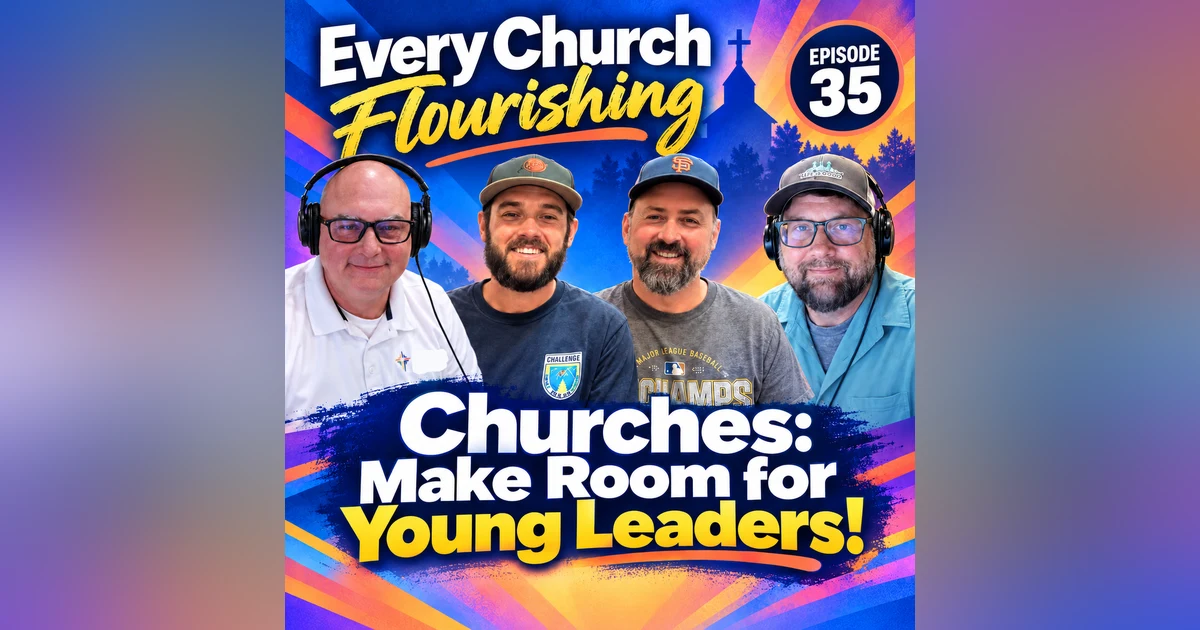
Churches: Make Room for Young Leaders! The Kingdom of God is Not Competitive, But Cooperative. Santa Cruz College Discipleship.

 Apple Podcasts
 Spotify
 Amazon Music
 YouTube
 Youtube Music
 iHeartRadio
 Podchaser
 JioSaavn
 Castbox
 Gaana
Gaana Today's episode features Pastor Brandon O'Sullivan from Gospel Community Church in Santa Cruz, California: https://www.gospelcommunitysc.org/leadership And Cody Bryan, from Christian Challenge at U.C. Santa Cruz.
Episode 35: How Can Parachurch and Church Ministries Work Together?? The Kingdom of God is Not Competitive, But Cooperative.
How Can Churches Make Room for Young Leaders and Not Stifle Them? Why is it CRUCIAL for churches to make room for young leaders??
How a Bible-Believing Church Can Make Disciples and Thrive in one of the most liberal Cities in America.
College Ministry at U.C. Santa Cruz
All about Christian Challenge College Ministry
Gospel Community Church and Christian Challenge UCSC are deeply integrated at the level of discipleship, leadership development, church membership, and ministry multiplication. Cody serves as a deacon at GCC; Brittany is active in women’s discipleship; another Challenge staff member, Josh Simmons, is also a GCC deacon; and Henry Kaufman came to faith at UCSC, became part of Christian Challenge’s core team, and is now a missions resident at GCC preparing for further ministry. GCC also explicitly lists Christian Challenge among the missionaries it supports financially and prayerfully.
What happens when a local church and a campus ministry genuinely see themselves as part of the same disciple-making mission?
Brandon O’Sullivan is the lead pastor and an elder of Gospel Community Church in Santa Cruz, where he oversees the church’s teaching and vision. He has served in full-time ministry since 2010 and has a particular passion for developing younger leaders who can reach people far from God and eventually start new churches and ministries throughout Santa Cruz County. Brandon holds a B.A. from The Master’s College, an M.A. from Reformed Theological Seminary, and a Doctor of Educational Ministry from The Southern Baptist Theological Seminary. He and his wife, Laura, originally met in Santa Cruz while serving as summer youth interns and have continued serving in ministry together.
Gospel Community Church itself began as a small church-planting group meeting in a Santa Cruz living room in May 2018.
Cody Bryan, together with his wife Brittany, directs Christian Challenge at the University of California, Santa Cruz. Cody and Brittany first encountered Christian Challenge as freshmen at Chico State, where they became friends, eventually began dating while serving together, and graduated in 2013. After marrying that summer, they immediately joined Christian Challenge full-time. They later became associate directors at Chico, helping train ten additional staff members before relocating to Santa Cruz to plant a new Christian Challenge ministry at UCSC beginning in fall 2021.
At UCSC, Christian Challenge combines campus evangelism with small-group Bible studies, weekly gatherings, one-on-one discipleship, retreats, mission opportunities, and intentional leadership development. Cody is also recognized in Southern Baptist collegiate ministry records as the campus minister at UC Santa Cruz.
Title: Partnering to Reach UC Santa Cruz
Guests: Pastor Brandon O'Sullivan (Gospel Community Church) & Cody Bryan (Christian Challenge UCSC)
Hosts: Dr. Chase Thompson & Pastor Chris Cole (Great Commission Association)
================================================================================
[00:00:00] Dr. Chase Thompson:
Today, we've got Pastor Brandon O'Sullivan and College Minister Cody Bryan, who are both ministering in Santa Cruz, California, one of the hardest to reach places in the United States of America. And we're talking about navigating some difficult ministry realities, the tension between old leaders and young leaders, the tension between parachurch ministries and normal church ministries. Brandon and Cody have done an excellent job of navigating those waters, and they're going to help us while talking about their partnership to reach college students at UC Santa Cruz. One of the things Brandon is going to point us to is the importance of mobilizing young workers into the kingdom.
[00:00:54] Pastor Brandon O'Sullivan:
But we also need to find ways to engage these younger ministers. And I just think of Jesus's words in Luke 10, which is that the harvest is plenithful, but the laborers are few. I do think a lot of times we don't really see the harvest as being plentiful or the laborers as being few. And we get really nervous about, well, what if someone else comes up and takes my job or I'm not as needed or something like that? Well, it should always be expanding and growing. And so we need as many laborers as we can possibly get. So I think we just need to really trust what Christ is saying there and then find, I mean, our greatest gift that we will probably leave to the next generation are the leaders that we'll invest in.
[00:01:44] Announcer / Intro:
The Every Church Flourishing podcast is all about helping churches, leaders, and pastors find health, encouragement, practical advice, soul care, and resources that work together to build up your local fellowship and the broader kingdom of God. Join hosts, Pastor Chris Cole and Dr. Chase Thompson from the Great Commission Association, led by Dr. Mike Stewart, as they explore the frontiers of ministry and aim for the goal of making every church flourish.
[00:02:09] Dr. Chase Thompson:
And hello and welcome into episode number 35 of the Every Church Flourishing Podcast. We've got a great one for you today. We've got Brandon O'Sullivan and Cody Bryan from Santa Cruz. They are partnering together in a mission to reach the College of UC Santa Cruz, the Banana Slugs, which is one of the very best college nicknames there is. So, Pastor Christopher, why don't you introduce our friends? You've known them longer than me. tell us all about their ministry.
[00:02:41] Pastor Chris Cole:
Well, I'm so excited to have both of these guys on the podcast, especially because I think our conversation today is just going to be so exciting and encouraging to people who are thinking about what does it mean to reach university students with the hope of the gospel? And how do you partner together as a local church with a ministry that could have the potential even to compete with a local church? But Brandon and Cody have done a phenomenal job of working together. So Pastor Brandon O'Sullivan is the lead pastor and elder of Gospel Community Church in Santa Cruz, where he was the church planter for that church. I'm just so excited. I could tell you lots of things about Brandon, about his degrees from the Master's College and Reform Seminary and from Southern Seminary. But I will tell you that his wife, Laura, is amazing. And fact that many people do not know, she's got connections to my homeland, Indonesia. So that makes her even more special. And Brandon planted the church in May of 2018. I think that's right. Something like that. Shortly thereafter, he built this connection with Cody Bryan. Cody was part of Christian Challenge at Chico State, met his wife, Brittany, there, and they immediately joined Christian Challenge shortly after they got married and became associate directors there at Chico State. And then, as they trade up a whole new team, they relocated to Santa Cruz to plant a new Christian Challenge ministry at UC Santa Cruz in fall 2021. And that's how they began to form this ministry together. So, for some of our listeners, you may not be familiar with Christian Challenge, and I'm sure Cody will be happy to tell us more about this ministry as we work through this conversation together. Christian Challenge is a Southern Baptist collegiate ministry focused heavily on campus evangelism and discipleship. And they do small group Bible studies, weekly gatherings, one-on-one discipleship, retreats, mission opportunities, and intentional leadership development. And, you know, it's one of the things we want to bring out in today's conversation is how Gospel Community Church and Christian Challenge at UC Santa Cruz are Significantly tied together. Cody serves at GCC as a deacon. His wife, Brittany, serves there as a deaconess and in women's discipleship and other ministries. And this is just a beautiful partnership and part of what we want to highlight today.
[00:05:22] Dr. Chase Thompson:
Guys, plug your website. Plug your church. How do people get in contact with you? I know you guys do a podcast. Tell us a little bit about all that.
[00:05:30] Pastor Brandon O'Sullivan:
Yeah, so gospelcommunitysc.org is our church website for those who are looking for a church family in the San La Cruz area. And then since we've been a church plant from the beginning, we've done a ton of online ministry, regular videos and all that stuff. So you can go to Daily Gospel on YouTube, and we have tons of videos walking through the Bible section by section and then tackling different tough topics.
[00:05:56] Dr. Chase Thompson:
Fantastic. So take us back to the beginning. How did all of this come together? How did you meet? When did you realize that the Christian Challenge Ministry and Gospel Community Church could really become partners on a deeper level than just your normal kind of church and college ministry partners at a distance? You guys are a lot closer than that. So tell us the genesis of this whole thing? How did we get together and how did it get to this great point of cooperation?
[00:06:30] Cody Bryan:
Yeah, when my wife and I were praying about planting Christian Challenge at UC Santa Cruz or anywhere really, we were looking at different campuses around the state. We were looking for a church we would be able to partner with. That was one of the parameters, the key parameters we were looking for. So before we ever locked on on a single location, we were researching churches in the area, watching sermons that they were uploading. It was a great time, ironically, because it was during COVID. And everybody, including people who had never uploaded their sermons online before, was live streaming or at least uploading their sermons. So we started watching Sunday sermons from different churches, looking for people that would line up theologically, that from what we could see in a video recording, line up with ministry values and priorities. And I remember the Sunday that it was, my wife was the one who watched Sunday's sermon from Gospel Community Church. And after she watched it, she told me so excitedly, Cody, I think I found a church that we could partner with. And so I watched the sermon as well. And then we planned a time to come and visit the church because they were meeting in person as well as uploading their sermons. So we came and visited the church and the welcome that we received when we first showed up was incredibly encouraging because that was what we were looking for. We wanted, we showed up without any preamble, without letting them know we were coming in. I had intentions of planting college ministry. We wanted to come in very incognito because we wanted to see what brand new face showing up to the church, what their experience was like. So we showed up one Sunday, nobody knowing who we were, what our intentions were. And the welcome we received was exactly what we were hoping for. And they actually spied us out very quickly. They were asking us so many questions and being so relationally intentional with us. They figured out that we were there to see if we might want to partner with them in planting a college ministry at UC Santa Cruz. We met with a couple from the church a couple of days later after visiting. And that was the genesis, that first visit.
[00:08:52] Pastor Brandon O'Sullivan:
And then from my point of view, it was when we started the church, we were heavily involved on campus, just our staff, our leaders, that was a big part of our focus. But as the church grew, our focus had to shift to this growing entity of the church. And so I was pretty dissatisfied with how uninvolved I was on campus after about a year. And so we just made an intentional effort to pray for somebody to lead that charge on campus and got a lot more than we bargained for. So God really answered that prayer. But the first Sunday that Cody and Brittany came, I didn't even meet them. I think that was when I tore my right Achilles tendon. We were just talking about, yeah, how I've torn both of my Achilles. So I think I was a little bit less mobile maybe. And obviously it was COVID as well. But I heard about this couple that wanted to start the ministry. And you're always, I mean, you're always a little bit skeptical of someone just showing up with their ministry they want to do. And then the first time I actually met Cody, he reached out and wanted to meet with him and his mentor. We met halfway between Chico and Santa Cruz at a Panera and he just pitched the ministry and said, we're going to fundraise. We're going to be invested in local church, all these things. And I think I had like one or two questions, but it was basically like, if you're going to force me to, I mean, I guess I have to do this. So it was a real gift from God.
[00:10:15] Dr. Chase Thompson:
So traditionally, I don't know how pervasive this is, but a lot of pastors have dealt with suspicion and are hesitant to cooperate with parachurch ministries. It almost seems like there's a competitiveness there. And I don't know how we've gotten to this point in the kingdom of Jesus where ministries and churches are so competitive with each other. I think it's partially because, like we were talking about before the show and discussing fantasy football and stuff, men are competitive. But the kingdom of God is not competitive. It's cooperative. So how did you overcome some of those initial maybe hesitancies that a lot of people have towards parachurch ministries and decide that this was something you really wanted to lock in on?
[00:11:06] Pastor Brandon O'Sullivan:
Oh, man, that's a tough question. I feel like we could do a whole podcast series on pastoral insecurity.
[00:11:12] Dr. Chase Thompson:
Oh boy, we sure could.
[00:11:13] Pastor Brandon O'Sullivan:
Because we are, I mean, we just are, you know, very insecure in a lot of ways. And that would require a lot of reflection to think through why that is. But I think, I mean, I remember reading a book by Larry Osborne. I forget which book it was, but he talks about this, how when you have, I think he called them like high flying eagles or some weird metaphor, but these young leaders in your church. Now, the age gap here is like a couple of years. So we're both fairly on the younger side, I guess, for ministry. But when you have these leaders that are excelling and even outshining you in certain ways, it's easy to get intimidated by that or not want them in your church. And we kind of, even without thinking sometimes, I think we kind of push people away. So I think just, I mean, the basics of it, I would think, are just seeing the mission as more important than whatever kingdom I'm building or Cody's building and saying, how can we partner together? Because challenges is so excellent at certain things. And then I think gospel community, we bring certain strengths to balance them out. There's been a lot for us of saying, why don't you guys just teach us how to do this part of the ministry? Because we're not that great at that as a church staff or as elders. And you guys are. You're doing it really, really well. So I've had a lot of fun with that. But at times, it just has been maybe a little bit of a hit to the ego to say, yeah, challenges doing a better job, discipleship, evangelism. They do a great job with welcoming, creating great environments for welcoming people, all those things. So you've been able to learn from them.
[00:12:42] Dr. Chase Thompson:
Fantastic. So I think some pastors have this stereotypical view of parachurch organizations that they can become their own sort of church entity and pull people away from the church. How do you guys do that differently? And what's your feelings on that? Is a parachurch a church or is it a parallel organization that works in cooperation with the church? You guys don't do that. How do you come into a church situation with a new pastor, a skeptical pastor and say, hey, we're not here to pull away members. We're not here to build our own kingdom. Guess I'm kind of asking how did that cooperation kind of develop into trust?
[00:13:30] Cody Bryan:
I think the first thing that added to that a lot was Brandon's character in that area where Brandon really values people and he really believes in people's potential, which I think makes him really easy to work with. I have had interactions with pastors in the past where it seemed to me that they viewed my ministry as junior varsity, ministry, and theirs was varsity ministry. What I was doing was a cute step toward doing real ministry. I have never gotten that sense from Brandon. He's always treated me like somebody who's doing genuinely valuable work for the kingdom of God, which obviously I believe that's what I'm doing. I've committed my life to the ministry work that I'm doing. I don't think that my work supersedes other people's, but I do think it's what God's called me to do personally And so him believing that what I'm doing is not just valid, but valuable, and that seems to be a genuine, deep-seated belief of his consistently comes out in how he treats me and how we work together. So that, I think, made it easy for me in this context.
[00:14:43] Pastor Brandon O'Sullivan:
Yeah, and on my end, you know, I've done youth ministry, college ministry, all that stuff. And I think I often did get siloed from the rest of the church congregation in those roles. And so Cody and his team don't have that same struggle. There's always going to be a pull toward that as a parachurch ministry to take whatever you're doing and say it's the be all end all of all ministries. But I think because we've tried to have a good relationship and we've talked through some of that, Cody and his team really see the primacy of the local church, that we need this family of believers across generations and across ages. That is the primary context for a believer to grow, but challenge is able to be the kind of the tip of the sphere in terms of evangelism on campus. They have such a great system for that. I'm sure we'll talk a little bit about that and for discipleship. And leadership development and so as they've just passed i think the five-year mark as a ministry so five years we've started to see some of their students become leaders and staff members within the group and then even now some of them are coming into the church and and serving on staff or just actually remaining here and finding ways to be involved with the church community post graduation so those things have that's that's i feel like we're starting to see the real fruit long-term that can come from a ministry like this.
[00:16:01] Cody Bryan:
And we had a meeting within the first four months of me moving to Santa Cruz where we talked about this as being the long-term vision of what was going to happen. And for me, that's always been the vision of our ministry. In college ministry, you're inherently ascending ministry because people don't stay in college. They graduate and they move away, usually. And even if they stay local, most of them aren't coming on staff. Most of them are leaving and they're primary. involvement in ministry is going to be in the local church. And so if, as a college ministry leader, if I'm getting in the way of people being involved in local church now, then I don't think helping set them up for success for the rest of their life and in being lifelong laborers, which is
[00:16:46] Pastor Chris Cole:
One of the
[00:16:47] Cody Bryan:
Primary values of what I'm trying to do, primary goals of what I'm trying to do.
[00:16:52] Pastor Brandon O'Sullivan:
Yeah.
[00:16:52] Cody Bryan:
When we met and talked early on, we talked about this idea of... The way I'm operating on campus is as a missionary, and I'm really trying to mobilize students to be reaching other students. And so while they're in college, my ministry approaches, I want to see them primarily focused on growing in Christ and turning around and sharing the gospel, making disciples with other students, because there's nobody more strategic to reach college students than college students. So I want to see the college students really focus on making disciples in their college context. Doesn't mean they're not involved in church. I want them to be involved in church. I want them serving. But then, Lord willing, through their time in college, they really get those reps in ministry of sharing the gospel, of investing in a new believer, in helping others grow closer to Christ. Then when they graduate, they're going to be, hopefully, exceptionally equipped young men and women to step into incredible roles of service in ministry in local churches, as missionaries, church planters, whatever God is calling them to do after they graduate. Then we're, like Brandon said, we're just now starting to see this happening locally. And my hope is that it's only going to expand from here.
[00:18:09] Pastor Chris Cole:
You know, it's so great to hear you guys talking about the mutual humility that I think has been so key to forging the partnership, your willingness to be humble before one another, encourage one another, embrace one another's ministries. And Cody, I love what you just said about seeing your students in the work that you're doing as a missionary task. So let's talk a little bit about your mission field, because a lot of our listeners that, because we have listeners that are actually listening to this podcast all over the world. If you're our listener that's listening to us in Finland, we are glad that you are listening to us. We would love to have you reach out to us and tell us how you heard about us in Finland. So if that's you, but not everybody knows about Santa Cruz and Santa Cruz is such a unique community and such a different community for So many people would sort of think of Santa Cruz as this very culturally different beach town in California. UC Santa Cruz is widely considered, even within our UC system, as one of the most progressive, secular, left-leaning, sort of everybody-do-your-own-thing environment. A few weeks ago, my wife and I had the privilege of taking one of your couples from your church out to dinner, talk about international missions. And just trying to get to dinner, we passed a coven of witches on one side of the road gathering. And then as we're walking in, there was a furry convention. And so I was like, you know, I feel like we're not in Kansas anymore here. So, Cody, you come from Chico. What did you find spiritually when you arrived at UC Santa Cruz? And what makes UC Santa Cruz such a unique mission field?
[00:20:08] Cody Bryan:
I was told by a lot of people before I showed up that Santa Cruz in general and also UC Santa Cruz was a distinctly spiritually dark place. That's the descriptor I got consistently from people that I talked to locally or who had used to live here. I talked to people who used to do ministry on campus and everybody described it the same way. And that is what I found that I think that's a good descriptor. I do think that there are a lot of pretensions culturally and societally here that have set themselves up against the knowledge of God that that has wreaked havoc culture on the values on the lifestyles of of people in Santa Cruz as well as on campus distinctly and so that was why we wanted to plant a ministry here my wife and I both for our entire time of being in ministry have felt a distinct burden to go where there's a need for people to share the gospel. That's one of the primary promptings that we were following in going into college ministry after we graduated and then in planting a college ministry eight years into ministry. And so when we showed up at Santa Cruz, we found that there were a lot of people with little to no spiritual background on campus. And we were excited. That's exactly what we were looking for. And so we started, I planted with two other full-time staff members. And we just started wandering the campus, trying to meet students and develop a relationship with them. And the way we do that is on the front end, we'll share the gospel with them. Usually we'll meet somebody and try to set up a time to grab coffee or lunch with them with the express purpose of sharing the gospel with them at that meeting. And they know we have an initial conversation with somebody. We will bring up a spiritual topic and then ask if they would like to continue that kind of a discussion over lunch or coffee. So they're aware that they're walking into a meeting with the express purpose of talking about God.
[00:22:16] Pastor Chris Cole:
Yeah, I love that.
[00:22:17] Pastor Brandon O'Sullivan:
I could definitely get into the weeds here in terms of Santa Cruz and some of the stories we've had. But I think maybe you know this, Chris, but when we planted GCC, our first location where we met for public services was on the west side of Santa Cruz. And it was an abandoned church building that had been sold to developers. But the previous church that had been there was about as out there as you could get. Where so the this church had a massive rainbow flag at the front of the property it was probably about 10 feet wide and and it was just facing you know the main street so everyone knew this was an affirming church and the pastor became a woman by his own you know profession at least so you know. A transgender pastor and then they when they sold the building they took the few million that they got from the building to start a brewery in Santa Cruz. And the proceeds went to Planned Parenthood and other organizations. So when we got to that location, we had this problem of, okay, we're going to rent when we have this rainbow flag out front. And we quickly decided there's no way we could do that. So we asked the owners if we could take that down. Shockingly, they said yes, but probably just because we were paying them, obviously. So we had to take it down and we had some people confront us, get very angry, ask about our values. And then for the next year, every time we came to church on Sunday, there would be a rainbow flag planted somewhere on campus. This was sort of the passive aggressive action of somebody who was pro-LGBT, but, So it's a funny, you know, Santa Cruz is a funny place, but for I want to be, I'm sure it's where you want to be, Cody, because that's where the gospel needs to go, needs to go into places like this.
[00:24:01] Pastor Chris Cole:
Well, and you guys have had tremendous fruitfulness. And I want to bring this out specifically because I love your heart of what you just said, that, you know, where there is darkness, where there is opposition to the gospel, where there is a deep and profound sense of lostness is exactly where we need to be sharing the good news of Jesus Christ. And you guys have been faithful to do that. And so tell us, what's that fruitfulness looked like? And, you know, maybe, you know, because I kind of know some of the answer here just from some prior conversations. Let's start with you, Cody. Tell us what you guys have seen. What's been the fruit of those gospel conversations that you guys have had on campus five years in? Cody, tell us what this looks like on the ground. What have you seen God doing in seeing people's lives changed with the hope of the gospel?
[00:25:00] Cody Bryan:
Yeah, we track the people that we share the gospel with. We like to say we count people because people count. It's not a magical evaluator of whether you actually are doing fruitful ministry work, but we saw them counting in the New Testament. So yeah, but we've in the last five years, we've been able to share the gospel with 398 students. That's through gospel appointments. We also do a fair amount of initiative evangelism. I don't track that, mostly because it would be too difficult to track at this point. But those are all just one-on-one gospel appointments that we've had. And then out of those 398, we've seen 140 students indicate decisions for Christ.
[00:25:47] Pastor Brandon O'Sullivan:
Wow.
[00:25:47] Cody Bryan:
And I use that wording really specifically because we don't know where their heart is. Yeah. But we don't try to sugarcoat the gospel when we share it, and so as far as we can tell, those 140 people had just received a really clear explanation of the gospel in a discussion context, so there's a lot of questions being asked back and forth and walking through a lot of scripture, and then they were asked very straightforward if they want to follow Jesus Christ as their Lord and Savior, and they've had those ideas explained to them on what that question means. And then we do our best to follow up with every single one of those people. We obviously haven't been able to follow up with every single one. Some people drop off, but I'm always hopeful of what God is doing in someone's life. I remember one student when I was at Chico, I shared the gospel with him. I discipled him for a year, and then he dropped off the face of the planet until his last, I think two months of school. So almost about three years later, having not seen him at all, he came back and having not heard a word from him, He said that he, since I'd stopped meeting with him, he actually committed his life to Christ, that God really used that time of investment to lay a foundation of understanding and scripture and who God is in the gospel. And then other people were able to come in and follow up with that foundation that God laid in his life and committed his life to Christ. And that story was always such an encouragement for me ever since then of never discounting just because if somebody drops off what God can do with his word, right? His word never returns void. And so as long as we're faithful with God's word and sharing it with people, it's amazing what he can do that I'm very suspicious we won't really see the full breadth of ministry fruit until we get to heaven one day.
[00:27:42] Pastor Brandon O'Sullivan:
Yeah, and I would say with those, just from my vantage point, those gospel appointments are very in-depth. This is not easy believism. This is not just, hey, sign on the dotted line or we're going to pray over you and not explain something to you. These are very in-depth. And so, the students are being asked questions, being explained what faith is, what the gospel is. And what I've been most excited about, as I've watched it, is at first it was the staff were doing all the gospel appointments. And then there was new believers that came to faith and they started to share the gospel with others. And now what we see a lot of is second or third generation believers. Because we always encourage people when they give their testimony for baptism. Say, who was part of that journey for you? Who led you to faith? And so, there was a while there where it was Alfred, who was a student. Now, he's one of our challenge staff. And it seemed like so many people were mentioning Alfred. Now, you'll hear certain names pop up like Norma. She's one of our members, just an amazing, wonderful young lady who's been so faithful, right? So, you'll hear so many people that have been investing in other students. And so, when those students can engage in evangelism and they see the results, it just lights a fire in them. And they get so hungry to learn, to grow, and to find new ways to reach people on their campus.
[00:28:59] Pastor Chris Cole:
One of the testimonies I've heard from some of your students is even young people who came to school maybe weren't either serious or very clear about their faith. And yet through their interactions with GCC and Challenge, they've become more aware of what it really means to follow and obey Jesus Christ. So there's not just conversion fruitfulness. You're really seeing discipleship fruitfulness as well. And what does that look like? You guys do this discipleship piece where you guys are doing things on campus and Brandon, you guys are doing discipleship, right? And equipping in the church context.
[00:29:40] Pastor Brandon O'Sullivan:
Yeah, what would you say from your vantage point? Well, what do you guys do well? What do we do well and how we work together?
[00:29:46] Cody Bryan:
For me and my staff, we're full-time on campus and so we're able to invest a lot of our time one-on-one or small group investing in students. That's a lot. Just today, right before this, I had a two, two and a half hour meeting with a guy that I've been discipling for three years. And so I invest a lot of my time and my staff as well into students, primarily trying to focus on student leaders because we want to be equipping them to be the ones doing the ministry work on campus. And so we're able to spend a lot of boots on the ground time Investing in those relationships and helping people learn how to follow the things Jesus commands us to do, and as well as the more counseling side of things, helping people walk through difficulties of life and understand how our faith applies across the board. But we try to do that in a way that is— we try to disciple in a way that we can take somebody from lost to laborer in a year. That's one of those phrases that our staff uses. I copied that from Paul Wooster, and I don't know if he came up with that or he copied it from somebody else, but that's where I got it from. He's the guy who planted the ministry at Chico State and discipled me for years and years and brought me on staff there. So that's what we do. I will say a huge piece of my own faith and maturity that was distinctly missing, not missing, weak. I don't want to discredit people who had invested in me before. Really on my own, I was weak in some really fundamental areas of biblical knowledge. I was much more a doer than a learner, and I neglected my own understanding of Scripture and areas of doctrine and theology that were hindering my ministry, and I didn't even realize it. And coming to Jesus— He was a heretic.
[00:31:40] Pastor Brandon O'Sullivan:
That's what he was trying to say. Just flat out.
[00:31:45] Cody Bryan:
I hope not, but very ignorant. of a lot of things and lacked a lot of convictions in areas where I wouldn't be able to answer people's questions about scripture that I was encouraging to read. It's like, hey, read this. And they're reading and asking me questions. And I'm like, I don't know. And so... I was able to, I have been invested in a lot by Brandon and by other leaders at GCC and have grown a lot in my understanding of scripture. I really bolstered up that area of weakness for me. And I think that you guys have done that for our whole team and any of our students that are involved at GCC as well. And I mean that in a very, very genuine and it's been incredibly edifying for me, my staff and our students.
[00:32:25] Pastor Brandon O'Sullivan:
Awesome. Yeah, and we've actually retooled all of our discipleship materials over the last maybe six months in partnership with Challenge to have a set of initial lessons. How many? Like eight, nine? I think it's eight. Eight. So for anyone who's a new believer or longtime believer to walk through the basics of the faith. So we felt like we needed to have a really clear system for discipleship. So we leaned on Challenge. They kind of led the way with that. They already had some materials they were using. So we adapted them worked through them together but we want our church and challenge to have a unified focus on how are we going to do a discipleship so that we work on that together and then on my end of things i mean a lot of my time, gets to go to i love investing in people for ministry so there's been an increasing number of challenge you know students and graduates that have been coming and then we're working on things like training them to preach we're hoping to do counseling, training in the future? How can you be a counselor in the local church? But things like that, leadership. So how do we develop these people for one ministry and then send them out? So we have a few young men who are preaching at different GCA churches, and that stuff gets me really, really excited because they're growing into and catching that vision for the ministry and for their own calling in the local church.
[00:33:45] Dr. Chase Thompson:
Yeah. Awesome. Well, I got excited earlier and I asked my next question too early, So I've already burned it, but I wrote a different one because I was really inspired and triggered and provoked in the best possible way by something Cody said about how sometimes in the church, The younger people, he was specifically talking about parachurch ministries, but just in general, we have this dynamic that has been going on at least as long as I've been alive, where the older people in the church treat the younger people in the church, especially the younger leaders and the younger ministers as kind of a JV ministry kind of mindset. And I'm old. I'm like in my 50s, way older than I want to be. But I feel like I still think like a young person because I was one of those treated JV kind of leaders in the church. And I don't think it's that I have bitterness from that, but it's something I tried to learn from because I think it's such a dumb attitude that some people in the church have towards young leaders and young ministers and what we're doing. And if you follow Ryan Burge at all, he's a brilliant sociologist on so many aspects of Christianity and religion in America. There's a crisis in the Southern Baptist Church right now in which we're too old and we're not young enough and we're not reproducing ourself. And yet there's all these pastors and leaders out there who are practicing, I don't know, call it age discrimination or whatever. Lots of young leaders and ministers are coming up in the church and they're being treated poorly because those ministers and leaders that are in charge now, when they were coming up, they were treated poorly. So it's almost like they see it as some sort of rite of passage. We're going to haze you. We're going to push you to the side because that's what happened to us. So that bothers me. And I think it is incredibly weakening to individual churches. And as I said, Ryan Birch is showing us that it's weakening the church as a whole, especially the Southern Baptist Church. So Brandon, I got a question for both of you guys along these lines. Brandon, how and why should pastors embrace young leaders and, you know, kind of convince them they aren't junior varsity, but they're real starters, real players, vital to the life of the church?
[00:36:17] Pastor Brandon O'Sullivan:
Yeah. Yeah. So I'm 37 years old. So to quote Monty Python and the Holy Grail, I'm 37. I'm not old. I can still say that. What are you, 34? 35. Okay. So not obviously not a huge gap here. But in thinking of these younger people that are building up, as I actually, I mean, like our softball team, I said, I'm the second oldest guy on this team. That happened really quickly. I do feel older in terms of our church, our very young church. And I love that. I hope when I'm 80 years old that I'm still hanging around 20 somethings who are just on fire and investing in them and learning from them. I think a lot about like when a baby is born in a family, it changes the dynamic of the entire family. It gives an energy and a purpose to the older members and excitement. You see life differently because you're seeing it through the eyes of that child. But as a child, obviously, you need those older people to anchor you, to invest in you. It's obvious to us, right? It's the same in a local church. So, I don't want to push out those who are 60s, 70s, 80s and beyond. Man, they are so valuable to the local church. We need them. We need them to stay engaged, to not just check out or fully retire in the sense of, you know, from the local church. So we want them, but we also need to find ways to engage these younger ministers. And I just think of Jesus's words in Luke 10, which is that the harvest is plentiful, but the laborers are few.
[00:37:42] Dr. Chase Thompson:
Yes.
[00:37:43] Pastor Brandon O'Sullivan:
I do think a lot of times we don't really see the harvest as being plentiful or the laborers being few. And we get really nervous about, well, what if someone else comes up and takes my job or I'm not as needed or something like that? Well, it should always be expanding and growing. And so we need as many laborers as we can possibly get. So I think we just need to really trust what Christ is saying there and then find, I mean, our greatest gift that we will probably leave to the next generation are the leaders that we'll invest in. That's where I've seen the most fruit in my ministry are those who are getting into ministry specifically or maybe another area of leadership in the secular world, but taking that sense of calling with them and expanding their reach. And then I just get to sit back and enjoy and celebrate what they're doing. And I don't have at this point anything else to do with it, right? But I was able to kind of light that fire, get them started, inspire them, and help them to see what God was calling them to. So I just think it's a very exciting thing to think about the next generation and what God's going to do through them.
[00:38:44] Dr. Chase Thompson:
I look, I couldn't agree with you more. Well, Pastor Christopher, I think this is probably a good time to take a break for the interview. We're going to finish the rest of it next week. But you and I have a tasty soda to review, so let's get to that. We have a bevy of strange sodas to review, a motley crew of strange sodas to review for the next few episodes. And we're going to lead off with a green soda. And I can pretty much only read one word there, and it's the word Fanta. And everything else is in Korean and my Korean is fairly rusty at best and non-existent in reality. So what's going on here, Pastor Christopher? What is this? I mean, I can't even tell what fruit that is. It's like a lime. Is this a lime?
[00:39:41] Pastor Chris Cole:
It is not. It is Fanta melon.
[00:39:45] Pastor Brandon O'Sullivan:
Melon.
[00:39:46] Pastor Chris Cole:
It's described often as having a flavor of like a cantaloupe or a honeydew and has a bright green flavor. It's quite exotic. There's a special version of it that exists for the Japanese market, apparently. But this is, in fact, a South Korean flavor. Maybe we should have had Dr. CJ Juan on here to help us interpret the text because we always want to interpret the text correctly. But I can't even read how many calories are in this thing. There are some numbers, but I don't think they're the caloric numbers.
[00:40:26] Dr. Chase Thompson:
Yeah, I see 350 millimeter. Oh, no, 72 kilocalories. So, yeah, about like these other foreign drinks we've had, not as sweet as an American cola, but way more calories than a diet or zero American cola.
[00:40:45] Pastor Chris Cole:
Right. Well, if it's melon, it's got to be healthy though, right?
[00:40:51] Dr. Chase Thompson:
You would think Well,
[00:40:53] Pastor Chris Cole:
I think we should give this Fanta melon a taste,
[00:40:57] Dr. Chase Thompson:
Pastor Chase Okay, and after we taste it, I'm going to give you some bad news about Fanta Okay,
[00:41:05] Pastor Chris Cole:
I'm going to be sad Probably
[00:41:08] Dr. Chase Thompson:
It didn't have a fizzy kick.
[00:41:11] Pastor Chris Cole:
That green is something.
[00:41:14] Dr. Chase Thompson:
Whoa, that is green. Okay, that last soda we had was super clear. Man, this is radioactive. Let's see if I can catch it on camera. Let's see, here we go. See that green? That's nuclear right there, partner.
[00:41:29] Pastor Chris Cole:
Yeah, I think it's not quite as green as it is in the can on camera there.
[00:41:35] Dr. Chase Thompson:
No. Do you remember Ecto Cooler? Was that a high C flavor?
[00:41:43] Pastor Chris Cole:
That is a throwback right there, sir.
[00:41:45] Dr. Chase Thompson:
That is a throwback. It's very, Ecto Cooler was very green. I'm wondering if I'm saying that right. Yeah, Ecto Cooler is a famous high C flavor that was super green and probably is no longer available because too many children and adults were killed by too much absorption of green. Wow.
[00:42:11] Pastor Chris Cole:
All right. Well, I say we dig into this and give it a taste and a whiff.
[00:42:18] Dr. Chase Thompson:
Okay. So you want to drink it before you find out the bad news so your conscience is clear. I think that's fair.
[00:42:24] Pastor Chris Cole:
Absolutely. Let's do it. Let's do it.
[00:42:27] Dr. Chase Thompson:
Great smell. Smells appley to me. Whoa. Interesting Yeah, that's the right word Interesting That is tasty, but also exotic and weird Yeah But I like it interesting really some of the things we taste i'm like it's not probably not going to taste like what it's supposed to this tastes like sweet melon i'm impressed you really taste the cantaloupeness
[00:42:56] Pastor Chris Cole:
Yeah i was gonna say honeydew cantaloupe yeah yeah it it almost has a honeydew on the front and a cantaloupe taste on the back if you can differentiate
[00:43:06] Dr. Chase Thompson:
You're right it does have some honeydew cantaloupe duality to it right good crisp mouthfeel
[00:43:16] Pastor Chris Cole:
Yeah chase this is very drinkable oh buddy
[00:43:20] Dr. Chase Thompson:
This is tasty man i love this and here's the bad news fanta first appeared in germany in 1940 during wartime shortages of coca-cola ingredients yeah that's not great no the original wartime drink used ingredients like whey and apple pomace i don't know what apple pomace is it doesn't sound great but man this is tasty
[00:43:53] Pastor Chris Cole:
You know, this is a tasty beverage. I really actually like it. In fact, I'm intrigued. Apparently, Coca-Cola Korea specifically recommends pouring phantom melon over a bed of ice and then adding a scoop of vanilla ice cream to it.
[00:44:15] Dr. Chase Thompson:
Wow. I could see that being really nice.
[00:44:18] Pastor Chris Cole:
Like an icy slush shake float.
[00:44:23] Dr. Chase Thompson:
Soda flow yeah thing yeah man that's good so to be clear pastor christopher and i not a fan of wartime germany but this is a south korean drink and we are okay with wartime south korea and their melon soda this is this is good stuff
[00:44:42] Pastor Chris Cole:
This is very good stuff and i'm gonna go ahead and and say wait I'm going to give this four Spurgeons.
[00:44:52] Dr. Chase Thompson:
That's pretty strong.
[00:44:53] Pastor Chris Cole:
Four out of five Spurgeons. I would drink this just for the joy of it.
[00:44:57] Dr. Chase Thompson:
I would too. I would share this with my kids. I would drink it. I wish I had a 12 pack in the fridge right now. This is the only one I have and I'm sad about it. I would give this, I think generally speaking, I'm a little bit more of an optimistic grader than you are. That's true. I also will give the lowest grades possible. So you're more of a realistic middle of the road person. I'm kind of bombastic. So I'm going to give this kind of a four and a quarter. Four and a quarter. It stands out for its uniqueness. I'll give it that extra quarter of a Spurgeon because it's a flavor I've never had and they pull it off really well. This is not something you get used to. I enjoy it immediately.
[00:45:44] Pastor Chris Cole:
And this is actually a new flavor, by the way. It actually was introduced in South Korea in April of 2025.
[00:45:53] Dr. Chase Thompson:
Whoa, that is new.
[00:45:54] Pastor Chris Cole:
There is a Japanese variant of it. But Coca-Cola, this is a new product. We're trying something new. And I think Coca-Cola hit it out of the park
[00:46:05] Dr. Chase Thompson:
With this one. I do too. Cutting edge, four to four and a quarter Spurgeons. If you can find this and if you are in trouble and you have a problem that the local law enforcement can't solve, maybe you should call the, oh, wait a minute. I was thinking the A-Team. No, if you're thirsty and you want something unique, you should try Fanta Sweet Melon. We highly recommend. Well, with that, I think it's closing time. Thanks for listening. Thanks for joining us with our zany soda reviews. We got more for you next week from Brandon O'Sullivan, Cody Bryan, and even another fantastic soda. I do want to point you to our Great Commission Association website, gcasbc.org. We have our annual missions conference coming up October 9th through 10th in sunny Seaside, California at the Embassy Suites there. If you are a GCA partner church, you want to register for that as soon as possible. And there is an Early Bird discount if you register before September 20th. All you got to do is use the code Early Bird, no spaces, to receive $15 off each meal ticket. All for now, good day to you and Godspeed.