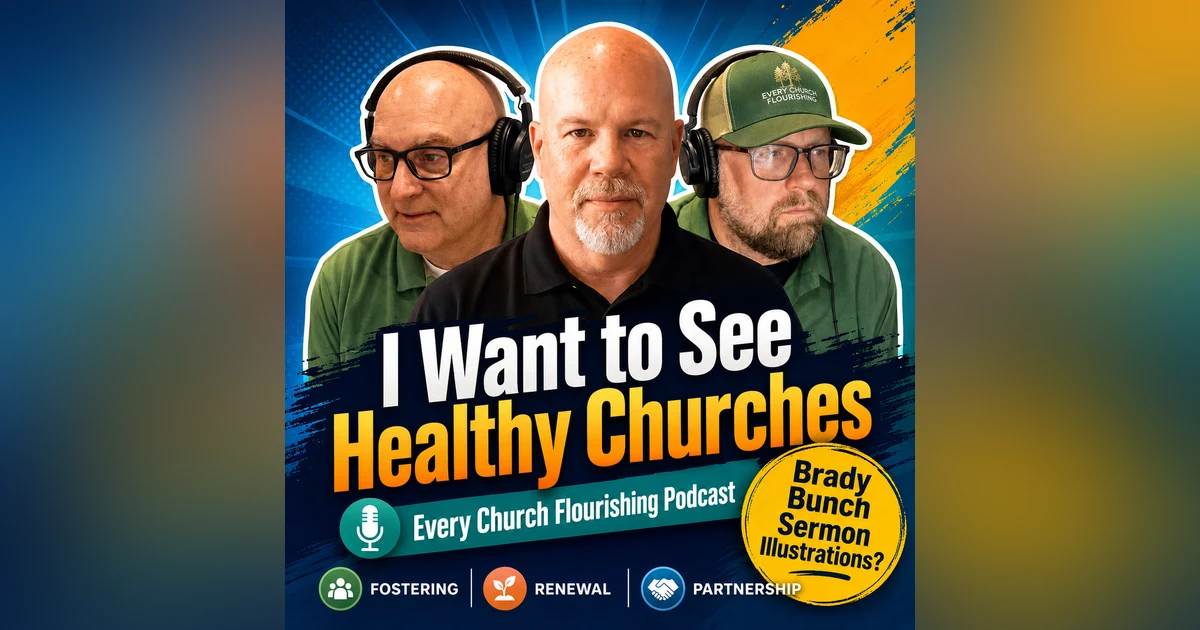
Brady Bunch Sermon Illustrations + I Want to See Healthy Churches. Churches Helping Churches Outside of Their Denomination. I would love to be funny like Alistair Begg.


 Apple Podcasts
 Spotify
 Amazon Music
 YouTube
 Youtube Music
 iHeartRadio
 Podchaser
 JioSaavn
 Castbox
 Gaana
Gaana Today, we continue talking with Pastor Ed Compean of Shoreline Calvary Chapel Church in Morro Bay about churches helping churches and interdenominational cooperation and unity.
Tango Mango Soda Review.
It’s the most honorable thing you can do to have the humility to say, “I don’t know it all, and I need help.”
Resources:
David Jackson - Falling in Love with Jesus Again: https://replantbootcamp.com/podcast/ep240/
Bob Bickford: Pathways to Partnership: https://www.amazon.com/dp/0999418149?lv=shuf&channelId=500&plpRedirect=mhFallback
If God wants the nations to be reached, He’s got it - He will fund it. Can churches of different denominations work together for the Kingdom of God?
Laying aside non-essential denominational differences for the sake of building healthy, Gospel-centric churches.
Chase Thompson: So today we continue our conversation with Pastor Ed at Shoreline Calvary Chapel Church in Morro Bay, California. I want to ask you, Pastor Ed, what is the goal of churches helping other churches?
Pastor Ed: The whole goal, 2 Timothy 2, 2, things that Paul heard, teach to Timothy, teach to able men who would teach to able men, that whole process of discipleship, of helping them do that. And that the goal is one day they're set free and they're doing it.
Christopher Cole: Is all about helping churches, leaders, and pastors find health, encouragement, practical advice, soul care, and resources that work together to build up your local fellowship and the broader kingdom of God. Join hosts, Pastor Chris Cole and Dr. Chase Thompson from the Great Commission Association, led by Dr. Mike Stewart, as they explore the frontiers of ministry and aim for the goal of making every church flourish.
Chase Thompson: Hello, everybody, and welcome in to episode number 32 of the Every Church Flourishing Podcast. I am your host, Chase Thompson. I'm joined by Pastor Christopher Cole of the Great Commission Association. We are interviewing, as I said earlier, Pastor Ed and talking about how churches can help other churches, which if you have a competition kind of mindset, seems counterintuitive, but that's not the mindset we should have. We're all on the Jesus team. Speaking of the Jesus team, if you're looking for a team of your own, an association to pair up with, we've got one for you. If you're out west, the Great Commission Association, which sponsors this podcast, would love to hear from you about joining up. You can check out our website, GCASBC.org. That's GCASBC.org. Well, let's jump back into the interview with Pastor Ed, and I'm going to talk about A chance encounter I had recently with Pastor Mark Dever. I could totally do the name drop thing and try to sound really cool and start off my next question by saying, last night I had a one-on-one conversation with Mark Dever, which is true. I really did have a one-on-one conversation with Mark Dever last night in person, but it was just an accident of the situation. I got a text earlier this week from a pastor in Seaside, Dominic Avila, who is a good friend. Our daughter's a good friend, and he invited me to come to his church last night. A bunch of other pastors were invited too, including Pastor Jeff and Pastor Drew with GCA, and Mark Dever was supposed to speak there. My son and I went, and a couple of guys from Valley Baptist Church, and on the way over, I was like, look, there's no way Pastor Mark Dever is going to be here in person because this isn't a big church, you know, and I don't, so, I was kind of betting it would be a virtual event or something like that. So I am sorry for my skepticism, Pastor Dominic, but he was there. And there was about, I don't know, 50, 60 pastors and leaders there. And it was fantastic. And I did my first time ever being in person at a Mark Dever event. And one of the things that struck me that he said, and I've been thinking about it ever since, is he talked again and again and again about his church's strategy for of investing in other churches, not just in a overseas missionary kind of way, not just in an SBC kind of way, because Capitol Hill Baptist is an SBC church, but they invest in other churches in their area that are gospel-based evangelical churches, not for the. Return to Capitol Hill, unless you count permanent spiritual rewards in heaven, which I would say is probably the greatest reward you could possibly go after, but not for the temporal now rewards. And he seemed very sincere in talking about that. And I don't know that we have enough, especially megachurch pastors, but pastors in general that think that way, that think that, hey, our church should be helping other churches. We have a good Samaritan parable that is one of the most dominant ones, and we don't often apply it to churches helping churches. So along those lines, Pastor Ed, how can, your church in specific, but churches in general, because there's gonna be other fostering churches and church replanters listening to this, how can a healthy church lend its strength to a struggling church without kind of conquering it or taking it over or controlling it or erasing its identity, or I guess even maybe even more likely kind of creating a permanent sort of unhealthy dependency, a codependency situation?
Pastor Ed: Yeah, that's a great question. When I get that made perfect, I'm going to write some books and help fund all this. It is difficult.
Christopher Cole: We anticipate that.
Pastor Ed: Okay, well, hold my arm. Keep my arm twisted a little bit. Yeah, I think we have to keep the local church the local church. So we're there helping them, supporting them and regularly asking the question, how might we serve you? But using the wisdom and discernment that that might enable them, you know, just writing another endless check or another, you know, one more check or whatever financial help or lending projects, but they're not doing the same, lending people to lead projects or lead outreaches. The whole goal, 2 Timothy 2, things that Paul heard, teach to Timothy, teach to able men who would teach to able men. That whole process of discipleship, of helping them do that, and that the goal is one day they're set free and they're doing it. There's a lot of discernment of methodology. There's a lot of discernment of how long that might take and every situation is going to be different. But if the goal isn't eventually that they are going to be a freestanding church that, as Pastor Christopher, you said, that will multiply, then we're probably failing them. And it gets blurry. I'm sure we can mess it up. And I'm sure we've messed it up a hundred times. I'd rather mess it up once in a while and have to clean it up, then give up and not do it. Yeah. You know, and then, you know, here's a good thing. I really feel like if we were getting into a sticky situation with Red Oaks, I might call you guys. The good thing about GCA, one of the things I love is if I have a question, I can call and Dr. Mike will get back to me. So if I need it, and that's a pro, that's a positive thing. And just talk something through with me.
Christopher Cole: Absolutely. I think this is very encouraging. And I would say to you, that is a high priority for the MAP team here at GCA is we deeply want to minister to and encourage our churches. So we want to be open to those phone calls, emails, texts, and we try. Our general rule on our team is we try to respond to every message from a church or a pastor within 24 hours. We don't always hit that mark. And it may be that we send you a text that says, hey, if this isn't critical, you know, can you hang on for another 12 hours or something like that before we get back to you? But that's, you know, it's encouraging to hear you say that. And thank you for noting that. I know it's a passion of ours, and we have a long way to go in being all that we want to be to minister to our churches, but we are grateful for how God has helped us grow in that area. Well, let's talk a little bit about some of the nitty-gritty, okay? The down-to-earth, the things that church pastors really, really seem to get most concerned about. What does it actually cost you guys to foster Red Oaks? I mean, and what are the greatest needs? Are you guys, you know, we've talked about you guys sending down people and some of the impacts there. Are you guys creating a financial investment? And what is their greatest need? And then how do you guys kind of plan on engaging that? And then I have a follow-up question related to some of that.
Pastor Ed: Sure. So we as a church have long been involved with sending missionaries and sending church planters out, and money's never actually the problem. It might be, we have to do some work around such.
Christopher Cole: Pastor Chase, we have heard it here.
Chase Thompson: Money's never the problem. I like that.
Christopher Cole: Money is never the problem. Brother, I love that you present. Tell us what you mean by that.
Pastor Ed: What I mean is, frankly, for this project, we haven't put a whole lot of money into it, but we have a budget item when they do hire a pastor that will probably need support. We expect to support that pastor. We're all in. Yeah, we're all in. We're willing to be a little sacrificial even. And so that's kind of in a holding pattern until we hear what the news is. But yeah, I mean, if God wants the nations to be reached, including the great nation of Santa Maria, he's got it. It's his problem, not mine. I don't mean just flipping about that, but he does that. That's his way. I don't know if that helps you. I don't know if that's- Yeah,
Christopher Cole: No, it's great. And you guys have been a great example of being present. That's one of the things that I think, if you're in a moderately healthy to healthier church, I think it becomes very difficult for you to understand how lonely and sad and alone people feel when they are part of a church that Is near death. And that's, you know, it's, you know, years and years ago, back when the dinosaurs roamed the earth and I was taking a pastoral care class in seminary, you know, I had a seminary professor that honestly, I didn't think was particularly good. He was probably a lot wiser than I actually realized. And I was way too arrogant to understand the depth of what he was saying. And that's probably the reality of it. But I remember him teaching distinctly on the ministry of presence and the incarnational reality of Christ, that Jesus showed up in the flesh, right, to be present amongst us. And what our calling as ministers was to be present. He's like, guys, you know, when you go to hospital rooms, he's like, just show up. You don't have to have a sermon. He's like, show up. And I think there is a lot of the ministry of presence in fostering. It's listening to people, loving people, being present with them in the room, sitting in their pews. I try to explain that sometimes to some churches that come to me and they're like, hey, what can we do to help this foster church? I'm like, can you send five people to sit in the pews? Because believe me, they're tired of being six, right? You know? And, and they, I get a lot of funny looks with that request, but has that been you guys' experience as well, Pastor Ed?
Pastor Ed: Yeah. Almost every time. It's very seldom any one person has went down. Right. It's usually a family. Sometimes it's multiple families. Last week, I had the honor of, of my son went down to cover the pulpit down there. Nice. And took one of our- You sent your best. I sent my best. Well, I have another son in Africa again, so I- Oh, okay. And I have a couple daughters. So, but yes, they would.
Christopher Cole: One third of your best.
Pastor Ed: Yes, I would say it that way. But yeah, so we sent our best and we also sent one of our worship leaders and he just led with guitar. And that's great to fill them up. There's a special thing that happens down there. Like you said, it's a ministry of presence. Before the service, you know, like any church, they sit around and have some coffee and donuts and get all amped up before you preach. It's good. It's sugar and caffeine. Yeah. And that's a special time with that church. They know they're not alone. And sometimes there's a question that pops up among them, you know, and you, sometimes you have an answer. Sometimes you say, let's pray and come back at that later. But it's a special thing to spend time with these people. They're reliable people. And because they're few doesn't mean it's less. Yeah. I think it was in the last week or two, you guys interviewed Jeff, who's up in the Silicon Valley. And he mentioned that when he first came in, you know, to a church that was a lot like Red Oaks, you know, as far as numbers, he didn't come in and call it, you know, because there's a few people. He went and preached his best. And I think I don't want our guys doing anything less or when I went down there.
Christopher Cole: You know, I love what you just shared, because just yesterday or Sunday. I was with a group of leaders in another one of our Renew churches, and they were sharing with me how meaningful it was when the preachers that came in to do pulpit supply would come and come early and sit there for their Bible study time before they preached. And they said, you know, it means that this person knows us better when they're preaching the word. So pro tip to those of you that are pulpit supply preachers, show the congregations a little love if your schedule permits and allows. Show up early, eat the donuts, drink the coffee, sit with the people in a Bible study, learn their names, listen to their heart, and it will help you multiply the effectiveness of your pulpit supply, I think almost certainly. Yeah.
Chase Thompson: So when I was growing up, I grew up in a household that was very TV oriented. My dad's a lawyer and fairly well off. And by the time it was marrying time, I want to say, and this was in the mid nineties, I want to say we had maybe 10 active televisions in the house. Every bedroom, a couple of the bathrooms, not my bathroom, but the laundry room. The laundry room had a television in it and the workout room. It was like a lot of television. And I married a woman, my wife, Janet, whose family basically had one television. In my house, the TV was on all the time. That's all I knew. I mean, that's how I was raised. And so you go into a room, if the TV's not on, you turn it on. So there's constant background noise in her house. The TV was almost never on. So when we first got married, Like I would have the TV on all the time. And she was like, well, why is the TV on? This is weird. And so it was an adjustment. Both of our houses were Christian. Both of our houses were Baptist, but we had adjustments. So relatedly, the Calvary Chapel and Southern Baptist denominations. Have a ton of similarities, but some, you know, fairly significant differences in polity and identity and leadership structure, church culture, all of that kind of stuff. So what would you say to churches that don't seek out such partnerships based on those differences? And relatedly, how have you been able to navigate those mostly slight, sometimes significant differences between Calvary and SBC.
Pastor Ed: Are you asking in our relationship to Red Oaks or us as Shoreline as a whole?
Chase Thompson: I would say both, actually.
Pastor Ed: Okay, yeah. First off, I probably am not a typical Calvary guy in my background. This is my background. And by the way, I largely identify as somewhat of a, you know, more GCA than SBC, but certainly a Baptist guy, you know. And I was born again, technically, in a Baptist church. So I do have some roots back there. Let's put it this way. If I look at the Baptist faith and message, right, 2000, and I look at the core doctrine of Shoreline and most Calvaries, the closed-hand things are the closed-hand things. There's nothing that's going to be significantly, but you're right. There's some polity issues. I think when I think of a Baptist tradition, there's a little bit more of a confessional side than we are used to. And you're right. The polity is usually a little different. We're very unlikely to vote in our background. We're very informative, hopefully, but not likely to vote. And so what I want to do when we work with Red Oaks is bring what's important and respect that at the core, they're an old school Baptist church. And I don't want to mess with that. Those are God's people. That's not up to me. I'm also, maybe I've had this experience of being a missionary. And when you're out among an unreached people group and the guy you're working with is a Presbyterian, yeah, we're not having that argument,
Christopher Cole: Right?
Pastor Ed: Because there's no gospel. We had the opportunity to help establish a church out in the Maasai land where we drove for hours and hours and hours. And as we drove for hours and hours and hours to get out there, then we walked for hours and hours and we came to where they were planting. And we met with the elders of the community and negotiated for them to start a church there. And then we traveled further into the bush down in Tanzania. And there was one other church and it was literally a two-hour walk away. And he was a Presbyterian. And I told our guy, said, this is your new best friend because you need people that are going to pray with you and walk with you and his success will be your success and your success will be his success. In those spots, there's just not a, there's no room for that competition or one-upmanship. And I absolutely believe that. But at the same time, here's a covenant theology guy that is bringing the gospel where there is no gospel, and that's a sell. So I'm probably getting distracted going back to missionary days.
Chase Thompson: No, no, I think you're actually answering in the right context.
Christopher Cole: So you're saying that you and the Presbyterian guy, you want to see people get saved, then you'll arm wrestle over which way to get them processed.
Pastor Ed: Well, I just trust, too, when he gets to heaven, he'll have to repent.
Christopher Cole: Exactly, yes.
Pastor Ed: But we were up among the Pocomo people up near the Somali border one time. And again, it happened to be another Presbyterian group up there. We were doing chronological Bible storing and training some pastors up there. And I had no qualms with helping that. There's literally no gospel there. I don't want to take that analogy and stretch it so far because there are other gospel churches in Santa Maria. But man, I want to see the church thrive there. It's not my business to go in there and tell them their polity is wrong or they need to make these changes. I just want to see a healthy church. We're in an unchurched area. We don't have the privilege to argue about those things. We have to bring the gospel and keep those closed hand things the closed hand things. And I know not everybody's going to agree with that, but I do.
Chase Thompson: No, I completely agree. Alabama, where I come from, there's a church on every street corner. Maybe, and I don't like it there either, but maybe you can afford to have just various beliefs separate the denominations because you're not all going to fit in one building. But if you're in California, you're going to have to draw those lines a lot lighter because whereas there's 700 churches in Birmingham, there's not going to be 700 churches in Salinas by or by anywhere near. And if you're in Kenya, you're going to have to draw those lines even lighter and lighter. And regardless, John 17 really should be foremost on our minds more so than it is because our Lord prayed for unity. And I sometimes feel like we turn a deaf ear to that prayer.
Pastor Ed: Yeah. Well, thanks for understanding because I know not everybody holds that. And I want to see healthy churches. Amen. Frankly, I want to see healthy churches look a lot like Shoreline. But at the same time, you know, I'm going to settle when the church down the road is just thriving, a little community church, and they're thriving. That's yes and amen.
Chase Thompson: Mm-hmm. Yeah.
Christopher Cole: Well, Pastor Ed, you mentioned something just now. We want to touch on this briefly. And this is the idea of how does a fostering church, pastors in general, so any thoughts or insights experience here, how do you help a congregation as a fostering church or you're trying to assist a partnering type church? You want to help the congregation make vital and necessary changes. You don't want to necessarily reopen old wounds or communicate, hey, everything you did before we arrived was just wrong. And now we, aha, are here. So you want to be sensitive to that, but you also don't want to leave them in a place of stagnation and decline. So what have you guys noticed? What maybe are some good pro tips or practices there or just your insight?
Pastor Ed: Yeah, I think Glenn has handled most of that. You know, he's kind of our lead guy on this. And so he's looking down the road. But in general, what we want to do is talk to them of what is core, the core doctrine. You know, in this case, we're going to point back, you know, at Red Oaks, we're going to point back to Baptist Faith and Message, you know, 2000. This is what we're doing. But the modalities of that may change. You know, that they're doing, with all respect to them, they're doing 1990s worship in there. And if someone walked in there today, they probably would say, oh, that's nice. And I thought it kind of was for the first time I was there. But the second and third time, I'm going, oh, yeah, there's a reason we've changed. It's not that those songs are wrong or the way they do worship is wrong, but what would attract some people? And they might come there and engage as a 20-year-old today or a 25-year-old today. Again, not messing with the gospel, not messing with the core doctrines. But maybe making some changes that they would identify with. That your illustrations are not from the Brady Bunch, but from whatever else is modern.
Christopher Cole: You know, we try to think about and talk through this in the terms, you know, scripturally. You know, when Paul says, you know, we become all things to all people, right? And obviously, some people could push that into a place of syncretism or doctrinal compromise. And yet, the other side is it doesn't remove the obligation for a church to communicate the gospel contextually. And the idea that, you know, well, you know, some unbeliever needs to come in and, you know, engage us where we are at is really just a, it's cultural snobbery is what it is. You're saying my modality of culture, my preference needs to become your preference because I think this is how Jesus is best worship, which I think, again, being a missionary, you get a global perspective, right? There's almost nothing in common in the culturalisms of a Maasai worship service under a tree on the plains of Kenya and contemporary church in Southern California. Yet, is the word of God being preached? Are the people of God singing psalms, hymns, and spiritual songs as unto the Lord and with encouragement in their hearts to one another? Is the word of God being read? These are timeless core biblical principles. But contextually, those things are expressed in radically different ways and with different value systems attached to them. Not acknowledging that really can sort of become this cultural snobbery, I think, in some ways. And so it's healthy and helpful to be able to say to a church, hey, I'm not going to We're not going to try and shake up everything tomorrow or change everything you're doing today and not everything you did beforehand is wrong. But we are going to ask you to think about questions like, what would it mean for your church to be on mission? What would it mean for your church to engage the community God has given you the responsibility to reach, love, pray for, and share the hope of Jesus with?
Pastor Ed: Well said. But I think that's the goal, keeping the church on the mission of God and recognizing it may, the mission hasn't changed, but methodologies may flex a little bit without compromising the gospel whatsoever.
Chase Thompson: Yeah. I will tell you what cultural thing that Americans and Maasai do have in common, at least based on my trip there a little over 20 years ago. I met several Maasai warriors and tribesmen, and one thing that struck me, and this was like 2005, so before the iPhone, almost every one of those guys, even in their traditional gear, all had phones. They all had really excellent, loud, custom ringtones, and they were into their phones. So the addiction to phone things is not a strictly American thing. That is a worldwide reality. Pastor Ed, imagine that a pastor is listening to this in a church that is on life support, slowly dying, struggling, or whatever. But for whatever reason, maybe it's shame. More likely, it's fear or not even knowing that help is available. They're not asking for help. What would you want to say to that guy that's listening who needs help?
Pastor Ed: I would say, have the humility to ask for help, to take a call or make a text or shoot an email up to the GCA and say, could you come down and help us or come up and make an assessment and give us some hints? We're laboring and we love these people, but somehow we're losing grip. It's okay. It's the most honorable thing you could do is have that humility to say, I don't know it all. And somewhere I've lost hang of this. I need some help. I don't think there's any shame in that. As a matter of fact, we should honor those people that do that. And maybe it's not even a fault thing. Maybe it's just demographics have changed at such a level or whatever. And just take that time and study it and Ask Dr. Christopher Cole or Dr. Chris Smith or whoever up at the GCA that wants to lend a hand. CJ, you know, there's just, there's a ton of help that people want to give. And nobody wants to see you struggling needlessly. Nobody wants to see someone struggle needlessly. Nobody wants to see our church in distress that doesn't need to be in distress. You know, God may be doing a work and that's just, in that sense, there's nothing we can do to help. God's doing a thing that that's what it is. But if it's a needless bunch of suffering that's keeping growth down, keeping baptisms down, keeping discipleship down, let's not do that.
Christopher Cole: Amen. Amen. Well, thank you, Pastor Ed, for being here. We want to close out with some quick pitch questions to you on all kinds of random and nefarious topics, just so that we can get to know you a little bit better. And I will kick that off with this really amazing question. If you could be anything else, and by this, of course, we acknowledge the sovereignty and goodness of God in his calling into ministry. But if that calling, that particular inward vocation of God, that call of the Holy Spirit had not been placed on your life, and you were simply listening to the other desires, your passions, giftings, talents, and the other indicators that God may use to place a calling on a person's life, what would you be if you were not a pastor?
Pastor Ed: Well, I'm going to guess, though, pastor and missionary are different. I'm not going to go my default. There's a part of me just every week says, honey, let's go. Let's go back to the field.
Christopher Cole: Let's go. Let's go.
Pastor Ed: It's a good thing that neither of us have that same feeling on the same week, but there is that part. I began my career life, so to speak, as a photojournalist working for some newspapers and such. There's a piece of me that misses newspapers. I just miss newspapers. I know they don't exist as they used to, but there's a part of me that would go back to being a newspaper journalist.
Christopher Cole: Nice.
Chase Thompson: That's a great answer. That was my highest grade in college was in photojournalism. I loved that class. So you've already shared what I think is a really premium bit of information as part of the church fostering process, that when you send people, it will ultimately strengthen your church when they come back. What other than that is the number one bit of wisdom or advice or even a practical tip you've learned from the church fostering process? Yeah.
Pastor Ed: On an official role, this is the one time we've kind of done it officially. We've helped a few churches over the years to do this. It's the joy, the joy of watching a church kind of be able to take their own baby steps and start to do it on their own. And we've done that a few times with other churches. And it's just wonderful. It's just a wonderful experience. To your church with any sort of resource whatsoever, not a big church, maybe not even a wealthy church, whatever. If you have any resource whatsoever of an elder or a pastor in your staff that could go over there, a youth leader that might go over and help another youth leader get their feet off the ground, there's nothing better than seeing that multiplied out. It's what we're called to do. It's a sense of fulfillment.
Chase Thompson: Yeah. It's like a vicarious joy you get from watching something else grow. I love that. I love that.
Christopher Cole: Pastor Ed, you already said that you have occasionally thought about the possibility of returning to Kenya at some point, should the Lord enable, empower, and call you guys there or somewhere back in the mission field. What do you miss most about Kenya?
Pastor Ed: I miss the people, the relationships that we have there. We have people that we adopted while we were over there, and John's still over there. And that's the only grandkids we have are John's kids. And so we miss that. But there's also other, when we went back and visited and we run into this, sometimes you just literally run into people. In a town of seven and a half million people, we've run into people I haven't seen in 10 or more years. And suddenly you're in Santa Street corner talking to them. I miss that. I miss that.
Chase Thompson: All right. Who are your favorite pastors to read or to listen to?
Pastor Ed: I really enjoy Alistair Begg.
Chase Thompson: Oh, I do too.
Pastor Ed: Yeah. I mean, just almost every time I listen, I just think I stink at this, but I really do enjoy him. I enjoy reading a little Spurgeon here and there. I wish I said I read more, but when I do, I just go, Oh my goodness. You could almost lift his messages and just apply them to today.
Chase Thompson: You could. It's amazing.
Pastor Ed: Yeah. Just, just amazing. So I think those would be the main, main guys I would, you know, I love Dever. Like I, I, Mark Dever, I just think is incredible, but I know I'm not him. You know what I mean?
Chase Thompson: Yeah. Me too. Me too.
Pastor Ed: And that, I'm not Alistair Begg either. I don't have that accent, but. Oh, it's so nice. Yeah. I, I think.
Christopher Cole: Who does have that accent? Yeah.
Chase Thompson: Look, I want to be funny like Alistair Begg. I'm not. He's got that dry sense of British humor that's just so spot on. And I know that's a pretty immature thing to want, but I would love to be funny like Alistair Begg.
Pastor Ed: He uses it well.
Chase Thompson: Yes, so well.
Pastor Ed: It's not manipulative. It's just, it's almost like an illustration that connects you.
Chase Thompson: Yeah. Yeah.
Christopher Cole: Well, Pastor Ed, your schedule suddenly changes and a person drops out of the meeting and you have been forbidden from doing any work and you now suddenly have an afternoon free to do whatever your heart desires, except work. What are you doing to spend your afternoon?
Pastor Ed: Well, if my wife works Fridays, so presuming I can't connect with my wife, I'm probably going to go on a trail run or maybe get some surfing in.
Christopher Cole: Okay. Going to either run or surf.
Chase Thompson: Yeah. You're like a pretty competitive marathoner, right?
Pastor Ed: Not competitive. I'm an old fat runner, but I love it. And my wife laughs at me because sometimes i'll enter a race just you're paying for this and you run these trails every you've run these trails anyway when you don't pay for it then why do we pay for it now
Chase Thompson: That sounds like the kind of thing my wife would say it's for the.
Christopher Cole: T-shirt man it's for the
Pastor Ed: T-shirt yeah that's right yeah i'm not competitive wouldn't be the word but there i do have a joy in it nice i love getting a little bit lost but in the trails of montano de oro or you know, somewhere else and just get a little bit lost and maybe get a little poison oak and a little sunburn. It's just not much poison oak.
Chase Thompson: Yeah. I love the woods. I'm in the woods all the time. I get maybe eight, 10 cases of poison oak a year, but I've yet to find my joy in running. I just like hiking and steps.
Christopher Cole: You leave that up to Janet.
Chase Thompson: Yeah, she does. She enjoys running more than I do. I like sprinting a little bit, but long distance, no, I'm not. I can't find the joy in that. Okay, so Pastor Ed, this is our last question, and it's really a profound one, I think. Let's say in the very, I don't know, somewhat likely event that Pastor Christopher and I are suddenly arrested by government agents in an anthropic or open AI corporate espionage or insider trading scandal. Were put in jail for crimes against artificial humanity. And the GCA casts about for a host for the show and they settle on you. Lots of isps there, but I think, you know, very possible that this could happen. Likely, very likely. Even likely, yeah. So what would you review, if not sodas, for the last segment of the show?
Pastor Ed: I think Pastor Christopher is giving me a hard time because I once told him, I'm not a big fan of the sodas. I love the podcast. Don't misunderstand.
Chase Thompson: It's very polarizing. We hear from people like Pastor Jeff, not a big fan of the sodas. And then we hear from other people. It's almost like that's what they listen for. So it's polarizing.
Christopher Cole: Some people dip sodas to us.
Chase Thompson: I've had so many. Look, I've got I've had five this week, Pastor Christopher, and another one or two on the way. And I'm not even kidding. They're just sitting on my kitchen counter.
Christopher Cole: That's so awesome.
Chase Thompson: Yeah. Yeah, it is.
Christopher Cole: So what are you going to review, Pastor Ed?
Pastor Ed: Well, it'd be much more spiritual to review gummy products.
Chase Thompson: Oh, gummy products. Yeah.
Pastor Ed: Gummy sharks, gummy, whatever. Swedish fish.
Chase Thompson: Yeah. I do like Swedish fish.
Christopher Cole: Oh, wow. We may have to have a guest segment.
Chase Thompson: Yeah. What is your favorite gummy product? This is interesting.
Pastor Ed: I would suggest the Swedish fish or the swimmers at Trader Joe's.
Chase Thompson: Oh, the swimmers are pretty good. What are your feelings on Sour Patch Kids? Is this like LDS kind of heresy or is it really in mainline gummy vanity?
Pastor Ed: It would be one of those denominations that we respect, but we wouldn't take full part. You know, we wouldn't have deep fellowship with.
Chase Thompson: I understand.
Christopher Cole: Got it. And how do you grade jelly beans in that family of this? Is this, are they part of the gummy family? Are they not? Because they've got that harder exterior, but they've got that.
Chase Thompson: Are they like the Catholic or Orthodox or are they like the Jehovah's Witnesses of this whole thing?
Pastor Ed: They're probably closer to Jehovah's Witnesses. Yeah.
Chase Thompson: Oh, wow.
Christopher Cole: Oh, wow.
Chase Thompson: On the outside of the kingdom.
Pastor Ed: Yeah. I would say I'm not a fan. Yeah. Okay. Don't get me wrong. Every Easter, I may grab a couple, but they're not my go-to.
Christopher Cole: But what about licorice by itself? Like, you know.
Pastor Ed: That's okay.
Chase Thompson: Yeah.
Christopher Cole: That's okay.
Pastor Ed: Yeah. That's okay. Gummies are at the top of your food chain.
Christopher Cole: Got it. Gummy Coke bottles?
Chase Thompson: I would hope to be like a bishop in the church of Sour Patch Kids, because that is my jam.
Christopher Cole: Okay.
Pastor Ed: We all have our stuff, man. And I will throw Sour Patch out.
Chase Thompson: I'm glad to be included in your ultimate eternal life gummy situation.
Christopher Cole: Well, Pastor Ed, we've been so, so blessed to have you on today's show. Thank you for your time. Thank you, really, and we mean this earnestly, for your love for your church, your love for the churches throughout Morro Bay, for your passionate commitment to helping your church multiply, and specifically thank you for helping to foster and care for one of our Renew churches. We count it a great privilege to have you as one of our partners in the gospel, as we together seek to see every church flourish and see every community reached with the hope of Jesus Christ. And so thank you again for all that you are doing. Know that you are in our prayers and we're grateful for the blessing you are to our GCA church family.
Pastor Ed: Appreciate you guys saying that. We're honored to be part of the GCA family.
Chase Thompson: Amen. I think there will be pastors and church leaders listen to this and they're going to say, hey, why not us? Why can't we? We're in a pretty good position, big church. Why can't we foster another church? If you're driving home and you see a family in a car broken down on the side of the road, the steam is coming up on the engine and they're obviously in some level of distress. I would hope most Christians and especially most pastors would say, hey, you know what, let me pull over and see if these people need any help. How much more so in the kingdom of God should we see a struggling church? In our area, or even as in your case, not in our area, but close enough and say, hey, we're going to pull over and help here. Because as you say, I think the strongest argument you made for that, Pastor Ed, is that churches are closing down and not enough churches are being planted. And the churches that are getting planted, the success rate is not super high. And so ultimately what's happening is we're seeing, as Dr. Ryan Burge would say, a massive step back in at least statistical Christianity in the United States of America. And I think one of the best ways to intervene there is exactly what you guys are doing, fostering other churches. So thank you from the bottom of my heart.
Christopher Cole: And to that end, Pastor Chase, I think we'll wrap it up with just these two recommendations. We will have these resources in the show notes, but we want to commend to you the wonderful work on church Fostering by our friend, Dr. David Jackson. We still hope to have David join our show here, maybe even in a few weeks time. And what a wonderful book that is on the practicalities of how your church can be involved in fostering another church. Or if you think maybe fostering is not for us, but we want to be partnering with a church in the replanting movement, then our good friends, Bob Bickford and Mark Callick have written a wonderful book called Pathways to Partnership. We will have the links for those resources in our show notes, and we commend them to you as just great resources for your church to consider how you could be part of the church renewal journey.
Chase Thompson: Amen. All right. Thank you, gentlemen. Hey, Pastor Christopher, let's grab a soda. Okay, we're back with more soda reviews. Pastor Christopher, I'm going to lead off by saying something that's probably going to be unpopular with most of our listeners. I would not rank mango in my top 10 fruits. What about you? Where do you sit with mango?
Christopher Cole: Okay, so you have to understand something about the land that I grew up in. In Indonesia, there are at least 33 species of mango trees and 200 plus cultivars of various mangoes. So I grew up literally climbing mango trees as a kid. And there are so many varieties and flavors of mangoes. So when people say to me, I don't like mangoes, I'm always like, You don't like American grocery store mangoes, which is sort of like our bananas, the Cavendish bananas that are in every single grocery store. I have, you know, they've not been bred for flavor. They've been bred for durability. But if you were to go to Indonesia and try an Arum Manis mango or a Manalagi, which literally the name for that mango is Where Is There More? Can you imagine a mango? Where is there more? or the honey mangoes that they have, you would know the variety of the many different kinds of mangoes there are and how delicious they are. So I'm excited. Today we do Tango Mango.
Chase Thompson: Yeah. And you know what? Going back to fruit, most Americans that have not been overseas don't really realize that. But so much of our fruit stinks here because it's sort of been genetically engineered for mass growth. I was stunned the first time I went to Kenya in Africa and had, number one, saw they had a ton of different varieties of bananas. Number two, ate some of them and realized, wait, bananas, not just a bland, pale, long fruit. Those bananas were astonishingly good. And I don't know why we don't have them in America more.
Christopher Cole: Yeah. It's the terroir, to borrow the winemaking term. You got to have varieties of soil and varieties of environment and you got to have a wide tropical base and a commitment to have local fruit versus whatever stays on the shelf. Did you know that most American bananas are like carbon dioxide to make them ripen before they put them on the shelf?
Chase Thompson: Yeah, probably doesn't help their flavor profile either. No, no. Well, okay. Your speech on mangoes has made me anticipate Tango mango more than I was before. We've had a couple of good cans. I love the black and orange and the bursting juice. This is a sharp can. Right.
Christopher Cole: And Chase, this says it's sugar-free. So I'm guessing they've got some non-nutritive sweeteners in here.
Chase Thompson: Yes, I'm guessing you're absolutely right. Oh, and hey, by the way, it looks like this is bottled in Ireland. Right in Dublin. That's fantastic.
Christopher Cole: I know.
Chase Thompson: So an Irish beverage.
Christopher Cole: That's pretty cool. And it's got 53 calories in it, I think.
Chase Thompson: Okay.
Christopher Cole: Is that right? Did I read that?
Chase Thompson: Something like that. So no sugar added is probably what we would say in America if it's got that many calories.
Christopher Cole: Right. Well, yes. It does have the sucralose acosulfame. I don't know what that is.
Chase Thompson: Yeah.
Christopher Cole: I'm excited. We should try this. It is vegan approved.
Chase Thompson: Okay, good.
Christopher Cole: Vegan approved. If you are a vegan, you can drink Tango Mango.
Chase Thompson: I would sort of assume that, but all right, I'm ready. Let's do it. I'm not a vegan, but I'm going to drink it anyway. Stronger smell.
Christopher Cole: It has that mango-ish smell.
Chase Thompson: Definitely. It really smells good. This may be the best soda we've smelled today. Okay, I'm going to go ahead.
Christopher Cole: The color.
Chase Thompson: Wow. This is also bursting with flavor.
Christopher Cole: It is. I'm not sure it's a mango flavor.
Chase Thompson: Well, it's 1% mango juice, 4% apple juice, according to the ingredients. That might be part of the problem. But I would say it's a good flavor. It certainly doesn't taste like apple juice. Not really at all.
Christopher Cole: It's got an acidic back end to it. Are you tasting that like on the back of your tongue?
Chase Thompson: Yeah. Oh, yeah. Yeah, I do.
Christopher Cole: And it's like kind of sitting there, which mangoes do that,
Chase Thompson: By the way. A little sour candy-ish.
Christopher Cole: Yes. Mm-hmm. Mm-hmm.
Chase Thompson: I like it. This is going to get a strong grade for me. Not as strong as our passion fruit sodas, but this is still going to get much more than a passing grade.
Christopher Cole: Yeah. This is not unpleasant at all. Once again, I would say I think this is also something that if somebody poured it into a glass and handed it to me in a tropical location, maybe not on the beach, maybe this is sitting on the veranda with that other Spurgeon favorite item that he liked to stick in his mouth, you know, the cigar made of the tobacco leaf thing. Yes.
Chase Thompson: Oh, yeah. Yeah.
Christopher Cole: Yeah. But if you were sitting on a classic 1930s planter veranda in the tropics, you could be poured this in some version. And I think people would be like, yeah, this is like a mango beverage.
Chase Thompson: That's what I would. Yeah. Yeah. I agree. I am often in a classic 1930s tropical setting.
Christopher Cole: Well, that is definitely a shame if you've never been in one of those.
Chase Thompson: Yeah. Okay.
Christopher Cole: I can. what are you giving this?
Chase Thompson: I'm gonna, I think I'm gonna give it a four. And it part, okay, not like a four and a half or a five or anything like that, because, I'm still not convinced I like the mango flavor, but I appreciate the strength of the flavor. Like when I drink this, I know I'm drinking something. This has panache. It has punch. It has power. And I like that. If I'm opening a can of soda, I want something that will get my attention and be a little bit of a wake up call. And this may not have caffeine, but it's got enough flavor to get my brain going a little bit.
Christopher Cole: Yeah, I'm with you right there. And by the way, I don't know that we've ever done this before. I also am going to give it a four.
Chase Thompson: Okay.
Christopher Cole: So I don't know that we've done an identical Spurgeon rating before. Not to my recollection.
Chase Thompson: So we'll call this a John 17 moment.
Christopher Cole: John 17, the unity of the spirit.
Chase Thompson: That's right. And maybe we're called to make every effort to maintain the unity of the spirit through the bond of peace. Well, Tango Mango Soda has brought us around closer to that point.
Christopher Cole: To the place of being like-minded and in one accord.
Chase Thompson: Well, reaching such a wonderful state of unity there, I think it's probably time to close out the show. Before we do, I want to point you to a couple of things I've mentioned in the last couple of episodes. Coming up September 19th at Foothills Church in San Luis Obispo. There is a women's conference called Flourish, and you can check out details for that on our website, gcasbc.org. And this Tuesday evening, I begin a class with the Great Commission Training Institute on church history. The prices are great, and you can also register for that course through the Great Commission website, gcasbc.org. All for now, good day to you and Godspeed.